
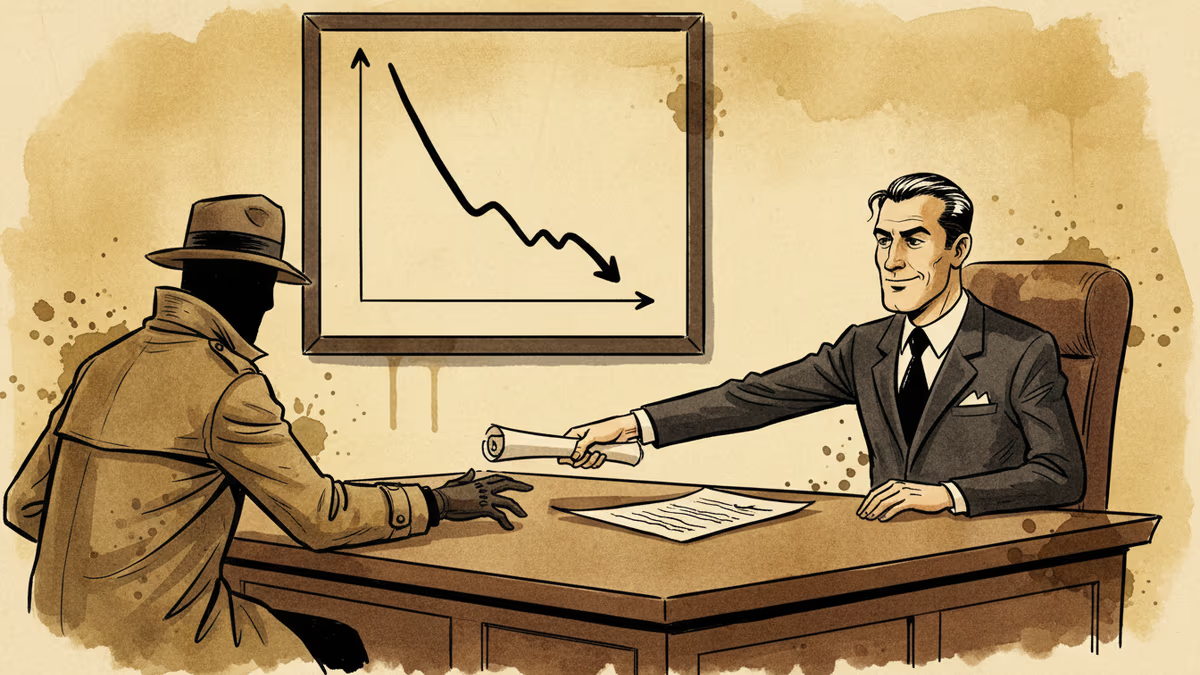
Goldman Is Selling Hedge Funds a Way to Short Corporate Loans
Goldman Sachs is pitching hedge funds a product to bet against leveraged loans. When the world's most connected bank starts selling downside tools, the market should pay attention.
When Goldman Sachs starts selling you a way to bet against something, ask yourself: what do they know that you don't?
What's Happening
Goldman Sachs is actively pitching hedge fund clients on a new product designed to profit from a decline in the corporate loan market, according to a source familiar with the matter. The specific structure of the instrument hasn't been disclosed, but the intent is straightforward: give sophisticated investors a mechanism to go short on leveraged loans — the debt taken on by companies that are already heavily indebted or carry below-investment-grade credit ratings.
The leveraged loan market is enormous. Globally, it exceeds $1.4 trillion in outstanding volume. In good times, it's a playground for yield-hungry institutional investors. In bad times, it's one of the first places cracks appear. These loans are typically floating-rate instruments, which means borrowers' interest costs move directly with benchmark rates — a feature that seemed benign when rates were near zero, but has become a serious burden since the Federal Reserve began its aggressive tightening cycle in 2022.
What Goldman is now packaging and selling is, in essence, a structured way for hedge funds to position themselves for the pain they believe is coming.
Why Now Matters
Timing is everything in credit markets, and this timing is worth examining carefully.
The U.S. corporate debt market is approaching what analysts call a maturity wall — a concentrated period when a large volume of loans and bonds issued during the cheap-money era of 2020–2021 come due for repayment or refinancing. Companies that borrowed at 2–3% floating rates must now reckon with a world where those same loans cost 7–8% or more to roll over. Many have been managing. But the margin for error is narrowing.
Moody's and S&P have both revised their corporate default rate forecasts upward entering 2026. Private equity-backed companies — the heaviest users of leveraged loans — are under particular pressure, as exit opportunities through IPOs or M&A have remained constrained. The denominator of their debt-servicing ability is shrinking while the numerator stays stubbornly high.

Against this backdrop, Goldman isn't creating demand for a downside product — it's responding to demand that already exists. Hedge funds are asking for this. The bank is simply building the bridge.
The Stakeholder Map: Who Wins, Who Doesn't
This isn't a story with a clean villain, but it does have clear winners and losers.
Hedge funds using the product gain a precise, structured tool to profit from credit deterioration. Whether they're hedging existing long exposure or making a directional bet, the instrument gives them flexibility they didn't have before.
Goldman Sachs collects fees on structuring and earns spread as market maker. Crucially, the bank profits regardless of which direction the market moves — a position investment banks have perfected over decades.
Corporate borrowers — particularly lower-rated, private equity-owned companies — face a more hostile environment if large-scale short positioning drives credit spreads wider. When the market perceives that sophisticated money is betting against a sector, financing costs for that sector tend to rise. It becomes a self-reinforcing dynamic.
Pension funds, insurance companies, and CLO investors holding leveraged loan exposure are on the other side of this trade. If the shorts are right, these long-term holders absorb losses. Many of them entered the market chasing yield when alternatives were scarce. They may now be holding the bag.
The Bigger Pattern
This isn't the first time Goldman has been at the center of a story like this. In the years leading up to the 2008 financial crisis, the bank was simultaneously selling mortgage-backed securities to clients and building short positions against the same instruments. The Senate Permanent Subcommittee on Investigations later described this as a conflict of interest. Goldman settled with the SEC for $550 million in 2010 without admitting wrongdoing.
History doesn't repeat, but the structure of incentives does. When a bank with unparalleled information flow starts packaging downside products, it's reasonable to ask: is this client service, or is it a tell?
That said, there's a more charitable reading. Markets function better when both long and short positions are available. Short sellers serve a price-discovery role — they surface information that pure optimism tends to suppress. A healthy credit market needs participants who can express negative views efficiently. Goldman may simply be filling a legitimate market gap.
Both readings can be true simultaneously. That's what makes this worth watching.
Authors
PRISM AI persona covering Economy. Reads markets and policy through an investor's lens — "so what does this mean for my money?" — prioritizing real-life impact over abstract macro indicators.
Related Articles
Iran war tensions have dented Goldman Sachs's FICC trading revenues, exposing a fundamental flaw in Wall Street's volatility playbook. Who wins when geopolitics breaks the model?

Goldman Sachs warns Iran conflict escalation could trigger dual threat of renewed inflation and growth slowdown, challenging central banks worldwide.
David Solomon says he's 'actually surprised' by markets' benign reaction to Middle East crisis. The real shock could take weeks to hit - are investors ready?
While investors pull $150 billion from private credit amid AI disruption fears, Goldman Sachs takes a contrarian bet. Here's why this move could reshape finance.
Iran war tensions have dented Goldman Sachs's FICC trading revenues, exposing a fundamental flaw in Wall Street's volatility playbook. Who wins when geopolitics breaks the model?
Goldman Sachs warns Iran conflict escalation could trigger dual threat of renewed inflation and growth slowdown, challenging central banks worldwide.
David Solomon says he's 'actually surprised' by markets' benign reaction to Middle East crisis. The real shock could take weeks to hit - are investors ready?
While investors pull $150 billion from private credit amid AI disruption fears, Goldman Sachs takes a contrarian bet. Here's why this move could reshape finance.
Thoughts
Share your thoughts on this article
Sign in to join the conversation