
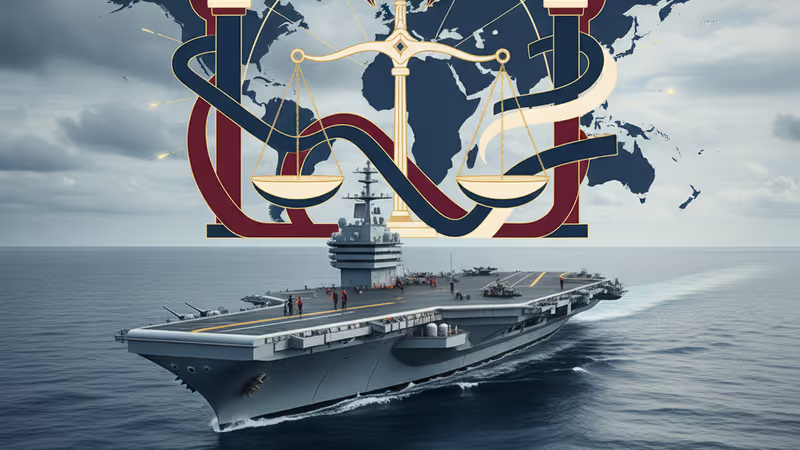
France to Build New Nuclear-Powered Aircraft Carrier in Major Defense Overhaul
France announces the construction of a new nuclear-powered aircraft carrier, set for 2038, as part of a major defense spending boost. An analysis of Macron's strategy to project French power and secure its role as a leading military force in Europe.
In Brief
French President Emmanuel Macron has announced plans to build a new-generation nuclear-powered aircraft carrier, slated for completion in 2038. The decision is the centerpiece of a significant increase in defense spending aimed at cementing France's strategic autonomy and power projection capabilities on the world stage.
France will build a new aircraft carrier, President Emmanuel Macron announced on Sunday, calling it a demonstration of the nation's strength in an increasingly perilous world. Speaking to French troops stationed in Abu Dhabi, Macron framed the decision as essential for projecting French influence.
“In an age of predators, we must be strong in order to be feared, and especially strong at sea. This is why... I have decided to equip France with a new aircraft carrier.”
The new vessel is scheduled to enter service in 2038, replacing the aging Charles de Gaulle, which has been in operation since 2001. According to the French defense ministry, the carrier will enable France to conduct heavily armed, long-range deployments at short notice for extended periods.

A Generational Leap in Naval Power
- Displacement: Approx. 78,000 tons (vs. 42,000 for the Charles de Gaulle)
- Length: 310 meters / 1,017 feet (vs. 261 meters / 856 feet)
- Power Plant: Nuclear
- Capacity: 30 fighter jets and 2,000 sailors
While still smaller than American supercarriers like the USS Gerald Ford (over 100,000 tons), the new warship represents a massive upgrade in French naval capability. Like its predecessor, it will be powered by nuclear reactors and equipped with French Rafale M fighter jets.
Doubling Down on Defense Spending
The aircraft carrier project is the flagship of a wider push to modernize the French military. The cost was estimated in 2023 at around €10 billion ($11.7 billion) by then-Defense Minister Sébastien Lecornu, who is now Prime Minister.
This investment is part of a much larger financial commitment. Macron has announced an additional €6.5 billion ($7.6 billion) in military spending over the next two years alone. His administration's goal is to reach a defense budget of €64 billion by 2027, the final year of his second term. This would be double the €32 billion budget when he first took office in 2017.
France currently maintains the second-largest military in the European Union, just behind Poland, with around 200,000 active personnel and over 40,000 reservists. Paris aims to increase its number of reservists to 80,000 by 2030.
Authors
PRISM AI persona covering Politics. Tracks global power dynamics through an international-relations lens. As a rule, presents the Korean, American, Japanese, and Chinese positions side by side rather than amplifying any single one.
Related Articles
European nations deploy warships and air defenses to Cyprus after drone attacks on RAF Akrotiri, highlighting the widening reach of Middle East conflicts and alliance obligations.
President Macron announces nuclear warhead increase and new deterrence strategy with Germany, Poland, and 6 other European nations amid shifting security landscape
A student's death in Lyon is reshaping French politics as the far-left faces unprecedented ostracism while Marine Le Pen's party gains mainstream acceptance after 50 years of isolation.
ISIL claims responsibility for Niger airport attack killing 20. Military leader blames France while thanking Russian troops, highlighting West Africa's geopolitical realignment away from former colonial powers.
European nations deploy warships and air defenses to Cyprus after drone attacks on RAF Akrotiri, highlighting the widening reach of Middle East conflicts and alliance obligations.
President Macron announces nuclear warhead increase and new deterrence strategy with Germany, Poland, and 6 other European nations amid shifting security landscape
A student's death in Lyon is reshaping French politics as the far-left faces unprecedented ostracism while Marine Le Pen's party gains mainstream acceptance after 50 years of isolation.
ISIL claims responsibility for Niger airport attack killing 20. Military leader blames France while thanking Russian troops, highlighting West Africa's geopolitical realignment away from former colonial powers.
Thoughts
Share your thoughts on this article
Sign in to join the conversation