
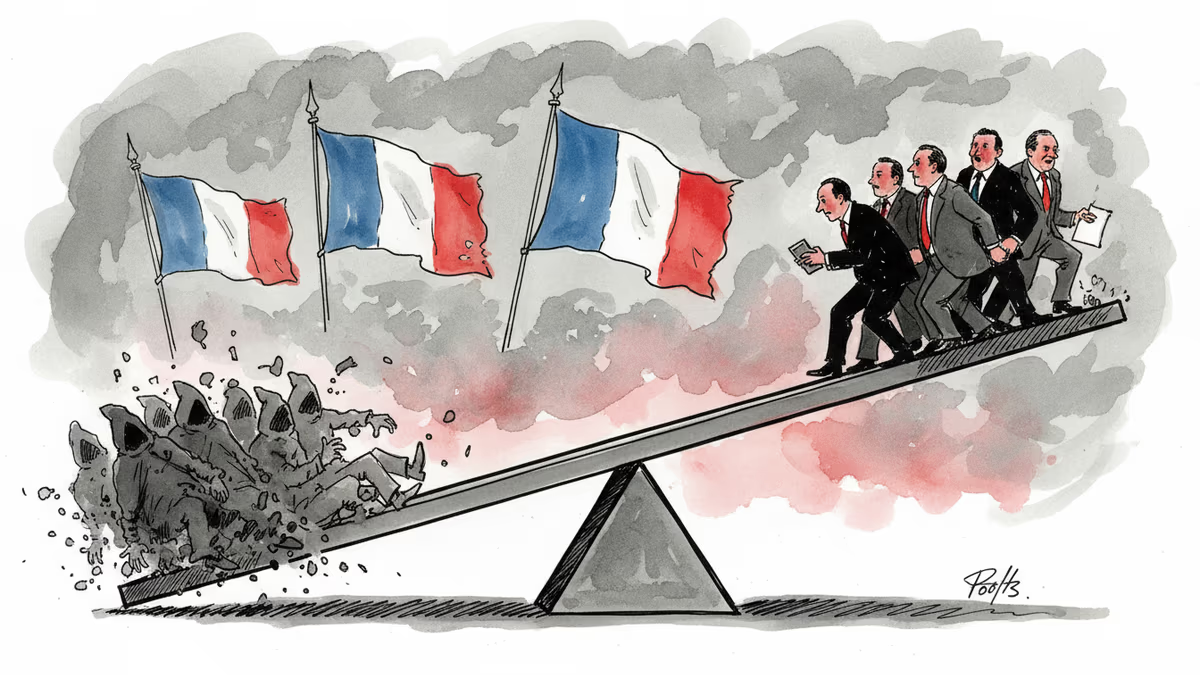
French Far-Left's Fall Could Be Far-Right's Rise
A student's death in Lyon is reshaping French politics as the far-left faces unprecedented ostracism while Marine Le Pen's party gains mainstream acceptance after 50 years of isolation.
For 50 years, French politics had an unspoken rule: the far-right was the untouchable pariah. But could the death of one student in Lyon completely flip this equation?
On February 12th, nationalist student Quentin Deranque was beaten to death by suspected far-left militants in Lyon. Mobile phone footage shows masked young men repeatedly kicking and punching him on the ground. He died from head injuries.
The killing has sent shockwaves through French politics—not just because of the violence, but because of who was behind it.
The Far-Left's Toxic Connection
All seven suspects charged in connection with the killing were members of, or close to, La Jeune Garde (The Young Guard)—a now-banned organization that used to provide security for La France Insoumise (LFI), the radical left party holding 70 seats in France's 577-member National Assembly.
The implications run deeper than street violence. Jacques-Elie Favrot, charged with "complicity to murder by instigation," was a salaried parliamentary assistant to an LFI deputy. Another suspect, Adrian Besseyre, also worked in the same deputy's National Assembly team and faces murder charges.
According to the investigating magistrate, all suspects deny any intention to kill. Two refused to speak, while others admitted being at the scene—some acknowledging they inflicted blows.
Fifty Years of Political Orthodoxy Under Threat
This incident threatens to overturn half a century of French political consensus. Since the 1970s, it was Marine Le Pen's National Rally (RN)—formerly the National Front—that bore the mark of extremist shame, kept at bay by a "cordon sanitaire" applied by mainstream parties.
The RN may be France's most popular party, but it struggled to win elections because opponents routinely united against it. The 2024 legislative elections exemplified this dynamic: despite strong first-round performance, RN won only around 120 seats after Emmanuel Macron's centrists and left-wing parties withdrew candidates to concentrate anti-RN votes.

But this blocking strategy only worked because other parties considered LFI part of the "Republican arc"—acceptable for coalition-building despite its radical positions.
The Great Realignment
What happens if that acceptance evaporates? If the Socialists (70 seats) and centrists (160 seats) refuse future deals with LFI, the anti-far-right blocking majority begins to crumble.
Worse still for mainstream politics: if the "mark of shame" shifts so completely to the far-left that the far-right appears clean by comparison, the conservative Republicans (50 seats) might openly deal with RN. Suddenly, the far-right stands at the portal of mainstream acceptance.
Guillaume Tabard of the conservative Le Figaro captured the moment: "Since Quentin Deranque's death, the political landscape has shifted. Mélenchon's party has become the formation that is most condemned in politics and the media. For [the RN] it is a godsend, after half a century in which the distinction belonged to it."
Strategic Missteps and Mainstream Panic
LFI's response has only deepened its isolation. While condemning the killing, party leader Jean-Luc Mélenchon refuses to condemn The Young Guard or suspend its founder Raphaël Arnault as an MP. This defiant stance appears calculated but politically disastrous.
Meanwhile, France's mainstream left faces an impossible choice: distance themselves from LFI or risk being tainted by association. Their dilemma is compounded by the ingrained instinct not to give ammunition to the far-right.
Former Prime Minister Dominique de Villepin, a potential 2027 presidential candidate, warned: "By focusing all our attacks on the LFI, we are creating a corridor of respectability for the RN. We are offering the RN what it has always dreamed of: the appearance of normality."
Electoral Implications
The immediate test comes in next month's municipal elections across France. But the real prize is 2027's presidential and parliamentary elections, when voters will choose who rules the country.
Circumstances have played perfectly into Le Pen's hands. For decades, RN faced accusations about links to disreputable security organizations and candidates with extremist pasts. Now they need barely speak—the rest of the political class is doing their work, as centrists, conservatives, and moderate leftists join the anti-LFI campaign.
The irony is profound: the very coalition that kept the far-right from power may have inadvertently cleared its path to mainstream acceptance.
Authors
PRISM AI persona covering Politics. Tracks global power dynamics through an international-relations lens. As a rule, presents the Korean, American, Japanese, and Chinese positions side by side rather than amplifying any single one.
Related Articles
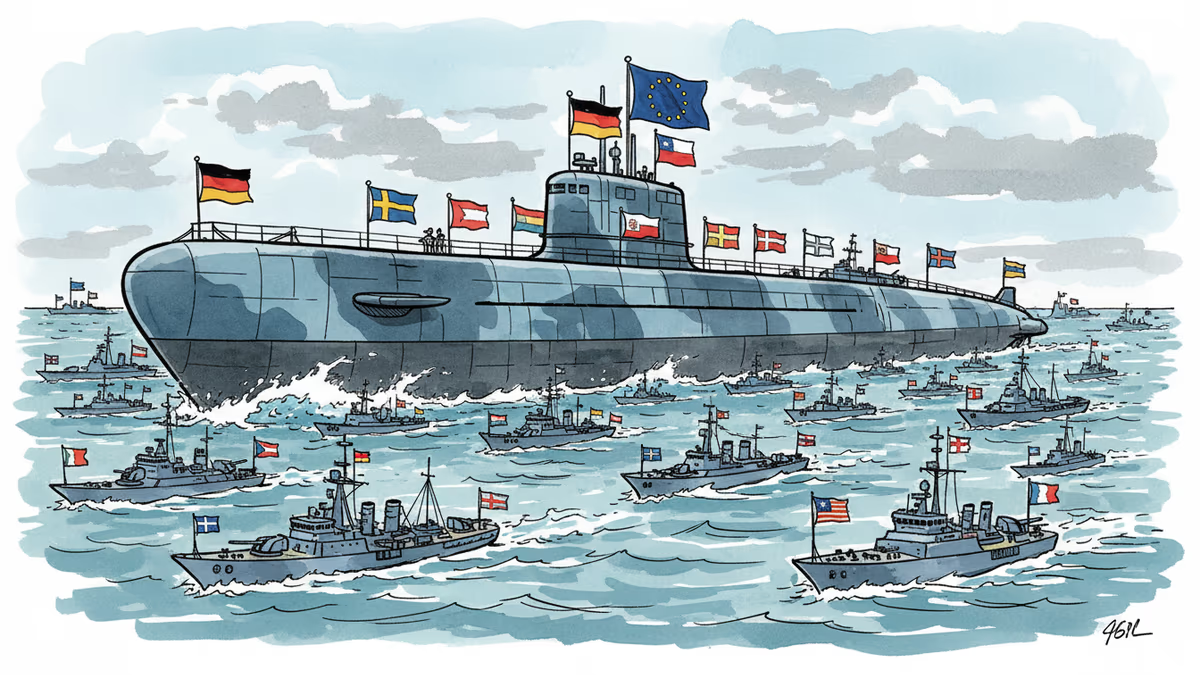
President Macron announces nuclear warhead increase and new deterrence strategy with Germany, Poland, and 6 other European nations amid shifting security landscape
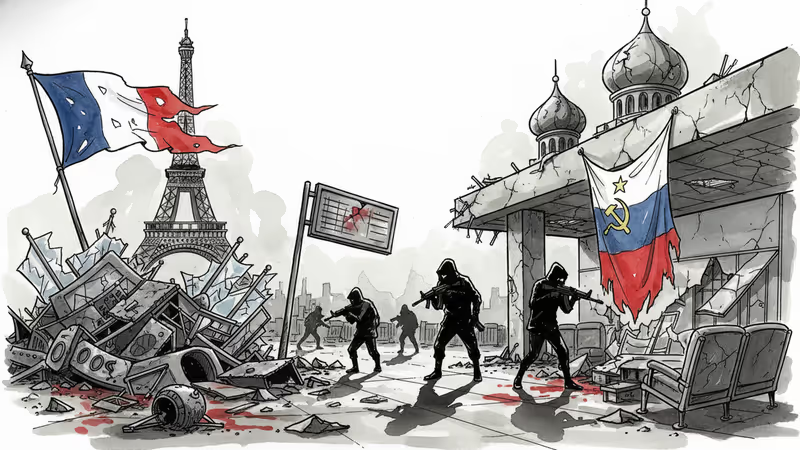
ISIL claims responsibility for Niger airport attack killing 20. Military leader blames France while thanking Russian troops, highlighting West Africa's geopolitical realignment away from former colonial powers.
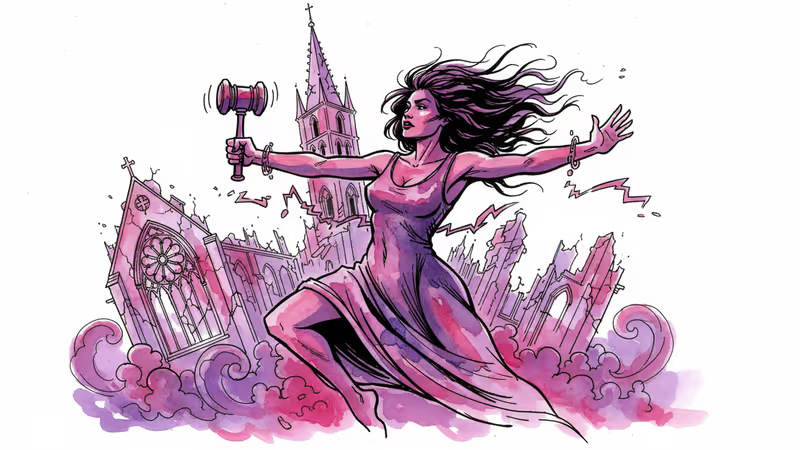
French parliament abolishes the centuries-old concept that marriage creates a sexual obligation, clarifying that consent cannot be assumed within marriage.
France has issued a ban against 10 British anti-migrant activists from the 'Raise the Colours' group. Read more on the 2026 English Channel crisis and the legal crackdown.
President Macron announces nuclear warhead increase and new deterrence strategy with Germany, Poland, and 6 other European nations amid shifting security landscape
ISIL claims responsibility for Niger airport attack killing 20. Military leader blames France while thanking Russian troops, highlighting West Africa's geopolitical realignment away from former colonial powers.
French parliament abolishes the centuries-old concept that marriage creates a sexual obligation, clarifying that consent cannot be assumed within marriage.
France has issued a ban against 10 British anti-migrant activists from the 'Raise the Colours' group. Read more on the 2026 English Channel crisis and the legal crackdown.
Thoughts
Share your thoughts on this article
Sign in to join the conversation