
Four Times in a Year: The Pentagon Keeps Handing GPS Launches to SpaceX
The US Space Force has transferred yet another GPS satellite launch from ULA to SpaceX — the fourth such move in just over a year. What this pattern reveals about the future of military space launches.
Once is an anomaly. Twice is a concern. Four times in just over a year is a verdict.
The US Space Force announced Friday it is transferring yet another GPS satellite launch away from United Launch Alliance and handing it to SpaceX. The mission — the final satellite in the GPS Block III program — was originally scheduled to fly this month on ULA's Vulcan rocket. It won't.
What Happened, and Why It Matters
Space Systems Command, the Pentagon office responsible for procuring military spacecraft and launch vehicles, confirmed the transfer of the GPS III SV10 satellite to a SpaceX Falcon 9. The announcement was brief and bureaucratic in tone. The implications are anything but.
ULA is a 50-50 joint venture between Boeing and Lockheed Martin — two of the most storied names in American aerospace. For decades, the company held a near-monopoly on US government satellite launches. Then SpaceX arrived, undercutting prices and, more critically, delivering on schedules. The rivalry has been building for years. What's happening now looks less like competition and more like a slow-motion reckoning.
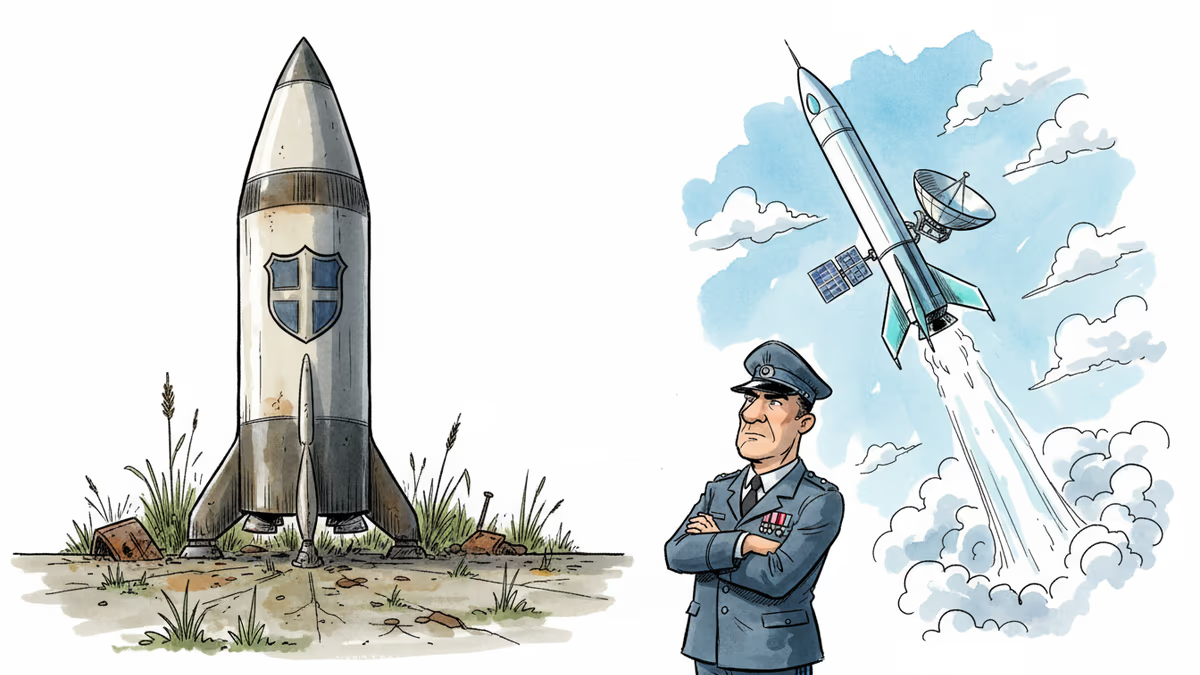
The three GPS satellites launched just before this one were also originally assigned to ULA's Vulcan rocket. Starting in 2024, the Space Force shifted each of them to Falcon 9. To compensate, military officials handed ULA three future launches that had been allocated to SpaceX — including, ironically, the very GPS III SV10 mission that has now been transferred back.
The merry-go-round of reassignments tells its own story.

A Pattern, Not an Incident
ULA's Vulcan rocket was originally targeted for its first launch in 2021. It finally flew in January 2024 — and even then, subsequent certification hurdles and technical issues kept pushing schedules. Meanwhile, SpaceX's Falcon 9 completed more than 90 launches in 2024 alone, cementing a reliability record that's become the de facto benchmark for the industry.
In commercial satellite launches, a delayed timeline is a business problem. In military launches, it's an operational one. GPS satellites don't just help hikers find trails — they underpin precision munitions, troop coordination, and naval navigation. Gaps in the constellation have real strategic consequences. That's why the Space Force keeps making the pragmatic call, even when it complicates the contractual balancing act with ULA.
For ULA, the stakes are existential. Vulcan was designed specifically to compete with Falcon 9 on price and capability. If it can't demonstrate schedule reliability, ULA's position in future long-term government launch contracts will continue to erode. Reports in 2024 suggested Boeing was exploring a sale of its ULA stake — a signal that at least one parent company is reassessing the investment.
The Uncomfortable Question Nobody Is Asking Loudly
From SpaceX's perspective, every transferred launch is a compounding asset. Each successful mission for the Pentagon builds institutional trust and positions the company favorably for the next contract cycle. SpaceX already dominates commercial launch. Its gravitational pull in the military market is growing.
But that dominance raises a question that defense analysts are beginning to ask more seriously: How much dependency on a single private company is strategically acceptable for critical national security infrastructure?
SpaceX is led by Elon Musk, whose public statements and political affiliations have grown increasingly visible. The company's Starlink network is already woven into Ukrainian military operations. Its Falcon 9 is now the default fallback for US military GPS launches. At what point does operational efficiency tip into strategic vulnerability?
Defense officials have been careful to frame the ULA-SpaceX dynamic as healthy competition — a two-vendor strategy designed to preserve redundancy. But when one vendor keeps missing its window and the other keeps absorbing the load, the two-vendor strategy starts to look like a one-vendor reality with paperwork.
Authors
Related Articles
American Airlines just signed Starlink for 500+ aircraft. It's not just about faster inflight internet — it's a calculated move in the run-up to what could be the largest IPO in history.

SpaceX's upgraded Starship V3 completed its first test flight, deploying 20 Starlink simulators but losing the Super Heavy booster. With an IPO weeks away, the stakes just got higher.
SpaceX's IPO filing puts AI at the center, claiming a $26.5 trillion market opportunity. But can Grok compete with OpenAI and Anthropic for enterprise customers?
SpaceX filed a nearly 400-page S-1 with the SEC, targeting an IPO as early as June 12. Here's what the filing reveals—and what it doesn't.
American Airlines just signed Starlink for 500+ aircraft. It's not just about faster inflight internet — it's a calculated move in the run-up to what could be the largest IPO in history.
SpaceX's upgraded Starship V3 completed its first test flight, deploying 20 Starlink simulators but losing the Super Heavy booster. With an IPO weeks away, the stakes just got higher.
SpaceX's IPO filing puts AI at the center, claiming a $26.5 trillion market opportunity. But can Grok compete with OpenAI and Anthropic for enterprise customers?
SpaceX filed a nearly 400-page S-1 with the SEC, targeting an IPO as early as June 12. Here's what the filing reveals—and what it doesn't.
Thoughts
Share your thoughts on this article
Sign in to join the conversation