
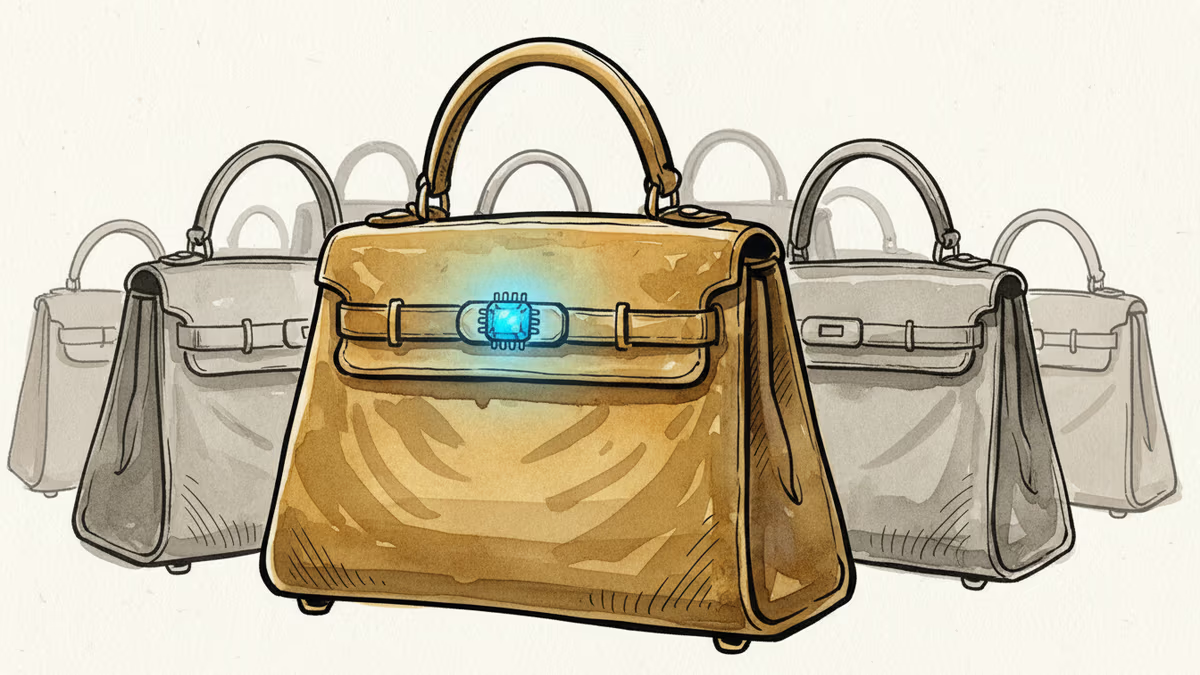
The $30B Fake Luxury Problem Just Met Its Match
Veritas develops 'hack-proof' chips to authenticate luxury goods, targeting $30B counterfeiting losses and $210B second-hand market verification needs
When Maisons Stop Authenticating Their Own Products
Luci Holland heard something that stopped her cold during meetings with luxury fashion houses: some locations had stopped authenticating their own products. The reason? Counterfeits had become too convincing to reliably detect.
This isn't just an embarrassing admission—it's a $30 billion annual problem for luxury brands and a trust crisis for the $210 billion second-hand market. Enter Veritas, Holland's startup that claims to have cracked the code with "hack-proof" authentication chips.
The Flipper Zero Test
Veritas built its reputation on a bold claim: their custom chips can't be bypassed by devices like Flipper Zero, a $200 hacking tool that's become the counterfeiters' Swiss Army knife. Traditional NFC chips? Child's play for these devices.
The secret lies in Veritas's custom coil and bridge structure. Attempt to tamper with the gem-sized chip, and it goes dormant, hiding all product-related codes. It's like a digital self-destruct mechanism, but for authentication rather than destruction.
Holland, drawing from her background at Tesla as a technical product manager and her artistic training in mixed media and metal sculpture, saw this as combining the best of both worlds: "What's truly innovative is we've used and combined elements from both hardware and software."
The Superfake Era
We've entered what industry insiders call the "superfake" era. Counterfeiters aren't just copying products—they're creating convincing authentication certificates and physical marks that have fooled even the brands themselves.

Some 150-year-old luxury houses that have survived world wars and economic crashes are now being outmaneuvered by sophisticated counterfeiting operations. Traditional authentication methods—special symbols, physical marks, certificates—have all been compromised.
"These brands deserve the most advanced protection," Holland argues, positioning technology as the great equalizer in this arms race.
Beyond Authentication: The Digital Twin
Veritas isn't stopping at authentication. Their blockchain-based system creates digital clones of products for potential metaverse activities or digital gallery exhibitions. Brands can monitor all chipped products in real-time, engage customers through exclusive invitations, and provide early access to new releases.
The $1.75 million pre-seed round led by Seven Seven Six included DoorDash co-founder Stanley Tang and former TechCrunch editor Josh Constine—a mix that suggests both consumer and media confidence in the approach.
Alexis Ohanian from Seven Seven Six frames it as an inevitable tech evolution: "It's absolutely an arms race, but we're used to fighting those and consistently winning in tech—and luxury brands need all the help they can get."
The Education Challenge
Despite the massive market opportunity, Holland identifies a surprising obstacle: education. "It is shocking to see that some of the shelf solutions, like NFC chips that brands are using, are actually so vulnerable and could easily be bypassed. This is the one thing most people don't know."
The irony cuts deep. Brands that have built century-long reputations on craftsmanship and exclusivity are unknowingly using security solutions that can be defeated by hobbyist hacking tools.
The question isn't whether technology can solve counterfeiting—it's whether solving counterfeiting changes what we're trying to protect.
Authors
Related Articles
Newly released Jeffrey Epstein files reveal deep ties to cryptocurrency leaders. How the convicted trafficker leveraged crypto's early promise for dark purposes, and what it means for the industry today.
THORChain's frozen funds expose the dark side of crypto's permissionless promise. When decentralized isn't really decentralized.

THORChain founder's contradictions expose the illusion of decentralization in crypto. When one person can freeze $200M with a single key, is anything truly decentralized?

A former Coinbase agent was arrested in India following a May 2025 security incident. Learn about the Coinbase data breach arrest 2025 and the $20M reward strategy.
Newly released Jeffrey Epstein files reveal deep ties to cryptocurrency leaders. How the convicted trafficker leveraged crypto's early promise for dark purposes, and what it means for the industry today.
THORChain's frozen funds expose the dark side of crypto's permissionless promise. When decentralized isn't really decentralized.
THORChain founder's contradictions expose the illusion of decentralization in crypto. When one person can freeze $200M with a single key, is anything truly decentralized?
A former Coinbase agent was arrested in India following a May 2025 security incident. Learn about the Coinbase data breach arrest 2025 and the $20M reward strategy.
Thoughts
Share your thoughts on this article
Sign in to join the conversation