

2026 Flying Taxi Commercial Launch: UAE and China Lead the Global Race
The 2026 flying taxi commercial launch is approaching as UAE and China lead the eVTOL race. Learn about Joby Aviation, EHang, and the future of urban air mobility.
Urban traffic is moving to the skies. By 2026, commercial "flying taxi" services utilizing electric vertical takeoff and landing (eVTOL) aircraft are poised to debut, with the United Arab Emirates and China taking the lead.
The 2026 Flying Taxi Commercial Launch: A New Era of Mobility
According to Nikkei Asia, industry giants like Joby Aviation, EHang, and Archer are preparing their aircraft for commercial duty. Joby Aviation recently showcased its five-seat eVTOL at the Dubai Airshow, signaling its readiness for the Middle Eastern market. Supported by Toyota, Joby's efforts to boost U.S. production suggest a massive scale-up is imminent.

China's Low-Altitude Economy and Infrastructure
China isn't just watching; it's accelerating. EHang is expected to launch its air taxi service soon, leveraging the nation's push for a "low-altitude economy." Meanwhile, battery manufacturers are in a race to power these aircraft, and companies like Kawasaki Heavy are testing autonomous prototypes for cargo transport. The bidding for airspace access in China provides a glimpse into the potential operational costs of this new frontier.
Authors
Related Articles

Joby Aviation acquires a 700,000-square-foot manufacturing facility in Dayton, Ohio. The move aims to double production to 4 aircraft per month by 2027.

Discover 7 innovative startups from TechCrunch Startup Battlefield 200 redefining space and defense. From propellantless propulsion to GPS-free AI navigation, the future of the frontier is here.

Samsung Electronics' union branch revealed that 84% of survey respondents oppose the government's roughly $290 billion (₩400 trillion) semiconductor megaproject in Gwangju. Government, management, the union and shareholders are all reading the same national project in sharply different ways.
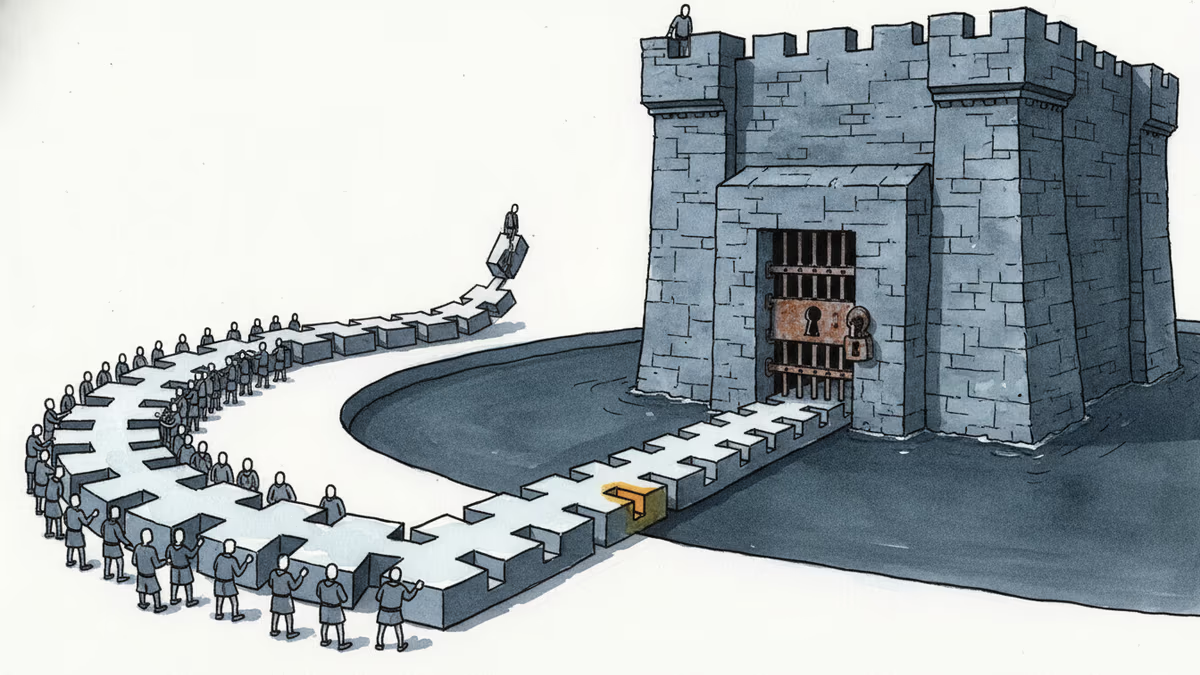
Nvidia shipped roughly a billion RISC-V cores in 2024, then announced it would run CUDA on the open standard. We break down how royalty-free instruction sets and open software stacks are trying to route around CUDA's lock-in. Part 2 of the Semiconductor Sovereignty series.
Joby Aviation acquires a 700,000-square-foot manufacturing facility in Dayton, Ohio. The move aims to double production to 4 aircraft per month by 2027.
Discover 7 innovative startups from TechCrunch Startup Battlefield 200 redefining space and defense. From propellantless propulsion to GPS-free AI navigation, the future of the frontier is here.
Samsung Electronics' union branch revealed that 84% of survey respondents oppose the government's roughly $290 billion (₩400 trillion) semiconductor megaproject in Gwangju. Government, management, the union and shareholders are all reading the same national project in sharply different ways.
Nvidia shipped roughly a billion RISC-V cores in 2024, then announced it would run CUDA on the open standard. We break down how royalty-free instruction sets and open software stacks are trying to route around CUDA's lock-in. Part 2 of the Semiconductor Sovereignty series.
Thoughts
Share your thoughts on this article
Sign in to join the conversation