
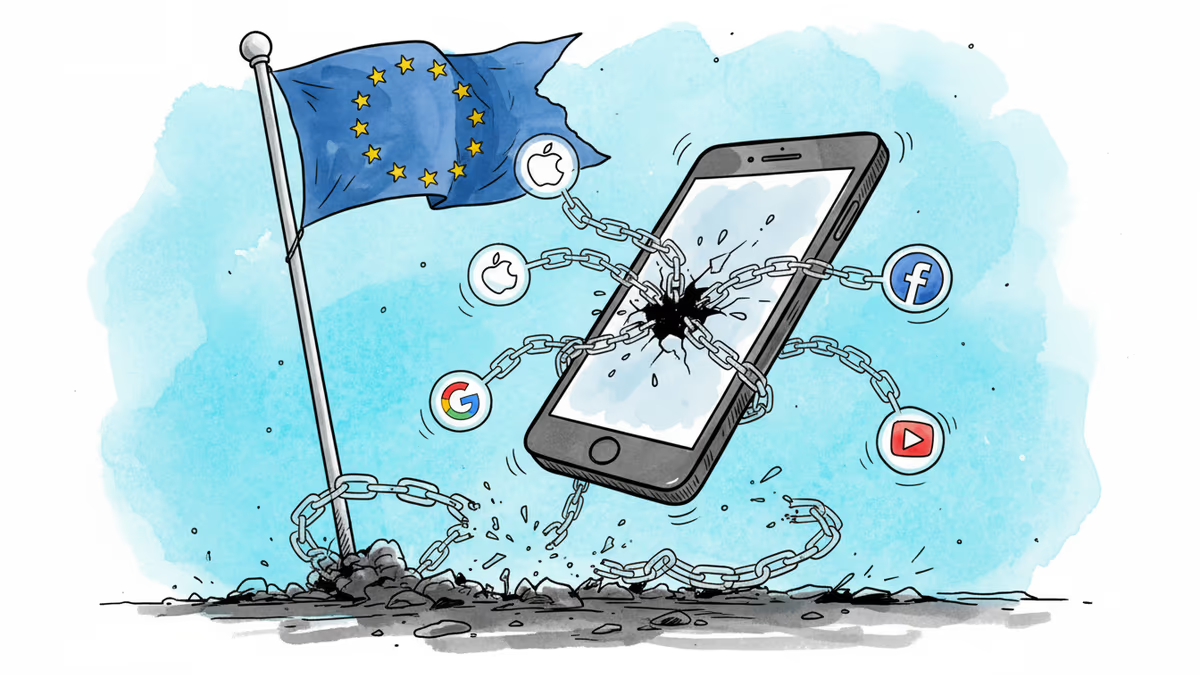
Finland's Jolla Phone Returns: Why Europe Wants Google-Free Smartphones
After 13 years, Finland's Jolla launches new smartphone with Linux-based OS, no Google services. 10,000 pre-orders signal growing demand for digital sovereignty in post-Trump tech landscape.
10,000 Pre-Orders for a Phone You've Never Heard Of
A small Finnish company called Jolla just secured 10,000 pre-orders for a smartphone most people have never heard of. It's not from Google or Apple. It costs €649 ($694) for mid-range specs. Yet Europeans are lining up to buy it.
The reason? It's a smartphone without Google. The Jolla Phone runs Sailfish OS, a Linux-based operating system with zero Google services baked in. For many buyers, that's not a bug—it's the feature.
The 13-Year Comeback Story
This isn't a typical startup success tale. Jolla nearly went bankrupt in 2015 after its tablet launch flopped. The company survived by licensing software to governments, including Russia. When the Ukraine war forced them to cut Russian ties, they faced another existential crisis.
But something shifted in 2024. Their collaboration with a Turkish company on the Jolla C2 proved there was appetite for alternatives. "Europeans want more European technology," CEO Sami Pienimäki tells WIRED. "People want to go away from Big Tech."
The timing isn't coincidental. As the second Trump administration cozies up to Silicon Valley, European distrust of US digital platforms has intensified. The new Jolla Phone is assembled in Salo, Finland—the same factory where Nokia phones were manufactured a decade ago.
What Makes Sailfish Different
Unlike GrapheneOS or e/OS, Sailfish isn't based on Android at all. It's pure Linux, meaning no Google DNA whatsoever. The company doesn't need to "deGoogle" anything—there's nothing to remove.

The trade-off? Android app compatibility isn't perfect. Some apps will crash or behave oddly. For users coming from mainstream smartphones, Jolla offers MicroG—open-source software that can run Google services without the Play Store. You don't even need a Sailfish account to use the phone.
The "Other Half" Innovation
The Jolla Phone brings back a unique feature from the original: swappable rear covers called "The Other Half." These aren't just cosmetic—they have pogo pins that can interface with accessories like a second display or keyboard attachment. There's even a community program for 3D-printing custom functional covers.
More importantly, the removable back means the 5,500-mAh battery is user-replaceable—anticipating EU regulations that will require this by 2027.
The Broader Anti-Big Tech Wave
Jolla isn't alone. French officials ditched Zoom for homegrown video conferencing software. Swiss company Punkt partnered with ApostrophyOS for its new smartphone. Canadian GrapheneOS just announced a partnership with Motorola.
This isn't just European protectionism—it's a fundamental shift in how governments and consumers think about digital sovereignty. The question isn't whether you trust Google with your data, but whether your country should depend on US tech infrastructure at all.
The Niche Premium Problem
The Jolla Phone faces the same challenge as other alternative devices: premium pricing for modest specs. The MediaTek Dimensity 7100 chip, 8GB RAM, and 256GB storage are respectable but not flagship-level. Compare that to the Light Phone III—a deliberately limited anti-smartphone that costs $699 for basic functionality.
Jolla's specs-to-value ratio is more reasonable, though the €649 price tag puts it in premium territory. The company is considering a US launch but currently focuses on the EU, UK, Norway, and Switzerland.
Authors
Related Articles
Tinder now rewards users who scan their irises at a World orb with free in-app boosts. As AI agents flood dating apps, 'being human' is becoming a verified status — and a business model.
Wisconsin Governor Tony Evers vetoed an age verification bill for adult sites, citing privacy concerns. With 25+ states going the other way, the debate cuts to the heart of online freedom vs. child protection.

CBP admits buying location data from ad industry while Meta contractors watch users in bathrooms through smart glasses. The digital privacy boundary is crumbling.
A security researcher discovered he could access 7,000 DJI robot vacuums and peek into strangers' homes. This Valentine's Day revelation exposes the hidden privacy risks of our smart home obsession.
Tinder now rewards users who scan their irises at a World orb with free in-app boosts. As AI agents flood dating apps, 'being human' is becoming a verified status — and a business model.
Wisconsin Governor Tony Evers vetoed an age verification bill for adult sites, citing privacy concerns. With 25+ states going the other way, the debate cuts to the heart of online freedom vs. child protection.
CBP admits buying location data from ad industry while Meta contractors watch users in bathrooms through smart glasses. The digital privacy boundary is crumbling.
A security researcher discovered he could access 7,000 DJI robot vacuums and peek into strangers' homes. This Valentine's Day revelation exposes the hidden privacy risks of our smart home obsession.
Thoughts
Share your thoughts on this article
Sign in to join the conversation