
Why Ferrari Hired Apple's Designer for Its First EV
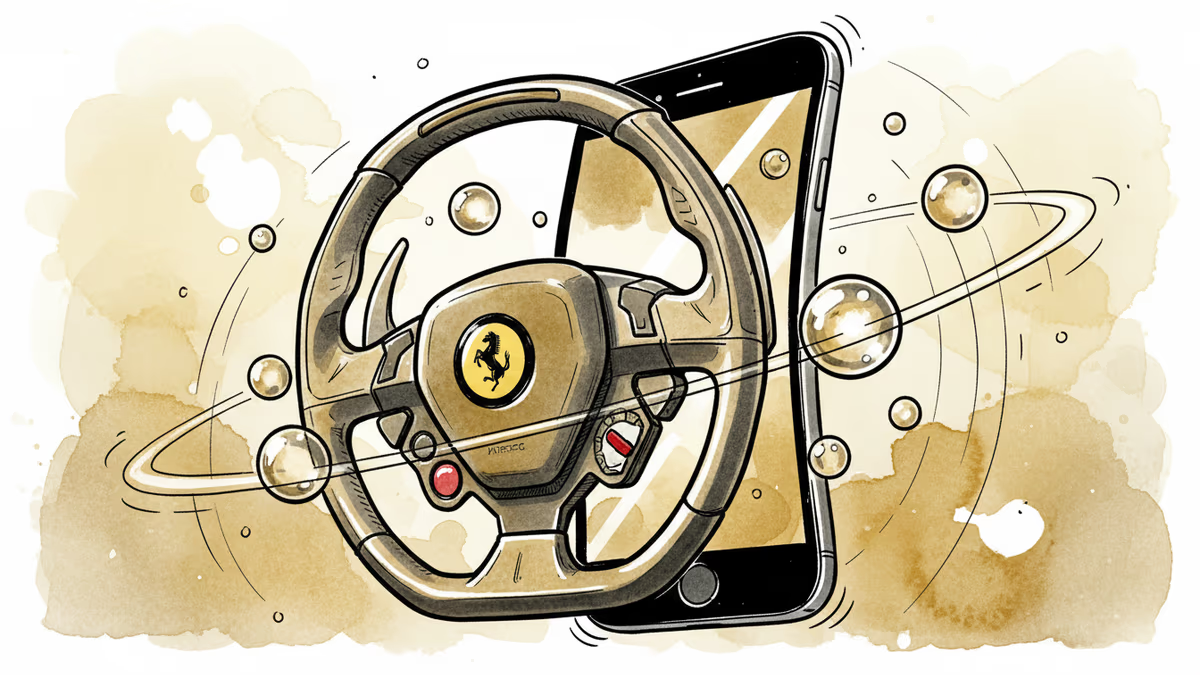
Ferrari unveils the interior of its first electric vehicle, designed by former Apple chief designer Jony Ive. The Luce's iPhone-inspired cockpit reveals luxury brands' strategy for the electric age.
The Name Change That Tells Everything
Ferrari dropped the word "electric" from its first EV. What was once nicknamed Elettrica is now officially the Ferrari Luce—Italian for "light." The rebrand wasn't just marketing fluff. "Elettrica would have been a wrong name for our car," CEO Benedetto Vigna explained at last week's unveiling in San Francisco.
The interior reveal, designed by Jony Ive's LoveFrom studio, looked like someone had deconstructed an iPhone and reassembled it inside a luxury vehicle. Glass, brushed aluminum, and leather—nothing else. No plastic except for two gears hidden in the control panel, Ferrari executives proudly noted.
This wasn't just design. It was a statement about what luxury means in the electric age.
When Apple DNA Meets Italian Soul
Ive contrasted his 27 years at Apple with automotive design: "Cars are very complicated, but I hope it will be obvious and clear the amount of care that has gone into every little piece." The result feels familiar to anyone who's held an iPhone.
The steering wheel binnacle looks like a landscape iPhone with three Apple Watches positioned in the center. Samsung-supplied OLED screens sit behind aluminum needles that seem to float in black void when the car is off. The central control panel? iPad-shaped, mounted on a ball-and-socket joint reminiscent of the iMac G4.
Even the key fob resembles a miniature iPhone, complete with glass back and yellow E Ink surrounding the Ferrari logo.
The Physical Button Revolution
While Tesla and others have eliminated physical controls in favor of touchscreens, Ferrari went the opposite direction. "When you look at this, you are not wondering, 'How many layers deep am I going to have to go to find something to make my bottom warm?'" Ive explained.

Every button has a singular purpose. The aluminum controls have what Ive calls "an incredible feel." Air vents feature aluminum shields that flip when twisted. Everything clicks or turns with satisfying precision.
This tactile approach runs counter to the industry's touchscreen obsession. Mercedes recently brought back physical buttons after customer complaints about their all-screen interfaces. Ferrari seems to have learned from others' mistakes.
Glass as Truth-Telling
Corning, Apple's longtime glass partner, supplied over 40 glass components for the Luce. Buttons, screens, even the center console casing. "Glass is a truthful material," Ive declared, contrasting it with plastic alternatives.
But will premium materials survive real-world use? Corning claims 13,000 crash tests prove their automotive Gorilla Glass can handle impacts. The half-millimeter holes drilled into the gear shifter knob—each requiring precise manufacturing—suggest Ferrari isn't compromising on durability.
The Ritual of Starting
The startup sequence feels ceremonial. Insert the iPhone-like key fob into the magnetic slot, press down, and watch yellow E Ink dim as the gear shifter glows amber. "You have this sense that it is really bringing life to the rest of the system," Ive observed.
This theatrical approach contrasts sharply with Tesla's minimalist start procedure or traditional luxury cars' push-button ignition. Ferrari is creating theater around the mundane act of turning on a car.
What This Means for Luxury
Ferrari's collaboration with Ive signals a broader shift in luxury positioning. While Porsche emphasizes performance with the Taycan and Bentley promises full electrification by 2030, Ferrari is betting on craftsmanship and tactile experience.
The strategy makes sense for a brand that sold just 13,221 vehicles globally in 2024. Ferrari doesn't need mass appeal—it needs to justify $300,000+ price tags in an era when a Lucid Air offers similar acceleration for half the cost.
For Apple fans, the Luce represents what Project Titan might have become if Apple hadn't killed its decade-long car project in 2024. The DNA is unmistakably there, from the rounded corners to the material choices.
The Luce won't arrive until late 2026, but its design philosophy is already challenging assumptions about what "smart" interfaces should feel like.
Authors
Related Articles
Waymo's new Ojai robotaxi isn't just a vehicle upgrade. It's the company's most serious attempt yet at cracking the cost problem that has kept autonomous vehicles from scaling. Here's what's really at stake.
The Ferrari Luce is finally here — 1,000 hp, a 122 kWh battery, and an interior designed by the team behind the iPhone. But the real story is what Ferrari risked to build it.
Ferrari's first EV, the Luce, starts at €550,000 in Italy. Designed inside and out by Jony Ive and Mark Newson's studio LoveFrom, it's Ferrari's first five-seater and a bold bet on design over performance specs.
Mercedes-AMG's new GT 4-door coupe packs three YASA axial flux motors producing 1,153 hp and 1,475 lb-ft of torque. Here's what it means for the EV performance race—and who actually wins.
Waymo's new Ojai robotaxi isn't just a vehicle upgrade. It's the company's most serious attempt yet at cracking the cost problem that has kept autonomous vehicles from scaling. Here's what's really at stake.
The Ferrari Luce is finally here — 1,000 hp, a 122 kWh battery, and an interior designed by the team behind the iPhone. But the real story is what Ferrari risked to build it.
Ferrari's first EV, the Luce, starts at €550,000 in Italy. Designed inside and out by Jony Ive and Mark Newson's studio LoveFrom, it's Ferrari's first five-seater and a bold bet on design over performance specs.
Mercedes-AMG's new GT 4-door coupe packs three YASA axial flux motors producing 1,153 hp and 1,475 lb-ft of torque. Here's what it means for the EV performance race—and who actually wins.
Thoughts
Share your thoughts on this article
Sign in to join the conversation