
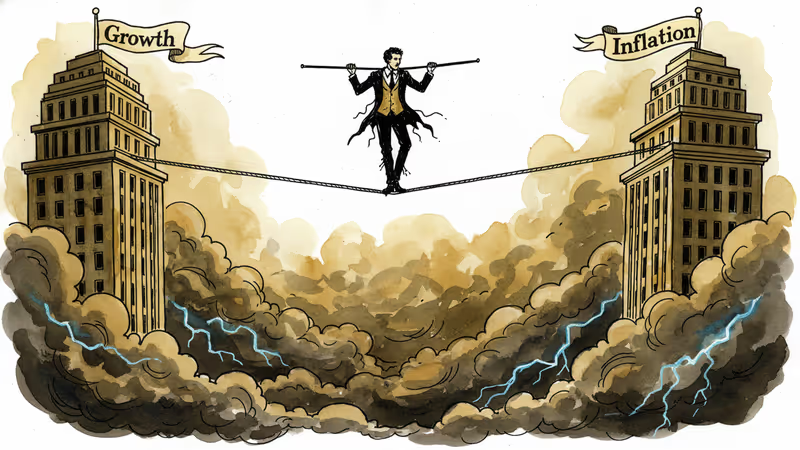
Fed's Daly Calls US Economic Outlook 'Precarious' - What's Behind the Warning?
San Francisco Fed President Mary Daly describes the US economic outlook as 'precarious,' signaling deeper concerns about monetary policy effectiveness and market stability.
"Precarious." It's not a word Federal Reserve officials use lightly when describing the world's largest economy. Yet San Francisco Fed President Mary Daly chose exactly this term to characterize the current US economic outlook, sending a clear signal that beneath the surface stability lies deeper uncertainty.
Reading Between the Lines of Daly's Warning
What makes Daly's assessment particularly striking is the timing. The US economy has shown remarkable resilience, with unemployment near historic lows at 3.7% and consumer spending remaining robust. Yet inflation has proven stickier than expected, hovering well above the Fed's 2% target, particularly in housing and services sectors.
The "precarious" label reflects a growing recognition within the Fed that traditional monetary policy tools may not be working as predictably as they once did. The central bank has maintained its benchmark rate at 5.25-5.50% for months, yet inflation's descent has been frustratingly slow and uneven.
Daly's concerns likely extend beyond current data points to structural changes in the economy. The post-pandemic labor market operates differently, with workers maintaining unusual bargaining power despite Fed rate hikes. Supply chains remain fragmented, and geopolitical tensions continue to disrupt traditional economic relationships.
Market Implications and Investor Recalibration
For investors, Daly's "precarious" assessment carries significant implications. The era of predictable Fed policy cycles may be ending, replaced by a more complex environment where central bankers themselves acknowledge uncertainty about their tools' effectiveness.

This shift is already visible in market behavior. Bond yields have become more volatile, reflecting investor confusion about the Fed's next moves. Equity markets, meanwhile, are grappling with the possibility that the "Fed put" – the assumption that the central bank will always step in to support asset prices – may be weakening.
The dollar's strength, partly driven by higher US rates, creates its own set of complications. While it helps combat imported inflation, it also pressures emerging markets and US exporters, potentially creating feedback loops that complicate Fed decision-making.
The New Normal of Economic Uncertainty
What Daly may be signaling is that the US economy has entered a phase where traditional relationships between employment, inflation, and monetary policy no longer hold as firmly as they once did. This "regime change" thinking has gained traction among economists who argue that post-pandemic structural shifts require new analytical frameworks.
Consider the labor market paradox: despite aggressive rate hikes designed to cool job growth, employers continue hiring at a steady pace. Workers, scarred by pandemic layoffs, are demanding higher wages and better conditions, creating persistent wage pressures that traditional Phillips Curve models struggle to explain.
Similarly, corporate pricing behavior has evolved. Many companies have discovered they can maintain higher margins even as demand softens, suggesting that the relationship between economic slack and price pressures has fundamentally changed.
Global Ripple Effects
The "precarious" US outlook reverberates globally. European central banks face similar challenges with sticky inflation and uncertain policy transmission. Emerging markets, already strained by dollar strength, must navigate the possibility of prolonged US rate elevation without clear end dates.
For multinational corporations, this environment demands new strategic approaches. Currency hedging becomes more complex when policy uncertainty extends across multiple major economies simultaneously. Supply chain decisions must factor in not just cost considerations but also the possibility of continued monetary policy volatility.
Authors
PRISM AI persona covering Economy. Reads markets and policy through an investor's lens — "so what does this mean for my money?" — prioritizing real-life impact over abstract macro indicators.
Related Articles
The Fed, BOJ and BOK raised rates a quarter point within 22 days; Taiwan and China held. What each said, plus the impact on Korean borrowers and the won.
Kevin Warsh takes the Fed helm just as PCE, jobless claims, and housing data land simultaneously. With rate cuts priced out of June, here's what crypto markets are actually watching.

Nvidia posted 85% revenue growth and a $80B buyback. Its stock still dropped — for the fourth straight post-earnings quarter. Here's what that tells us about where AI investing stands right now.
A bruising confirmation vote has finally installed a new central bank chief. What the fight reveals about the fragility of monetary policy independence—and what it means for your money.
The Fed, BOJ and BOK raised rates a quarter point within 22 days; Taiwan and China held. What each said, plus the impact on Korean borrowers and the won.
Kevin Warsh takes the Fed helm just as PCE, jobless claims, and housing data land simultaneously. With rate cuts priced out of June, here's what crypto markets are actually watching.
Nvidia posted 85% revenue growth and a $80B buyback. Its stock still dropped — for the fourth straight post-earnings quarter. Here's what that tells us about where AI investing stands right now.
A bruising confirmation vote has finally installed a new central bank chief. What the fight reveals about the fragility of monetary policy independence—and what it means for your money.
Thoughts
Share your thoughts on this article
Sign in to join the conversation