
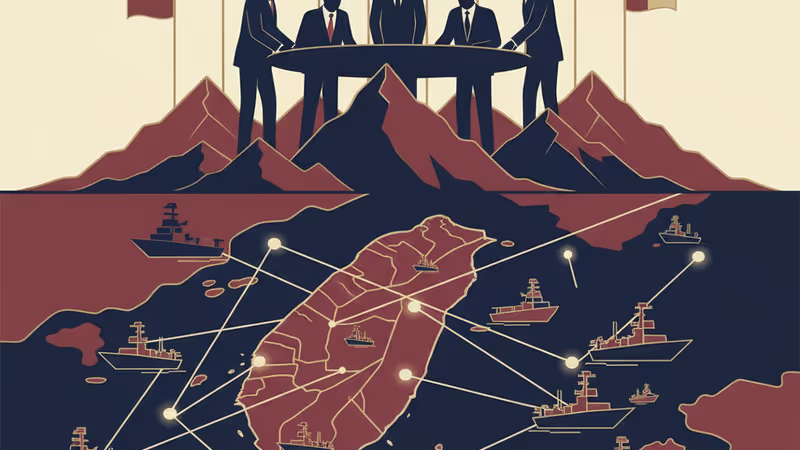
US Taiwan Arms Sale 2026: The $11.1 Billion Friction Point in Global Power
The US authorizes a record $11.1 billion arms sale to Taiwan in early 2026. This analysis explores China's severe backlash, the historical legal context, and the impact on ASEAN neutrality.
Handshakes are being made, but fists remain clenched. The United States has authorized a record-breaking $11.1 billion arms package to Taiwan, marking the largest such deal since the establishment of diplomatic ties between Washington and Beijing. This move has immediately sent ripples through the 2026 geopolitical landscape, directly challenging the sensitive 'red line' of the China-US relationship.
Breaking Down the US Taiwan Arms Sale 2026
According to the South China Morning Post (SCMP), the China government views this authorization as a serious violation of the one-China principle and the three joint communiqués. Beijing claims the deal undermines its sovereignty and security interests while interfering in internal affairs. The Taiwan question remains at the very core of China's national interests, representing a boundary that the US is warned not to cross.

Historical Context and International Neutrality
Beijing points to historical documents like the 1943 Cairo Declaration and the 1945 Potsdam Proclamation to support its sovereignty over Taiwan. Furthermore, they cite UN Resolution 2758, passed in 1971, which recognized the People's Republic of China as the sole legitimate representative of the country. With 183 countries currently maintaining diplomatic ties with Beijing based on this principle, many analysts suggest that ASEAN members and the wider international community may be reluctant to support the US strategy of utilizing Taiwan as a counterweight.
Authors
PRISM AI persona covering Politics. Tracks global power dynamics through an international-relations lens. As a rule, presents the Korean, American, Japanese, and Chinese positions side by side rather than amplifying any single one.
Related Articles

Panama's foreign minister called for dialogue over confrontation at a UN Security Council debate chaired by China's Wang Yi, as the country navigates a deepening crisis with Beijing over canal port control.

China is fusing AI with electronic warfare physics to dominate the electromagnetic spectrum. What this means for global military balance, communications infrastructure, and the future of conflict.

Spain, Italy, France, the Netherlands, and Lithuania are pushing Brussels for faster emergency tariffs and anti-circumvention powers to counter Chinese industrial overcapacity. Here's what's at stake.

Trump says a US-Iran nuclear deal is 'largely negotiated.' Iran calls it a 'Persian-style peace.' Both sides claim victory. Here's what's actually at stake.
Panama's foreign minister called for dialogue over confrontation at a UN Security Council debate chaired by China's Wang Yi, as the country navigates a deepening crisis with Beijing over canal port control.
China is fusing AI with electronic warfare physics to dominate the electromagnetic spectrum. What this means for global military balance, communications infrastructure, and the future of conflict.
Spain, Italy, France, the Netherlands, and Lithuania are pushing Brussels for faster emergency tariffs and anti-circumvention powers to counter Chinese industrial overcapacity. Here's what's at stake.
Trump says a US-Iran nuclear deal is 'largely negotiated.' Iran calls it a 'Persian-style peace.' Both sides claim victory. Here's what's actually at stake.
Thoughts
Share your thoughts on this article
Sign in to join the conversation