
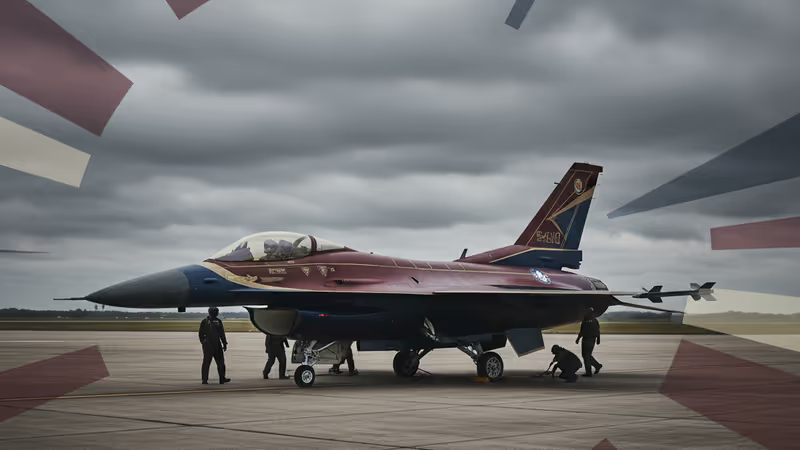
Taiwan's Delayed F-16V Jets Finally Begin Ground Tests in US
After repeated delays, Taiwan's newly ordered F-16V fighter jets have begun ground tests in the US. This marks a crucial step in bolstering Taiwan's air defense amid rising tensions with China.
F-16V fighter jets ordered by Taiwan are now undergoing ground tests in the United States, a significant milestone for a program plagued by repeated delays. The development comes as Washington and the American contractor face mounting pressure to accelerate deliveries.
First Signs of Progress
Photos circulating online in recent days provide the clearest public indication yet that the long-delayed program has entered a substantive testing phase. According to reports, the images show at least one Taiwan-bound F-16V Block 70 two-seat aircraft conducting taxi and systems checks at a US airfield.
The order for 66 new F-16V jets is separate from an ongoing project to upgrade Taiwan's existing fleet of F-16A/B fighters. These new aircraft are considered crucial for modernizing Taiwan's air defense capabilities against a growing threat from China.
High Stakes Amid Regional Tensions
The delays have been a source of significant concern in Taipei and have drawn criticism from lawmakers in Washington. With military pressure from China intensifying, the timely delivery of the advanced fighters is seen as a critical test of America's commitment to Taiwan's self-defense and its broader security role in the Indo-Pacific.
While the tests are a welcome milestone, the repeated delays have highlighted vulnerabilities in the Western defense-industrial base. For Taiwan and other US allies, the episode serves as a critical test of Washington's ability to deliver on its security commitments in a timely and effective manner.
This content is AI-generated based on source articles. While we strive for accuracy, errors may occur. We recommend verifying with the original source.
Related Articles
China's Long March 12A rocket failed its booster recovery, marking the second such failure in a month and a setback for its space program. The failure highlights the challenge of catching up to U.S. firms like SpaceX and its implications for China's satellite megaconstellation project.

China has dropped electric vehicles (EVs) from its list of strategic industries for the first time in a decade, signaling a major policy shift. What does this mean for the global market, and what lessons can the U.S. learn from China's industrial playbook?
The U.S. nuclear submarine USS Greeneville arrived in Busan, South Korea, on Dec. 23, 2025, for a logistical stop. This visit reinforces the U.S.-South Korea defense alliance and serves as a strategic signal of deterrence in the region.
A federal judge declared a mistrial in the case of Linda Sun, a former aide to New York governors, after the jury deadlocked on charges that she acted as an unregistered agent for China.