

China's Reusable Rocket Ambitions Suffer Second Setback in a Month
China's Long March 12A rocket failed its booster recovery, marking the second such failure in a month and a setback for its space program. The failure highlights the challenge of catching up to U.S. firms like SpaceX and its implications for China's satellite megaconstellation project.
China's push to master reusable rocket technology has hit another snag. The country's first state-owned reusable booster, the Long March 12A, successfully launched on Tuesday from the Jiuquan Satellite Launch Centre but failed during its first-stage recovery attempt. It’s the second time this month that a Chinese effort to retrieve an orbital-class booster has fallen short, underscoring the significant gap with the United States.
The High Stakes of the Recovery Race
This isn't just a technical challenge; it's a strategic necessity for Beijing. Reusable rockets are critical for lowering launch costs and increasing frequency, two factors essential for China’s ambitious megaconstellation projects, Guowang and Qianfan. These state-backed initiatives, which plan to deploy networks of up to 10,000 satellites each, are China's answer to SpaceX's Starlink. Without reusability, the economic viability of this massive project is in serious question.
An Exclusive Club Still Dominated by the U.S.
To date, the U.S. is the only nation to have successfully landed and reused an orbital-class booster. SpaceX pioneered the feat with its Falcon 9 rocket nearly a decade ago, fundamentally changing the economics of space access. Just last month, Jeff Bezos's Blue Origin saw its New Glenn rocket achieve the same milestone, solidifying the American lead.
China has a mix of state-owned developers, like the Long March's designer Shanghai Academy of Spaceflight Technology, and a growing number of commercial space companies racing to be the first in the country to succeed. However, Tuesday's failure shows that the goal remains elusive.
This setback highlights the immense difficulty of mastering controlled descent and landing, a feat SpaceX made look routine. It raises questions about whether China's state-directed approach, combined with a burgeoning commercial sector, can replicate the disruptive innovation that came from a more bottom-up, commercially-driven ecosystem in the U.S.. The race isn't just about hardware; it's about the model of innovation itself.
This content is AI-generated based on source articles. While we strive for accuracy, errors may occur. We recommend verifying with the original source.
Related Articles

China has drafted a comprehensive law to regulate all its activities in Antarctica, expanding oversight from science to tourism and fishing, aiming to bolster its role in global governance.

China has dropped electric vehicles (EVs) from its list of strategic industries for the first time in a decade, signaling a major policy shift. What does this mean for the global market, and what lessons can the U.S. learn from China's industrial playbook?
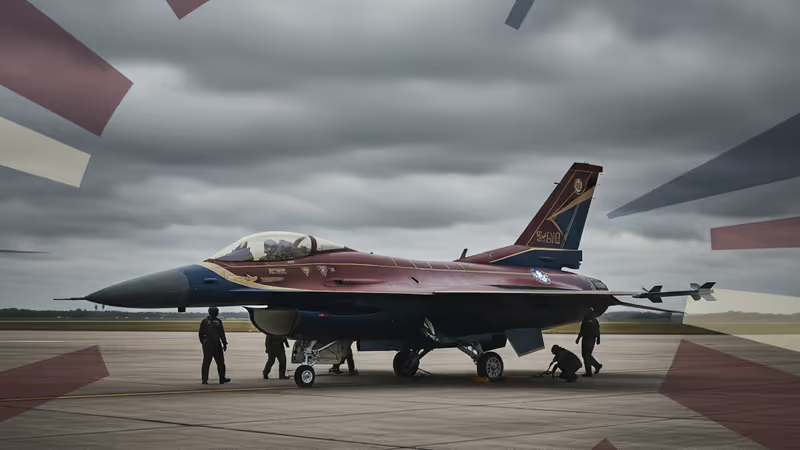
After repeated delays, Taiwan's newly ordered F-16V fighter jets have begun ground tests in the US. This marks a crucial step in bolstering Taiwan's air defense amid rising tensions with China.

U.S. President Trump warns Venezuelan President Maduro that 'it would be smart to leave' power as the U.S. seizes oil tankers, sparking condemnation from Russia and China and raising geopolitical tensions.