
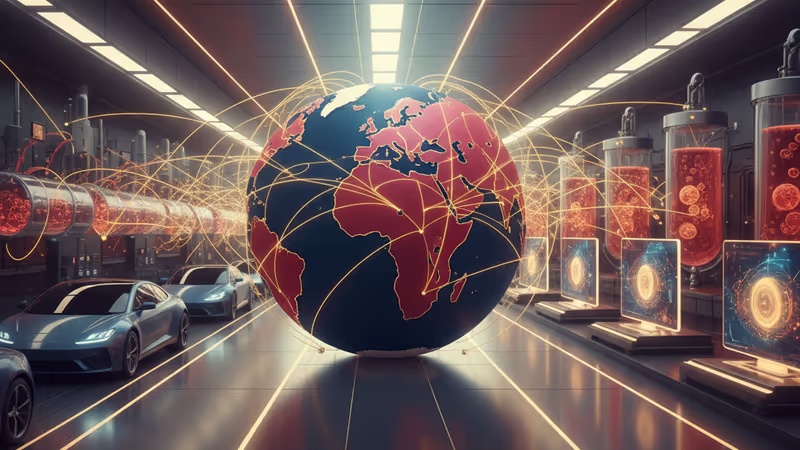
China Unplugs a Decade of EV Subsidies, Pivoting to the Next Tech Frontier
China has dropped electric vehicles (EVs) from its list of strategic industries for the first time in a decade, signaling a major policy shift. What does this mean for the global market, and what lessons can the U.S. learn from China's industrial playbook?
After a decade of relentless state-led investment that made it the world's undisputed electric vehicle (EV) leader, China has made a stunning policy pivot. In its 15th Five-Year Plan (2026-2030), Beijing omitted EVs from its official list of strategic industries for the first time in ten years. The move signals that China's leadership believes the industry has graduated from its hyper-accelerated development phase and is ready to face market forces, a transition that holds critical lessons for the U.S. and its allies.
Venture-Capital Statecraft and Its Side Effects
China's EV dominance was built on a strategy best described as venture-capital statecraft. From 2009 to 2023, the government poured an astonishing $230 billion into the sector through subsidies, tax breaks, and cheap credit. This happened even when demand was negligible; in 2009, total EV sales in China were just 500 units. The bet paid off. By 2024, China's EV production hit 12.4 million units, accounting for 70% of global output.
However, this supply-side push created severe economic distortions. The strategy led to what Beijing now calls “involution”—a state of hyper-competition, overcapacity, and deflation. China's EV production capacity is now three times its domestic demand. As of August 2025, only three EV makers—BYD, Li Auto, and Aito—are profitable. This imbalance is economy-wide: nearly a quarter of all industrial firms are losing money, the highest share since 2001, as investment consistently outpaces consumption.
The Export Release Valve and the New Blueprint
So far, China has managed these pressures through a crucial 'release valve': exports. With domestic demand weak, overseas markets have absorbed the massive overcapacity. China's record $992 billion trade surplus in 2024 was a key driver of its 5% GDP growth. In markets like Brazil, Mexico, and Thailand, Chinese models account for over 80% of EV imports. Some local officials even resorted to inflating economic data by exporting “zero-mileage” cars as 'used' to foreign markets at a discount.
With the EV industry now considered mature, Beijing is applying the same playbook to a new set of frontiers. The new strategic industries list is a guide to the future: quantum technology, bio-manufacturing, hydrogen and fusion energy, 6G communications, embodied intelligence, and brain-computer interfaces. These sectors are now slated to receive the same preferential financing and state support that built China's EV empire.
China's experience offers a clear, if costly, blueprint for scaling new industries. For U.S. policymakers, the lesson is twofold. First, industrial policy must balance supply-side incentives with demand-creation measures like public procurement and tax credits to avoid creating domestic overcapacity. Second, strategic coordination with allies on R&D, market access, and targeted protectionism is crucial to effectively compete with China's state-driven model.
This content is AI-generated based on source articles. While we strive for accuracy, errors may occur. We recommend verifying with the original source.
Related Articles
China's Long March 12A rocket failed its booster recovery, marking the second such failure in a month and a setback for its space program. The failure highlights the challenge of catching up to U.S. firms like SpaceX and its implications for China's satellite megaconstellation project.

China has drafted a comprehensive law to regulate all its activities in Antarctica, expanding oversight from science to tourism and fishing, aiming to bolster its role in global governance.
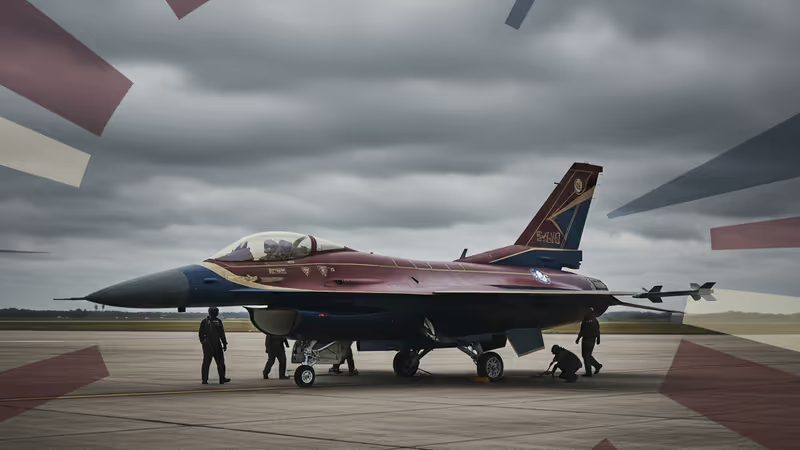
After repeated delays, Taiwan's newly ordered F-16V fighter jets have begun ground tests in the US. This marks a crucial step in bolstering Taiwan's air defense amid rising tensions with China.

U.S. President Trump warns Venezuelan President Maduro that 'it would be smart to leave' power as the U.S. seizes oil tankers, sparking condemnation from Russia and China and raising geopolitical tensions.