
Musk's SpaceX-xAI Merger Could Create the Ultimate Space-AI Empire
Elon Musk reportedly in talks to merge SpaceX and xAI ahead of planned IPO. The deal would combine rockets, satellites, and AI under one corporate umbrella with space-based data centers.
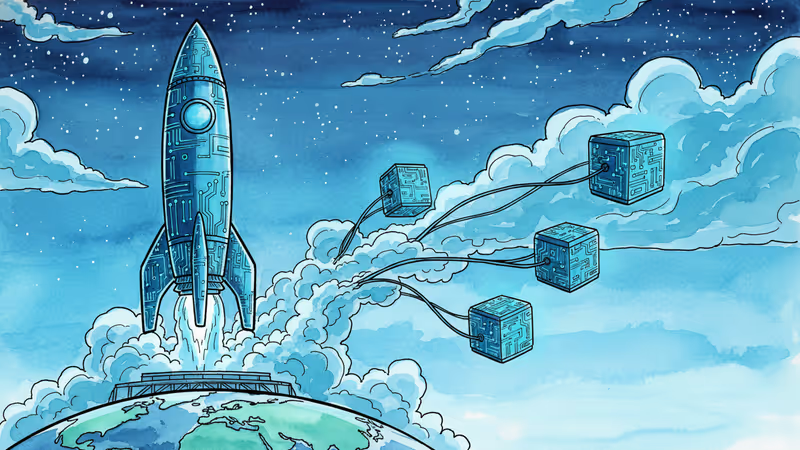
Elon Musk wants to put AI data centers in space. And if a new Reuters report is accurate, he's closer than ever to making it happen.
SpaceX and xAI, both Musk-led companies, are reportedly in talks to merge ahead of SpaceX's planned IPO this year. The deal would bring together Grok chatbots, the X platform, Starlink satellites, and SpaceX rockets under one corporate roof. Two new entities—K2 Merger Sub Inc. and K2 Merger Sub 2 LLC—were quietly established in Nevada on January 21, lending credence to the merger speculation.
If completed, this wouldn't just be another corporate restructuring. It would create something unprecedented: a vertically integrated space-AI conglomerate that could fundamentally reshape how we think about computing infrastructure.
The Space Data Center Vision Takes Shape
Musk has long talked about putting data centers in orbit, and a SpaceX-xAI merger would make that vision practically feasible. Imagine AI training happening in the vacuum of space, powered by solar energy, with virtually unlimited cooling and no terrestrial infrastructure constraints. It sounds like science fiction, but Musk's track record suggests otherwise.
The companies are already deeply intertwined. Last year, SpaceX invested $2 billion in xAI, and just this week, Tesla revealed it had also pumped $2 billion into the AI startup. When xAI acquired X last year, the deal valued xAI at $80 billion and X at $33 billion. Meanwhile, SpaceX recently completed a secondary sale valuing it at $800 billion, making it America's most valuable private company.
Financial Times reports that Musk wants to take SpaceX public in June, though his timelines have historically been... optimistic.

Beyond Corporate Consolidation
This potential merger represents more than business efficiency—it's about creating an integrated ecosystem where space infrastructure, artificial intelligence, and global communications converge. Think real-time AI processing of satellite data, instant global connectivity for autonomous vehicles, and computing power that's literally out of this world.
But vertical integration isn't always a winning strategy. While companies like Google's parent Alphabet maintain diverse business units, they generally preserve operational independence. Musk prefers a more fluid approach, with Tesla engineers working on X features and SpaceX technology flowing into The Boring Company.
For investors, this creates both opportunity and risk. A unified space-AI-social media-satellite company could generate unprecedented synergies. But it also means one division's problems could cascade across the entire empire.
The Regulatory Wild Card
A merged entity would likely face intense regulatory scrutiny. SpaceX already operates critical national security infrastructure through government contracts, while xAI competes directly with OpenAI, Google, and Microsoft in the AI race. Combining space assets with AI capabilities could raise national security concerns, especially given Musk's increasingly complex relationship with various governments.
The timing is also curious. As AI companies face mounting pressure over data usage, energy consumption, and market concentration, moving computing infrastructure to space could be seen as either innovative problem-solving or regulatory arbitrage.
Authors
Related Articles
American Airlines just signed Starlink for 500+ aircraft. It's not just about faster inflight internet — it's a calculated move in the run-up to what could be the largest IPO in history.
SpaceX's upgraded Starship V3 completed its first test flight, deploying 20 Starlink simulators but losing the Super Heavy booster. With an IPO weeks away, the stakes just got higher.
SpaceX's IPO filing puts AI at the center, claiming a $26.5 trillion market opportunity. But can Grok compete with OpenAI and Anthropic for enterprise customers?
SpaceX filed a nearly 400-page S-1 with the SEC, targeting an IPO as early as June 12. Here's what the filing reveals—and what it doesn't.
American Airlines just signed Starlink for 500+ aircraft. It's not just about faster inflight internet — it's a calculated move in the run-up to what could be the largest IPO in history.
SpaceX's upgraded Starship V3 completed its first test flight, deploying 20 Starlink simulators but losing the Super Heavy booster. With an IPO weeks away, the stakes just got higher.
SpaceX's IPO filing puts AI at the center, claiming a $26.5 trillion market opportunity. But can Grok compete with OpenAI and Anthropic for enterprise customers?
SpaceX filed a nearly 400-page S-1 with the SEC, targeting an IPO as early as June 12. Here's what the filing reveals—and what it doesn't.
Thoughts
Share your thoughts on this article
Sign in to join the conversation