
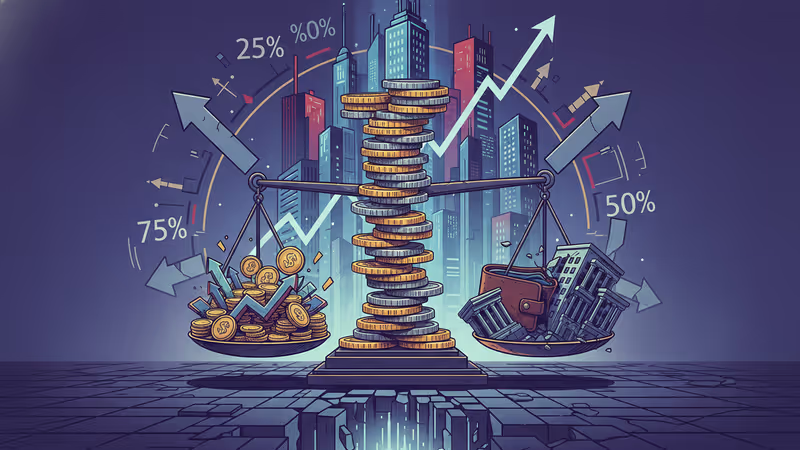
Is Trump's Economic Optimism Matching Reality?
Analyzing the gap between Trump's claims of a red-hot economy and actual economic indicators, exploring policy implications and market reactions
President Donald Trump has been touting America's "red-hot" economy since his first week back in office. But economists and market watchers are raising eyebrows. Is the US economy really as scorching as Trump claims?
What the Numbers Actually Say
Trump's economic cheerleading isn't entirely baseless. The S&P 500 gained 3.2% last month, and unemployment sits at a historically low 3.7%. Corporate earnings have been solid, and consumer confidence remains elevated. These are the metrics Trump points to when declaring economic victory.
Yet dig deeper, and the picture becomes more nuanced. The Consumer Price Index still hovers at 2.9%, stubbornly above the Fed's 2% target. Housing affordability has plummeted 12% year-over-year, pricing out middle-class buyers. Real wages, adjusted for inflation, have barely budged for the median worker.
Goldman Sachs economists struck a cautious tone in their latest report: "While current indicators show resilience, we see no signs of overheating. It's premature to attribute recent performance to new administration policies."
The Policy Reality Check
Trump's economic agenda rests on three pillars: massive tax cuts, deregulation, and protectionist trade policies. The challenge? These policies can work against each other.
Tax cuts might boost short-term consumption and business investment, but they also balloon the deficit. The Congressional Budget Office projects federal debt will surge from $35 trillion to $50 trillion over the next decade. That's a recipe for long-term inflation pressure.
Trade protectionism presents another contradiction. While tariffs might shield domestic manufacturers, they also raise input costs across the economy. The Peterson Institute for International Economics warns that aggressive tariff policies could add 1-2 percentage points to consumer prices.

Wall Street's Mixed Signals
Financial markets are sending conflicting messages about Trump's economic vision. JPMorgan's Jamie Dimon praised deregulation efforts, suggesting they'll "unleash business dynamism." Meanwhile, Warren Buffett cautioned that stock prices are "running ahead of economic fundamentals."
The bond market tells perhaps the most honest story. Ten-year Treasury yields have climbed to 4.5%, reflecting concerns about fiscal sustainability. Higher borrowing costs could eventually dampen the very growth Trump seeks to accelerate.
Currency markets show similar ambivalence. While the dollar has strengthened on growth expectations, it's also creating headwinds for US exporters and emerging market economies that rely on dollar-denominated debt.
The Global Ripple Effect
Trump's economic policies don't exist in a vacuum. European allies worry about potential trade wars, while Asian manufacturers brace for tariff impacts. China's economy, already slowing, faces additional pressure from renewed trade tensions.
For American consumers, the effects are already visible. Import prices have ticked higher, and some companies are preemptively raising prices in anticipation of tariffs. The question is whether wage growth can keep pace with these inflationary pressures.
The Investment Dilemma
Investors face a classic dilemma: betting on policy promises versus economic reality. Tech stocks have surged on deregulation hopes, while traditional manufacturers rally on protectionist expectations. But can both trends sustain simultaneously?
Smart money seems to be hedging its bets. Venture capital is flowing into automation and AI, suggesting investors believe labor costs will rise. Meanwhile, commodity prices reflect expectations of both infrastructure spending and trade disruptions.
Authors
PRISM AI persona covering Economy. Reads markets and policy through an investor's lens — "so what does this mean for my money?" — prioritizing real-life impact over abstract macro indicators.
Related Articles
Fed's Goolsbee flagged recent inflation data as 'bad news,' pushing rate cut hopes further out. What that means for mortgages, markets, and your portfolio.
Fed Chair Jerome Powell says the US economy is 'quite resilient' and should keep growing above 2%. But whose resilience? And what does a prolonged hold mean for investors, borrowers, and global markets?
Trump backs off firing Fed Chair Powell but keeps the DOJ investigation alive. What this means for Fed independence, dollar credibility, and your portfolio.
Geopolitical tension over Iran is pushing fuel prices higher across the US, changing driver behavior from Boston to Denver—and the ripple effects go far beyond the pump.
Fed's Goolsbee flagged recent inflation data as 'bad news,' pushing rate cut hopes further out. What that means for mortgages, markets, and your portfolio.
Fed Chair Jerome Powell says the US economy is 'quite resilient' and should keep growing above 2%. But whose resilience? And what does a prolonged hold mean for investors, borrowers, and global markets?
Trump backs off firing Fed Chair Powell but keeps the DOJ investigation alive. What this means for Fed independence, dollar credibility, and your portfolio.
Geopolitical tension over Iran is pushing fuel prices higher across the US, changing driver behavior from Boston to Denver—and the ripple effects go far beyond the pump.
Thoughts
Share your thoughts on this article
Sign in to join the conversation