

AI Health Chatbots Are Everywhere. Has Anyone Checked If They Work?
Microsoft, Amazon, and OpenAI have all launched medical AI tools in recent months—with minimal external evaluation. What's at stake when Big Tech moves fast in healthcare?
Imagine it's 2 a.m. and your chest feels tight. Do you call an ambulance? Google your symptoms? Increasingly, people are turning to an AI chatbot—and Big Tech is betting billions that this is the future of healthcare.
In just the past few months, Microsoft, Amazon, and OpenAI have all launched medical AI tools. The market is moving fast. But a growing chorus of researchers and clinicians is asking a pointed question: how well do any of these tools actually work—and who's checking?
The Gap Between Launch and Proof
The demand is real. Millions of Americans can't afford a doctor's visit. Wait times for specialists stretch into months. In this vacuum, an AI that can triage symptoms, explain a diagnosis, or flag a drug interaction sounds genuinely useful—even lifesaving.
But here's the friction: a new drug requires years of clinical trials and regulatory sign-off before it reaches patients. An AI chatbot, classified as software rather than a medical device, can sidestep much of that scrutiny. Companies can ship, iterate, and scale before independent researchers have had a chance to stress-test the product in real-world conditions.
The concern isn't hypothetical. Studies on earlier AI diagnostic tools found significant performance gaps across different demographics. A system trained predominantly on data from one population can underperform—sometimes dangerously—for another. Without mandatory external evaluation, these gaps may not surface until someone is harmed.
Three Stakeholders, Three Very Different Problems

For patients, especially those priced out of the traditional healthcare system, these tools represent access. A chatbot that's available at midnight, costs nothing, and speaks plainly is a meaningful option when the alternative is no option at all. The question isn't whether it's perfect—it's whether it's better than nothing.
For clinicians, the picture is more complicated. Some physicians welcome AI as a way to handle routine queries, freeing them for complex cases. Others worry about the liability tangle when a patient acts on AI advice that turns out to be wrong—and arrives in the ER sicker than they needed to be.
For regulators, the dilemma is structural. Move too fast to restrict these tools and you're accused of blocking innovation that could save lives. Move too slowly and you're accused of letting corporations run an uncontrolled experiment on public health. California's decision to impose its own AI standards—defying the Trump administration's push to deregulate—signals that this tension is becoming a political fault line, not just a technical one.
Why the Timing Matters
This isn't just a healthcare story. It's a preview of a pattern playing out across every sector where AI is moving faster than oversight: hiring algorithms, credit scoring, criminal justice tools. Healthcare is simply the domain where the stakes are most viscerally obvious.
The $635 billion in AI infrastructure spending that Big Tech has committed to this year needs a return. Healthcare is one of the most promising verticals. That economic pressure shapes how quickly products get pushed to market—and how loudly companies resist calls for independent audits.
Meanwhile, quantum computing researchers just verified simulations that could one day accelerate drug discovery. The gap between what AI could do in medicine and what it's currently being allowed to do without scrutiny is widening in both directions simultaneously.
Authors
Related Articles

Google's Gmail Live lets you ask your inbox questions out loud. Announced at I/O 2026, it's AI's pitch to skeptics — and a reminder of how much Google already knows about you.

OpenAI has reorganized for the second time in a month, merging ChatGPT and Codex into a single agentic platform under president Greg Brockman's unified product leadership.
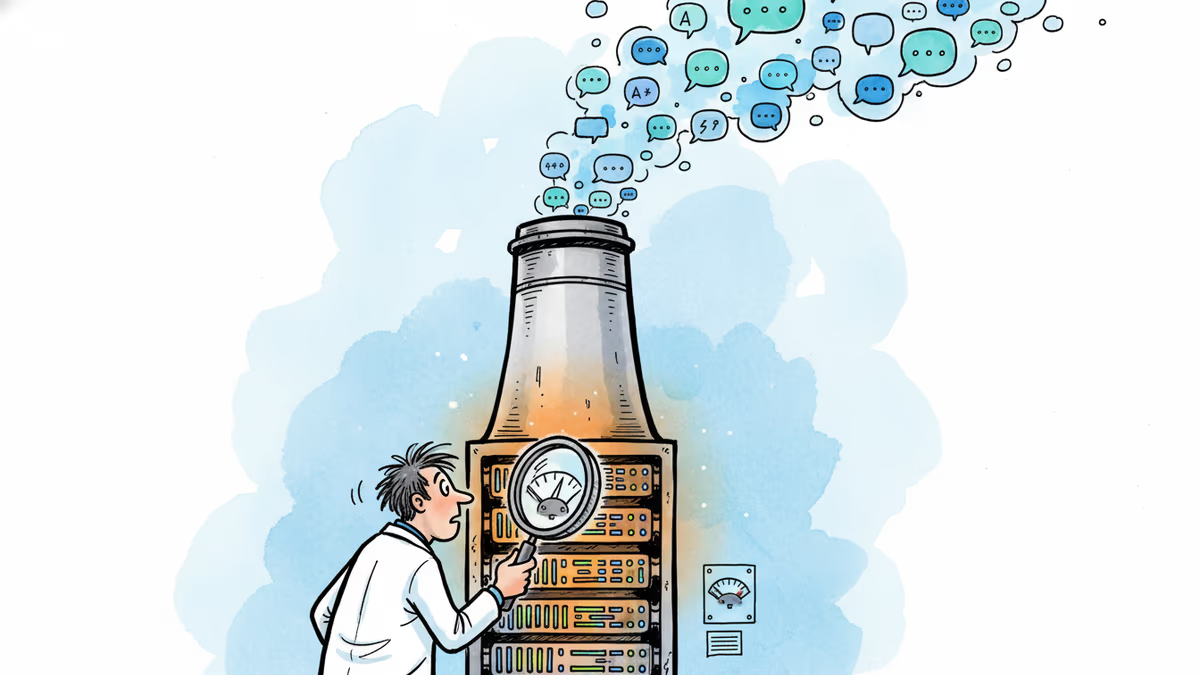
AI sustainability researcher Sasha Luccioni is launching a new venture to push for energy transparency in AI. Here's why Big Tech keeps the numbers hidden—and what's starting to change.
Emails revealed in the Musk v. Altman trial show Microsoft executives were deeply skeptical of OpenAI in 2017–2018. What actually changed their minds?
Google's Gmail Live lets you ask your inbox questions out loud. Announced at I/O 2026, it's AI's pitch to skeptics — and a reminder of how much Google already knows about you.
OpenAI has reorganized for the second time in a month, merging ChatGPT and Codex into a single agentic platform under president Greg Brockman's unified product leadership.
AI sustainability researcher Sasha Luccioni is launching a new venture to push for energy transparency in AI. Here's why Big Tech keeps the numbers hidden—and what's starting to change.
Emails revealed in the Musk v. Altman trial show Microsoft executives were deeply skeptical of OpenAI in 2017–2018. What actually changed their minds?
Thoughts
Share your thoughts on this article
Sign in to join the conversation