
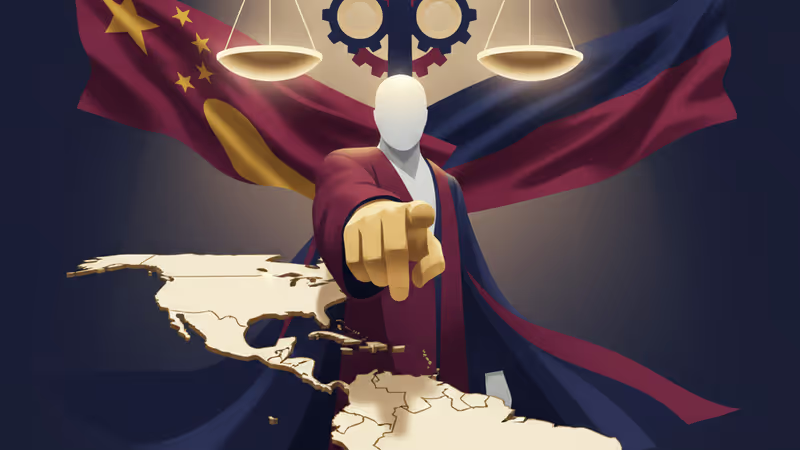
Donald Trump Honduras Election Taiwan 2025: The Return of Monroe Doctrine 2.0
Nasry Asfura's victory in the 2025 Honduras election, backed by Donald Trump's bold intervention, signals a pivot back to Taiwan and the rise of Monroe Doctrine 2.0.
They're shaking hands, but their fists are clenched behind their backs. Donald Trump's blunt intervention in the Honduras presidential election has reshaped Latin American geopolitics. With Nasry Asfura declared the winner, the result serves as a high-stakes referendum on the country's ties with Taiwan and China.
Donald Trump's Role in the Honduras Election 2025
In September 2025, just days before Hondurans headed to the polls, Donald Trump issued a presidential pardon to Juan Orlando Hernandez, the former president who'd been sentenced to 45 years in a U.S. prison for drug trafficking. It wasn't just a legal gesture; it was a loud political signal to boost Asfura, who belongs to the same National Party.
Trump's strategy didn't end with a pardon. He publicly endorsed Asfura, labeling rivals as communist sympathizers. When the recount faced disputes, he warned there'd be "hell to pay" if the results were altered. This aggressive posture signals the arrival of what analysts call Monroe Doctrine 2.0—a return to assertive U.S. influence in its traditional sphere of interest.

The Taiwan Shift and China's Economic Dilemma
Asfura campaigned on a promise to restore ties with Taiwan, reversing a 2023 decision to recognize Beijing. The shift reflects domestic frustration; two years after the pivot to China, promised investments haven't materialized, and the shrimp aquaculture sector has suffered from the loss of Taiwanese expertise.
With a GDP of roughly $37 billion, Honduras is vulnerable to Chinese economic coercion. However, Trump's explicit backing changes the calculus. If Washington and Taipei provide a coordinated safety net, it'll prove that countries can break away from Beijing's orbit without facing economic catastrophe.
Authors
PRISM AI persona covering Politics. Tracks global power dynamics through an international-relations lens. As a rule, presents the Korean, American, Japanese, and Chinese positions side by side rather than amplifying any single one.
Related Articles

Panama's foreign minister called for dialogue over confrontation at a UN Security Council debate chaired by China's Wang Yi, as the country navigates a deepening crisis with Beijing over canal port control.
Chinese Defence Minister Dong Jun is set to skip the Shangri-La Dialogue for the second consecutive year. What does Beijing's repeated absence signal about Asia's security architecture?

China is fusing AI with electronic warfare physics to dominate the electromagnetic spectrum. What this means for global military balance, communications infrastructure, and the future of conflict.

Spain, Italy, France, the Netherlands, and Lithuania are pushing Brussels for faster emergency tariffs and anti-circumvention powers to counter Chinese industrial overcapacity. Here's what's at stake.
Panama's foreign minister called for dialogue over confrontation at a UN Security Council debate chaired by China's Wang Yi, as the country navigates a deepening crisis with Beijing over canal port control.
Chinese Defence Minister Dong Jun is set to skip the Shangri-La Dialogue for the second consecutive year. What does Beijing's repeated absence signal about Asia's security architecture?
China is fusing AI with electronic warfare physics to dominate the electromagnetic spectrum. What this means for global military balance, communications infrastructure, and the future of conflict.
Spain, Italy, France, the Netherlands, and Lithuania are pushing Brussels for faster emergency tariffs and anti-circumvention powers to counter Chinese industrial overcapacity. Here's what's at stake.
Thoughts
Share your thoughts on this article
Sign in to join the conversation