
The World Is Skipping GDC — And That's a Problem Beyond San Francisco
International developers are staying away from the 2026 Game Developers Conference, citing safety concerns in the US. The ripple effects reach far beyond one conference.
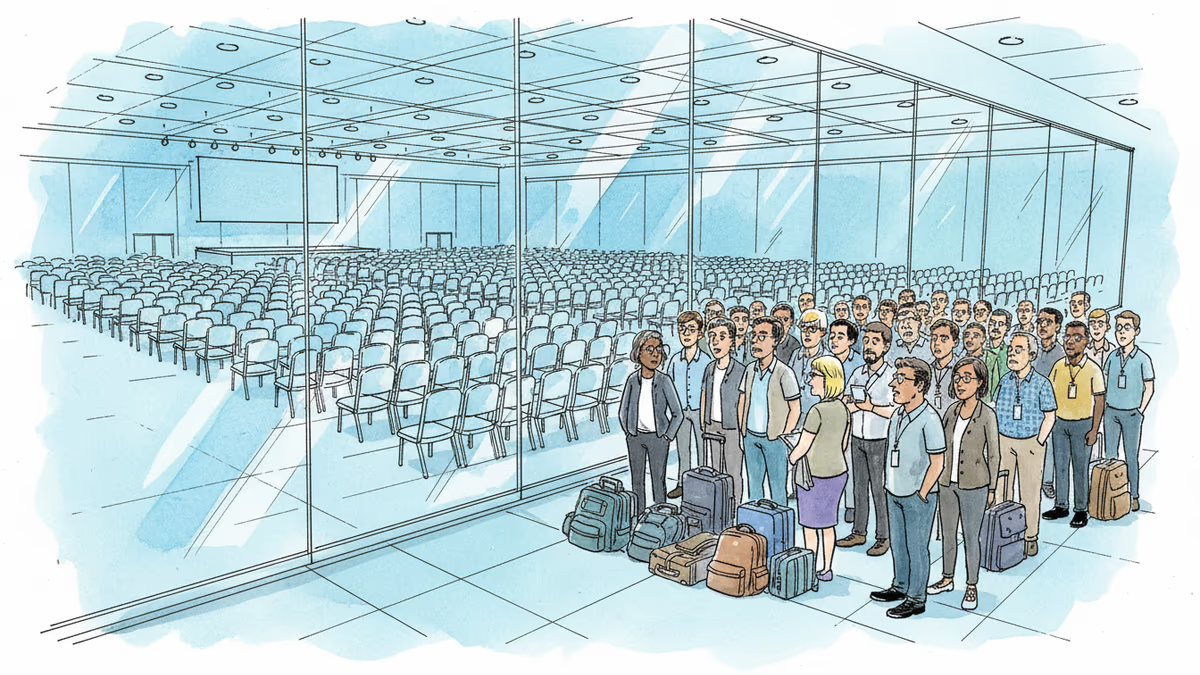
For 38 years, the Game Developers Conference has been the place where the gaming world converges. This year, the world decided not to show up.
Every March, San Francisco's Moscone Center fills with tens of thousands of developers, producers, and publishers from across the globe. Deals get signed. Studios get built. The next generation of games gets its first public breath. But in 2026, a growing number of international attendees are making the same quiet calculation: the professional upside doesn't outweigh the personal risk of traveling to the United States.
"I Don't Know Anyone Who's Going"
Emilio Coppola, Executive Director of the Godot Foundation, put it plainly from his base in Spain: "I honestly don't know anyone who is not from the US who is planning on going to the next GDC. We never felt super safe, but now we are not willing to risk it."
His sentiment is far from isolated. Dozens of international developers, interviewed by Ars Technica over recent months, described the same calculus. The concern isn't a single policy or a single incident — it's the accumulation of an atmosphere. Developers from minority backgrounds, those with transgender identities, and those who've been publicly outspoken on political issues say they fear being targeted at the US border in ways that are unpredictable and difficult to contest.
Since 2025, reports have multiplied of international travelers facing social media scrutiny, device searches, and in some cases denial of entry — not for any legal violation, but under the broad discretion of border enforcement. When the rules feel arbitrary, even a valid visa stops feeling like a guarantee.
What an Empty Chair Actually Costs

This might read as a conference attendance story. It's not.
GDC is infrastructure for the global games industry. It's where an indie developer from Poland finds a publisher, where a studio in South Korea hires a technical director, where a Brazilian composer lands their first AAA credit. Strip out the international layer and you don't just have a smaller event — you have a fundamentally different one.
The numbers frame the stakes clearly. The US accounts for roughly 22% of the global games market. The people who understand the other 78% are the ones deciding not to board the plane. For American studios chasing international expansion, that's not an abstract loss.
There's also a substitution effect already underway. Gamescom in Cologne, MIGS in Montreal, and various Asia-Pacific events are quietly marketing themselves as the open alternative. Industry networks, once shifted, tend to stay shifted. A developer who builds their key relationships at a European conference in 2026 may not need San Francisco in 2027.
Who Sees This Differently
Not everyone reads the situation the same way.
For large American publishers and platform holders, GDC remains a high-value domestic event — a place to announce, recruit, and consolidate relationships with US-based studios. The absence of international indie developers doesn't immediately disrupt their core agenda. From their vantage point, the conference goes on.
For event organizers at Informa, the calculus is more uncomfortable. A conference's prestige is inseparable from its diversity of attendees. A GDC that skews heavily American is a different product than the one that built its reputation. The question of whether to address this publicly — and how — puts organizers in an awkward position between their business interests and the political climate their attendees are responding to.
And for governments watching from the outside, this is a data point in a longer argument about whether the United States remains a reliable host for global knowledge exchange. Science conferences, academic symposia, and tech summits are all watching the same dynamic play out.
Authors
Related Articles
Generative AI tools dominated GDC 2026 — but most developers aren't shipping them in real games. What's holding the industry back, and what does that gap reveal?
GDC survey reveals 52% of developers view generative AI negatively, up from just 18% in 2024. What's driving this dramatic shift in perception among game creators?

Nintendo is reportedly offering cheaper, smaller Switch 2 cartridges. This isn't just cost-saving; it's a strategic move to redefine physical media ownership.
Samsung Electronics' union branch revealed that 84% of survey respondents oppose the government's roughly $290 billion (₩400 trillion) semiconductor megaproject in Gwangju. Government, management, the union and shareholders are all reading the same national project in sharply different ways.
Generative AI tools dominated GDC 2026 — but most developers aren't shipping them in real games. What's holding the industry back, and what does that gap reveal?
GDC survey reveals 52% of developers view generative AI negatively, up from just 18% in 2024. What's driving this dramatic shift in perception among game creators?
Nintendo is reportedly offering cheaper, smaller Switch 2 cartridges. This isn't just cost-saving; it's a strategic move to redefine physical media ownership.
Samsung Electronics' union branch revealed that 84% of survey respondents oppose the government's roughly $290 billion (₩400 trillion) semiconductor megaproject in Gwangju. Government, management, the union and shareholders are all reading the same national project in sharply different ways.
Thoughts
Share your thoughts on this article
Sign in to join the conversation