
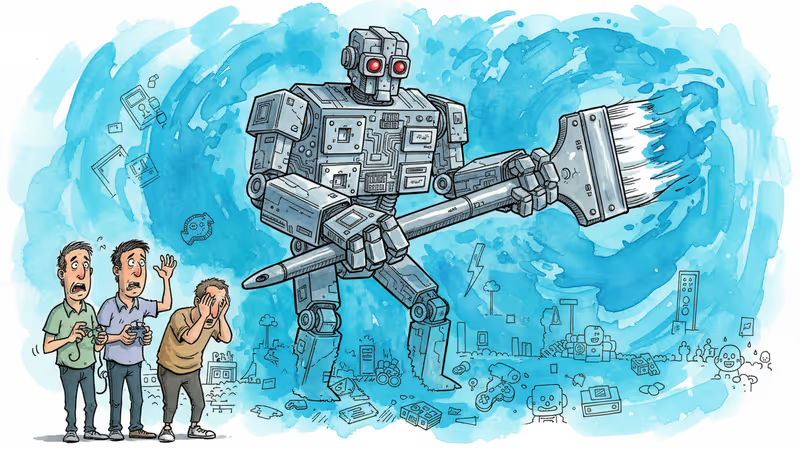
Half of Game Developers Now Say AI Is Harming the Industry
GDC survey reveals 52% of developers view generative AI negatively, up from just 18% in 2024. What's driving this dramatic shift in perception among game creators?
52% of game developers now believe generative AI is having a "negative" impact on their industry. That's a staggering jump from just 18% two years ago, according to the latest Game Developers Conference survey. Only 7% see the technology as positive.
This isn't just a statistical blip—it's a fundamental shift in how the people who actually make games view one of tech's most hyped innovations. The trajectory tells the story: 18% negative in 2024, 30% in 2025, and now more than half in 2026.
What's Happening on the Ground
Generative AI has infiltrated nearly every corner of game development. From concept art and character design to code generation and voice synthesis, the technology promises faster, cheaper content creation. Yet those closest to the process are increasingly skeptical.
The core tension isn't about efficiency—it's about authenticity. Many developers report that AI-generated assets lack the intentionality and craftsmanship that define quality games. "It feels like we're trading soul for speed," one survey respondent noted.
There's also a practical problem: AI output often requires significant human refinement. What appears to save time upfront frequently creates more work downstream, as developers spend hours fixing inconsistencies, adjusting styles, and ensuring coherence across AI-generated elements.
The Creative Identity Crisis
For artists and designers, the rise of AI represents more than a workflow change—it's an existential challenge. Skills honed over decades can now be replicated in seconds by algorithms trained on millions of images. The question isn't whether AI can create art, but whether that art carries the same meaning.

This mirrors broader cultural anxieties about automation, but with a twist. Unlike factory workers or data entry clerks, game developers chose their profession specifically for its creative demands. When that creativity becomes commoditized, the very reason for doing the work disappears.
The survey results suggest developers are pushing back against the narrative that AI is an inevitable upgrade. Instead, they're asserting that some aspects of creation can't—and shouldn't—be automated.
Industry Pressure vs. Artistic Integrity
The growing negativity comes despite—or perhaps because of—increasing pressure from publishers and investors to adopt AI tools. Cost reduction and faster turnaround times are compelling business arguments, especially in an industry facing layoffs and studio closures.
But developers see a different calculation. They worry that AI-generated content will homogenize games, making everything feel similar and soulless. The fear isn't just about job security—it's about the medium's artistic future.
Some studios are finding middle ground, using AI for ideation and rough drafts while keeping human creativity at the center of final decisions. But the survey suggests these compromises aren't satisfying most developers.
The Broader Implications
This developer backlash could influence how AI develops in gaming and beyond. Unlike consumers who might not notice AI-generated content, developers are the gatekeepers who decide what tools get used and how.
Their resistance might slow AI adoption in gaming, creating space for more thoughtful integration. Or it might accelerate the technology's development as companies rush to address developers' specific concerns about quality and workflow disruption.
The gaming industry has always been an early adopter of new technology, from 3D graphics to virtual reality. If developers are rejecting AI at this scale, it raises questions about the technology's readiness for creative industries more broadly.
Authors
Related Articles
From a niche experiment in 2018 to a mainstream disruption in 2026, AI-generated music is forcing the industry to rethink creativity, copyright, and compensation.
OpenAI is closing its Sora video generation app less than two years after its splashy debut. The move raises hard questions about AI product longevity, creator trust, and where the video AI race is really headed.
OpenAI is rolling out adult text features for ChatGPT, calling it 'smut' rather than 'pornography.' That single word choice reveals a calculated strategy at the intersection of markets, regulation, and ethics.

International developers are staying away from the 2026 Game Developers Conference, citing safety concerns in the US. The ripple effects reach far beyond one conference.
From a niche experiment in 2018 to a mainstream disruption in 2026, AI-generated music is forcing the industry to rethink creativity, copyright, and compensation.
OpenAI is closing its Sora video generation app less than two years after its splashy debut. The move raises hard questions about AI product longevity, creator trust, and where the video AI race is really headed.
OpenAI is rolling out adult text features for ChatGPT, calling it 'smut' rather than 'pornography.' That single word choice reveals a calculated strategy at the intersection of markets, regulation, and ethics.
International developers are staying away from the 2026 Game Developers Conference, citing safety concerns in the US. The ripple effects reach far beyond one conference.
Thoughts
Share your thoughts on this article
Sign in to join the conversation