
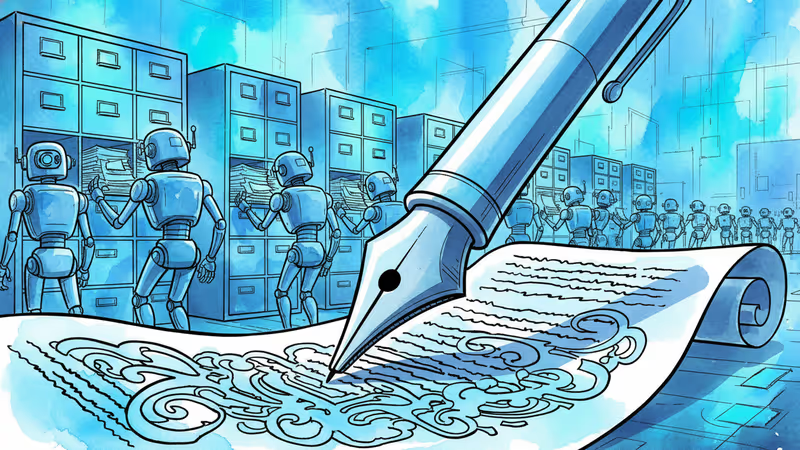
DocuSign's 7,000 Employees and the AI Contract Revolution
DocuSign CEO Allan Thygesen reveals how 7,000 employees are transforming electronic signatures into AI-powered contract intelligence, and why the biggest opportunity lies beyond just getting documents signed.
What exactly do 7,000 people at DocuSign do all day? For most of us, DocuSign is just that place where you click to sign things online. But CEO Allan Thygesen has a different story to tell—one where electronic signatures are just the beginning of a much bigger transformation.
Thygesen, who joined from Google three years ago, is betting that DocuSign's future lies not in signatures, but in what he calls "intelligent agreement management." It's a vision that could reshape how businesses handle the $10 trillion worth of agreements that flow through the global economy each year.
Beyond the Simple Click
The signature moment—that familiar DocuSign experience we all know—represents just 20-30 percent of what most large companies have automated in their agreement processes. Everything else, from drafting to negotiation to storage, remains stuck in what Thygesen calls "the email and manual labor era."
"Other than digitizing the asset itself," Thygesen explains, "absolutely nothing has changed in agreements over the last 50 years." Documents still disappear into what he describes as "deep, dark places"—SharePoint drives, email inboxes, or digital filing cabinets that are somehow harder to search than the physical ones they replaced.
This is where DocuSign's IAM (Intelligent Agreement Management) platform comes in. Launched last year, it uses AI to extract intelligence from the millions of contracts sitting in corporate archives. The system can tell you which agreements are coming up for renewal, how your terms compare to industry standards, or which contracts contain clauses you're not taking advantage of.
The Anatomy of 7,000 Jobs
So what are all those people doing? The largest chunk—about 1,000 account executives—still focuses on sales and marketing. That might seem excessive for a product that "just works," but DocuSign serves 1.8 million companies, from small businesses to over 95 percent of Fortune 500 companies.
The interesting part is how distributed this customer base is. No single client represents a meaningful share of DocuSign's $3 billion in annual revenue. It's a business model built on ubiquity rather than dependence on a few large contracts.
Another 1,000-plus employees work in product and engineering—a number that's grown significantly under Thygesen's leadership. He identified a troubling pattern: during COVID's boom years, when DocuSign's growth rate jumped from 25 percent to 60 percent, the company had essentially gone to sleep. "If you're a sales rep and your revenue growth rate goes from 25 percent to 60 percent without much effort, you're in the auto-taking business," he notes.
The AI Liability Question

Perhaps the most controversial aspect of DocuSign's AI push is its contract summarization feature. The system now offers to explain what you're signing before you sign it—a capability that raises immediate red flags for anyone with legal training.
The liability question is obvious: if DocuSign's AI misinterprets a contract clause and someone makes a decision based on that interpretation, who's responsible? Thygesen's answer reveals both the opportunity and the challenge of AI in legal contexts.
"We know people are already copying agreements into ChatGPT," he says. "So the question becomes: should we provide a better, more accurate service, or should we leave people to do this in less secure ways?"
DocuSign's competitive advantage here lies in its data. The company has 150 million private contracts in its AI training set—orders of magnitude more than any competitor. But even this massive dataset revealed surprising limitations. When DocuSign first tested its AI on real corporate contracts after training on public documents, accuracy dropped by 15 percentage points.
The gap between public contracts (what most AI models train on) and private corporate agreements (what businesses actually use) turned out to be enormous.
The Commoditization Paradox
Thygesen offers an interesting perspective on the AI model landscape. While he describes frontier models as increasingly interchangeable for DocuSign's purposes, he's also writing "large checks" to providers like Google and OpenAI. The cost per document processed has dropped by what he estimates as "a factor of a hundred" since 2023.
This creates a fascinating dynamic: AI capabilities that were once prohibitively expensive are now bundled into standard subscriptions. For DocuSign, this means they can offer AI analysis of thousands of contracts as part of a standard enterprise package. For AI model providers, it suggests a race toward commoditization in enterprise applications.
"I was very worried we'd need a complicated pricing structure tied to the number of agreements," Thygesen recalls. "Now, even for fairly large companies, it's just included in your subscription."
The Trust Infrastructure
What makes DocuSign's expansion possible isn't just technical capability—it's trust infrastructure built over two decades. When the company started, "no one thought electronic signatures were a good idea. Not regulators, not companies, not consumers."
That trust becomes crucial when you're asking businesses to let AI interpret their most important legal documents. DocuSign's signature verification isn't really about the squiggly line you draw on screen—it's about identity verification and consent tracking that can hold up in court.
"A signature is where identity and consent commingle," Thygesen explains. The real product is a database that can definitively say: "This verified person agreed to this specific document at this specific time."
Authors
Related Articles
2026 website builder landscape analysis. From Squarespace to Hostinger, which platform serves small business owners and entrepreneurs best?
Five stories from late September, traced to where the paper trail stops: Korea's export record, Nvidia's Hugging Face 8-K, a US-China AI channel, the UN on AI, and rising births.
Huawei's CANN is open source under a license barring software for non-Ascend chips. Inside China's second CUDA, and the two links still outside it: pre-training compute and 5nm capacity.
Samsung Electronics' union branch revealed that 84% of survey respondents oppose the government's roughly $290 billion (₩400 trillion) semiconductor megaproject in Gwangju. Government, management, the union and shareholders are all reading the same national project in sharply different ways.
2026 website builder landscape analysis. From Squarespace to Hostinger, which platform serves small business owners and entrepreneurs best?
Five stories from late September, traced to where the paper trail stops: Korea's export record, Nvidia's Hugging Face 8-K, a US-China AI channel, the UN on AI, and rising births.
Huawei's CANN is open source under a license barring software for non-Ascend chips. Inside China's second CUDA, and the two links still outside it: pre-training compute and 5nm capacity.
Samsung Electronics' union branch revealed that 84% of survey respondents oppose the government's roughly $290 billion (₩400 trillion) semiconductor megaproject in Gwangju. Government, management, the union and shareholders are all reading the same national project in sharply different ways.
Thoughts
Share your thoughts on this article
Sign in to join the conversation