
Disney's $2.5B Digital Bet Is Wobbling—Both Sides at Once
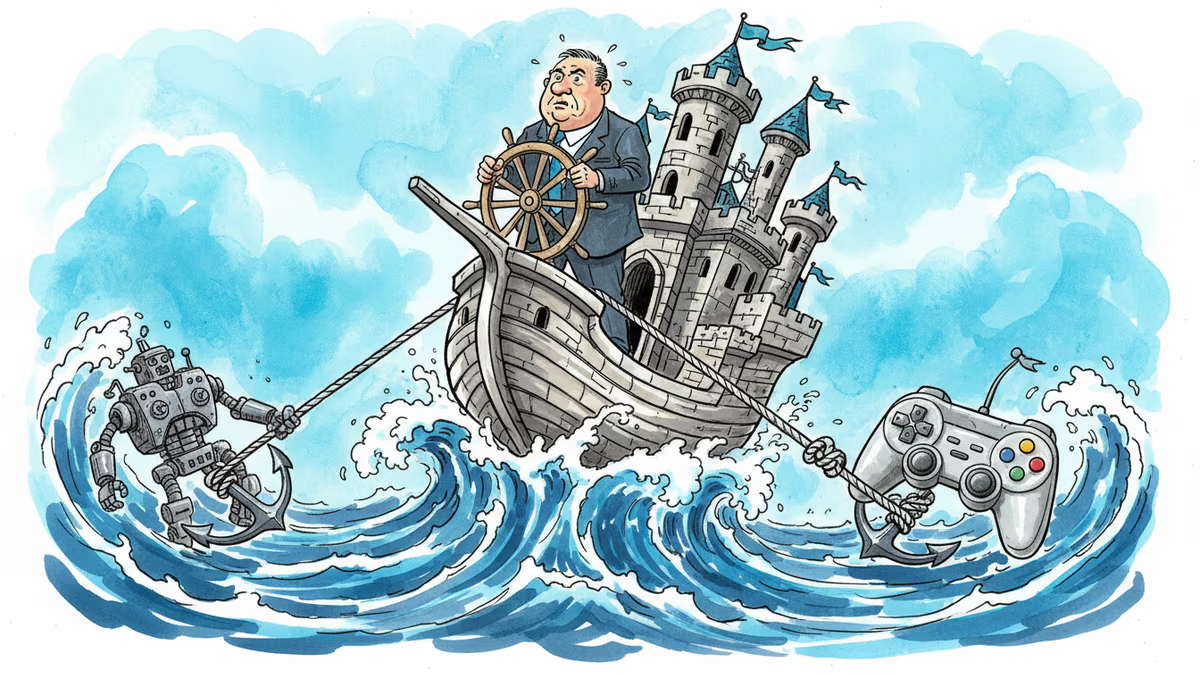
Days into his tenure, Disney CEO Josh D'Amaro faces simultaneous crises: OpenAI's Sora shutdown threatens a $1B AI deal, while Epic's layoffs cast doubt on a $1.5B metaverse plan.
Most new CEOs get at least a honeymoon week. Josh D'Amaro didn't.
Not even seven days into leading Disney, D'Amaro is staring down two simultaneous cracks in the company's digital future—a $1 billion AI deal that just lost its centerpiece product, and a $1.5 billion metaverse partnership that has gone conspicuously quiet. Together, that's $2.5 billion in strategic bets that are suddenly looking shaky.
What Actually Happened
Last year, Disney made headlines by announcing a deep collaboration with OpenAI to integrate Sora—OpenAI's video generation model—into Disney+. The pitch was compelling: generative AI woven into a streaming platform with one of the world's most recognizable content libraries. The price tag was $1 billion.
Then OpenAI shut down the Sora image-generation program. Just months after the announcement. The reasons remain opaque—technical constraints, internal strategy shifts, or regulatory pressure are all possibilities. Disney hasn't abandoned the idea of AI integration into its streaming service, but its primary partner's primary product is gone, and there's no public Plan B.
The second crisis is quieter but potentially more telling. In 2023, Disney committed $1.5 billion to Epic Games—the maker of Fortnite—to build a shared metaverse-style gaming experience. The vision was ambitious: Disney characters and worlds living inside one of gaming's most popular platforms. Then Epic laid off 1,000 employees. And updates on the project have been, to put it charitably, sparse.
Why This Matters Beyond Disney

These aren't just two bad news stories happening to land at the same time. They reveal something structural about how legacy media companies are approaching tech transformation.
Disney chose to outsource its digital future to external partners rather than build in-house. That's a defensible strategy—it's faster, cheaper upfront, and lets you tap expertise you don't have. But it also means your roadmap is only as stable as your partners' products. When OpenAI pivots and Epic restructures, Disney absorbs the turbulence without having built the underlying capability itself.
This is a pattern worth watching across the entertainment industry. Netflix built its recommendation engine in-house. Spotify acquired podcast studios rather than licensing them. The companies that have navigated tech transitions most durably tend to be the ones that internalized the capability rather than renting it.
Three Ways to Read This
For investors, the concern isn't just that two deals are wobbling—it's that both were central to Disney's growth narrative beyond traditional content. Streaming subscriber growth has plateaued industrywide. The AI and gaming pivots were supposed to open new revenue lines. If both stall, the question becomes: what's the actual growth story?
For the creative industry, there's an uncomfortable irony here. Animators, VFX artists, and writers who feared that Sora integration would automate their roles now have more time—but not because Disney chose to protect them. The delay is a byproduct of a business relationship falling apart. That's a fragile kind of relief.
***For OpenAI and Epic***—and by extension the broader AI and gaming sectors—these stumbles raise questions about how ready enterprise partnerships with legacy media companies actually are. The technology may be impressive in demos; integrating it into a decades-old content machine is a different problem entirely.
Authors
Related Articles
OpenAI has reorganized for the second time in a month, merging ChatGPT and Codex into a single agentic platform under president Greg Brockman's unified product leadership.
Josh D'Amaro took over Disney with a bold Disney Plus vision. Days later, he's in a First Amendment fight with the Trump administration over The View. What does this mean for media freedom?
After two weeks of witnesses calling him a liar, OpenAI CEO Sam Altman testified in his own defense, claiming Elon Musk tried to kill the company twice.
Sam Nelson, 19, died after following ChatGPT's advice to mix Kratom and Xanax. His parents are suing OpenAI for wrongful death, raising urgent questions about AI trust, liability, and design.
OpenAI has reorganized for the second time in a month, merging ChatGPT and Codex into a single agentic platform under president Greg Brockman's unified product leadership.
Josh D'Amaro took over Disney with a bold Disney Plus vision. Days later, he's in a First Amendment fight with the Trump administration over The View. What does this mean for media freedom?
After two weeks of witnesses calling him a liar, OpenAI CEO Sam Altman testified in his own defense, claiming Elon Musk tried to kill the company twice.
Sam Nelson, 19, died after following ChatGPT's advice to mix Kratom and Xanax. His parents are suing OpenAI for wrongful death, raising urgent questions about AI trust, liability, and design.
Thoughts
Share your thoughts on this article
Sign in to join the conversation