
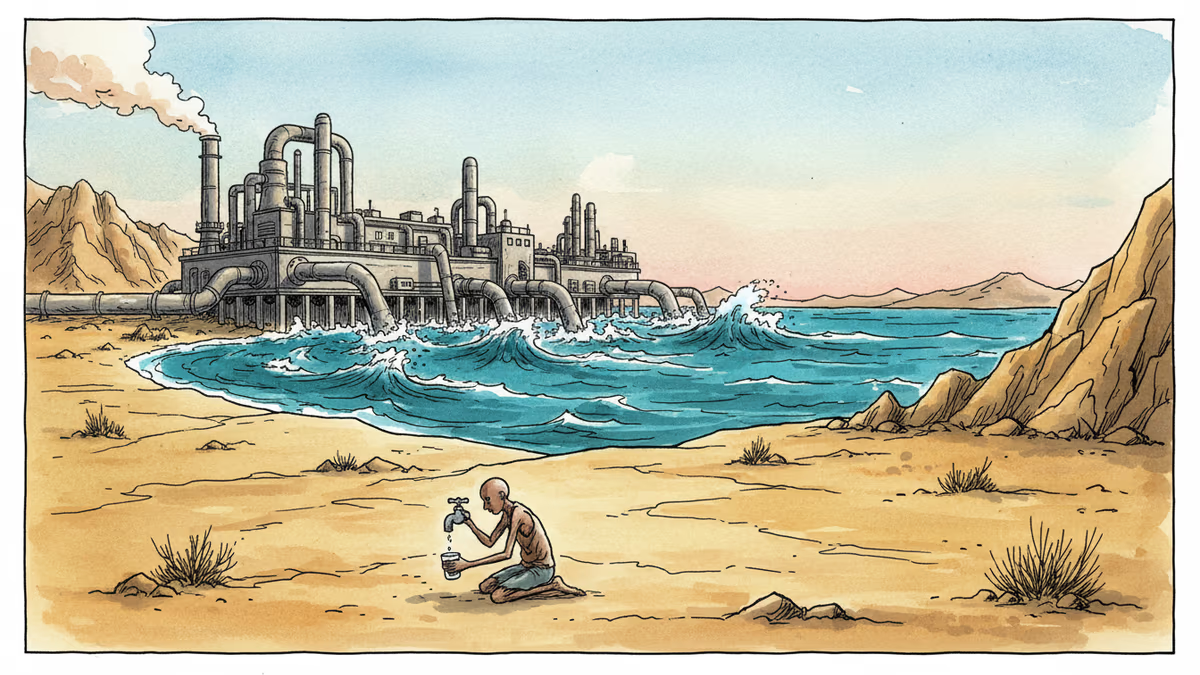
The Country That Drinks the Ocean
Qatar gets 99% of its drinking water from the sea. As the Middle East prepares to spend $25 billion expanding desalination capacity, this once-niche technology is becoming critical global infrastructure.
Turn on a tap in Qatar, and the water that flows out almost certainly started as seawater. Not some of it—99% of the country's drinking water is pulled from the Persian Gulf, stripped of salt, and piped into homes. For a nation of 3 million people with no permanent rivers and almost no groundwater, this isn't a backup plan. It's the only plan.
Desalination—the process of removing salt and impurities from seawater to produce fresh water—has long been treated as an expensive, energy-hungry solution reserved for the world's most water-desperate corners. But as climate change rewrites the map of water scarcity, that framing is becoming obsolete. What was once a regional workaround is quietly becoming one of the most critical infrastructure technologies on the planet.
The Numbers Behind a Thirsty World
Globally, desalination accounts for just 1% of all fresh water withdrawals. That figure sounds marginal—until you look at where the other 99% simply doesn't exist.
According to a 2026 study published in npj Clean Water, there are 17,910 operational desalination facilities worldwide. Of those, 4,897—roughly 27%—are located in the Middle East. A region that holds just 6% of the world's population hosts more than a quarter of its desalination infrastructure. The Gulf Cooperation Council nations (Bahrain, Qatar, Kuwait, the UAE, Saudi Arabia, and Oman) have built entire urban civilizations on this technology. There are no permanent rivers on the Arabian Peninsula. Without desalination, cities like Riyadh and Doha, as they exist today, would not be possible.
The scale of individual facilities is striking. Saudi Arabia's Ras Al-Khair water and power plant produces over 1 million cubic meters of fresh water every single day—enough to meet the needs of millions of people in Riyadh. Attached to it is a power plant with a capacity of 2.4 gigawatts, because producing that much water demands an enormous amount of energy. And according to IEA data, the average desalination plant is now roughly 10 times larger than it was 15 years ago, as operators chase the efficiency gains that only come with scale.
$25 Billion and a 40% Expansion

This infrastructure buildout is accelerating, not plateauing. The Middle East's desalination capacity is projected to grow by more than 40% between 2024 and 2028, with capital expenditure on new facilities expected to exceed $25 billion over that period, according to the same npj Clean Water study. Major new plants are slated to come online in Saudi Arabia, Iraq, and Egypt.
The electricity implications are significant. As the industry shifts away from fossil-fuel-driven thermal processes toward electrically powered reverse osmosis systems, the IEA projects that desalination could add 190 terawatt-hours of electricity demand globally by 2035. To put that in context: that's the annual electricity consumption of approximately 60 million households. The technology is getting cleaner and more efficient, but it's also getting bigger—and hungrier.
This creates an uncomfortable tension. Pairing desalination with renewable energy—solar power, in particular—is the obvious path to sustainability, and it's one that sun-drenched, water-scarce regions are well-positioned to pursue. But the capital investment required to make that transition at scale is enormous, and not every water-stressed nation has the sovereign wealth funds of the Gulf states to draw on.
More Than a Middle East Story
For investors and policymakers outside the region, the instinct might be to treat this as a specialized market with limited global relevance. That instinct is increasingly hard to justify.
Southern Spain, northern Africa, parts of India, and the American Southwest are all facing deepening water stress. The conditions that made desalination indispensable in Qatar are spreading. The technology—particularly membrane-based reverse osmosis—is becoming more cost-competitive as manufacturing scales up and energy efficiency improves. What costs roughly $0.50 to $1.00 per cubic meter to produce today was several times more expensive two decades ago.
For water technology companies, infrastructure investors, and engineering firms, the pipeline of projects is real and growing. For policymakers in water-stressed regions, the question is no longer whether desalination is viable—it's whether it can be deployed fast enough, and powered cleanly enough, to matter.
There's also a security dimension that rarely makes headlines. As the original reporting notes, desalination infrastructure in conflict zones is acutely vulnerable. When a plant goes offline, it's not a service disruption—it's an existential threat to the population it serves. Water infrastructure has become a geopolitical asset, and in some cases, a target.
Authors
Related Articles

Fake shelter apps, death threats by text, and silent infrastructure attacks. The Iran-Israel-US cyber conflict is reshaping what war looks like in 2026.
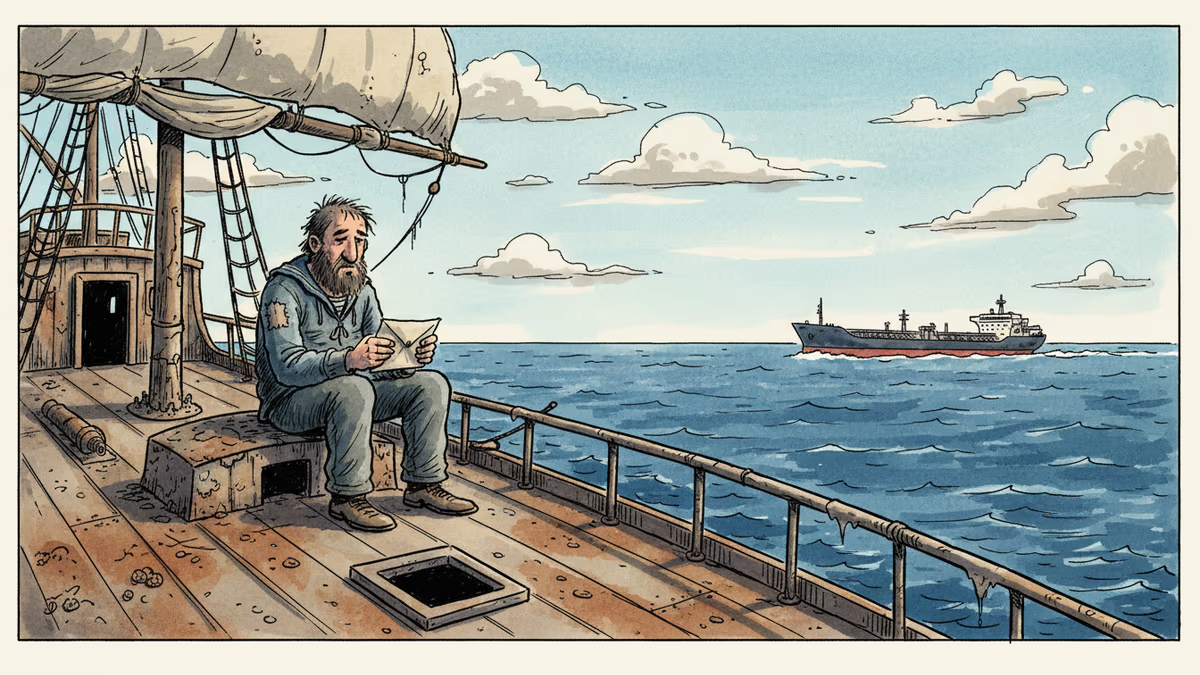
As the Strait of Hormuz closure traps 1,900 vessels, abandoned seafarers reveal a structural flaw at the heart of global trade—no single authority is responsible when things go wrong.

Iran has fired 1,700+ drones and 360 missiles at the UAE in a month. Dubai's expat tech community isn't leaving — and some are doubling down. What this tells us about geopolitical risk pricing in 2026.
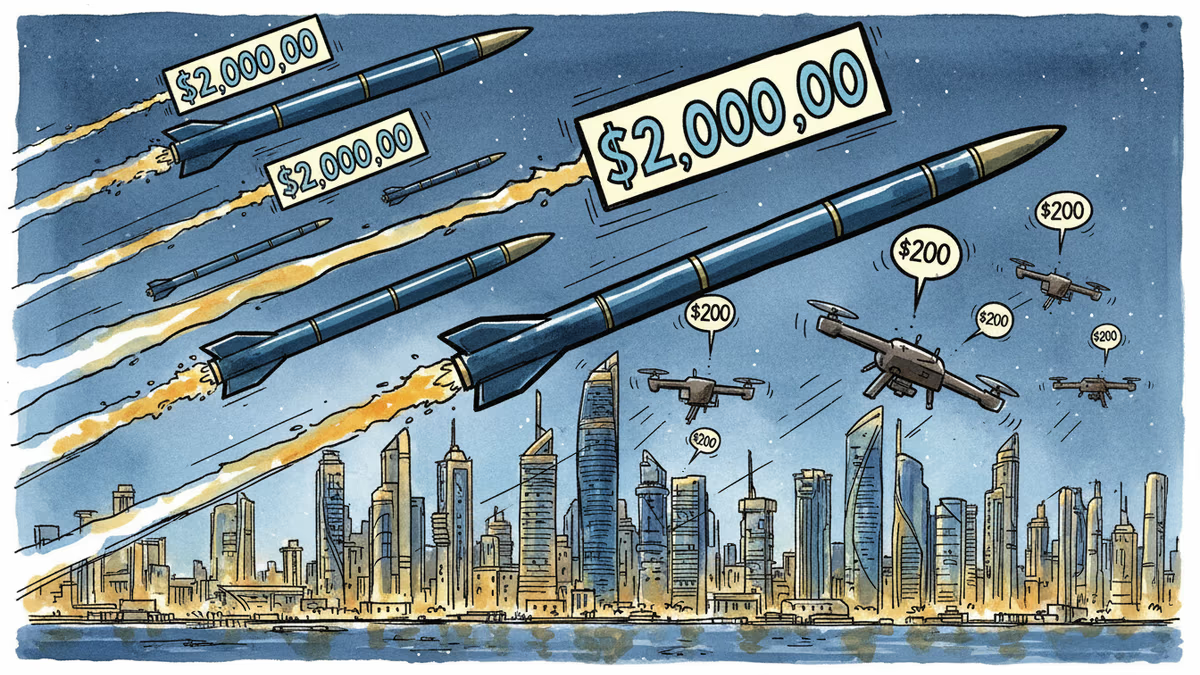
Gulf states' missile defense systems faced their biggest test as Iran launched hundreds of projectiles. High interception rates couldn't prevent all casualties—revealing the economics of modern warfare.
Fake shelter apps, death threats by text, and silent infrastructure attacks. The Iran-Israel-US cyber conflict is reshaping what war looks like in 2026.
As the Strait of Hormuz closure traps 1,900 vessels, abandoned seafarers reveal a structural flaw at the heart of global trade—no single authority is responsible when things go wrong.
Iran has fired 1,700+ drones and 360 missiles at the UAE in a month. Dubai's expat tech community isn't leaving — and some are doubling down. What this tells us about geopolitical risk pricing in 2026.
Gulf states' missile defense systems faced their biggest test as Iran launched hundreds of projectiles. High interception rates couldn't prevent all casualties—revealing the economics of modern warfare.
Thoughts
Share your thoughts on this article
Sign in to join the conversation