
Space Data Centers Promise Relief, But Risk Turning Nations Into Digital Tenants
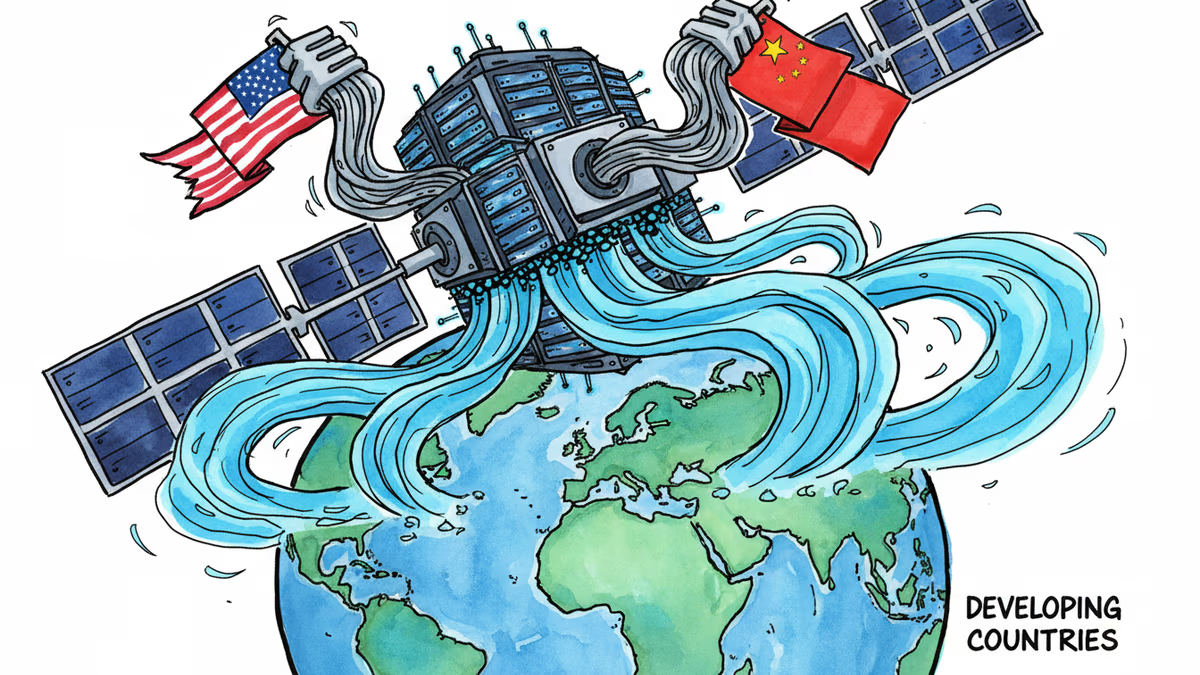
As US and Chinese companies race to build orbital data centers, experts warn developing countries could become data suppliers without meaningful control over their digital infrastructure.
Seven Companies Just Bought Tickets to Space in One Month
In the past month alone, six American companies and one Chinese firm have announced plans to build data centers in orbit. Elon Musk called it a "no-brainer" at Davos, predicting space will be "by far the cheapest place to put AI." China has set a five-year target for space-based supercomputers, opening a new front in the US-China tech war.
The pitch sounds compelling: 24/7 solar power, unlimited cooling, and relief for Earth's overstressed power grids. South Africa battles load-shedding blackouts. India's data centers are among the fastest-growing water consumers and polluters. Brazil's northeast faces rising temperatures and energy constraints.
But experts see a darker possibility: orbital data centers could turn developing nations into "data suppliers" while control remains firmly in American and Chinese hands.
The Promise: Leapfrogging Infrastructure Constraints
"For a country with an overstressed power grid, 'outsourcing' heavy AI training to orbit could be a massive win," says Olubayo Adekanmbi, CEO of Washington-based EqualyzAI. "The danger is that the Global South becomes a 'consumer-only' tier."
His warning is blunt: "If you don't have launch equity, you're just renting intelligence."
The appeal is undeniable. Orbital data centers could bypass South Africa's persistent blackouts, India's water scarcity, and Brazil's cooling challenges. They'd sidestep data localization laws and export controls that complicate cross-border computing.
But that's exactly where sovereignty concerns begin.

The Risk: Data Without Borders, Control Without Representation
"Data localization policies have been a lever for domestic bargaining power on Earth, but orbital compute could render these mechanisms moot," warns Payal Arora, professor of inclusive AI culture at Utrecht University.
"If citizen-generated data is processed in orbit, sovereignty becomes ambiguous: Is it with the country of origin, the state that launched the satellite, the operator managing the orbiting data center, or the cloud provider controlling access?"
The physical infrastructure may orbit globally, but its governance decidedly does not. Colin Thakur, who teaches digitization at the University of South Africa, puts it starkly: "Unless new multilateral frameworks are built, orbital compute risks becoming an extension of existing terrestrial monopolies with power projected upward, not redistributed."
The Players: A Familiar Duopoly
SpaceX reportedly plans solar-powered AI satellite data centers funded by its upcoming IPO. Jeff Bezos' Blue Origin has joined the race. At least five US companies have publicly expressed interest.
China isn't sitting idle. The country has launched a national plan for space-based supercomputers, with at least two private Chinese companies investing in the expedition.
For many emerging economies, participation seems impossible. "Sovereignty tends to follow infrastructure ownership closely," notes Jane Mungai, Africa fellow at Carnegie Endowment for International Peace. "If countries cannot participate in owning this infrastructure, they must at least participate in governing it. Otherwise, they risk being relegated to data producers — without meaningful agency over how their citizens' data is stored, processed, or controlled."
The Stakes: Temporary Relief or Structural Dependence?
Adekanmbi draws a parallel to mobile phones bypassing landlines in Africa: "We believe orbital infrastructure could be the 'leapfrog' moment, but only if we treat orbital compute as a Global Public Good, like GPS."
The alternative is troubling. Countries already struggling with digital sovereignty could find critical infrastructure moved beyond regulatory reach entirely. The "compute divide" could shift from temporary to structural.
Thakur's assessment is sobering: "Orbital infrastructure is an opportunity only if developmental states actively participate as investors, co-owners, and rule-shapers."
Authors
Related Articles
SpaceX wants to launch a million orbital data centers to power AI without draining Earth. The vision is compelling. The physics, economics, and debris math are not.

OpenClaw, an open-source AI agent, has sparked a cottage industry in China—from installation services to pre-loaded hardware. What does this grassroots AI adoption wave reveal about where the technology is really headed?

A GSMA-led coalition is pushing ultra-low-cost 4G phones into six African markets. The target price is bold. The obstacles — component costs, taxes, thin margins — are real.

xAI's 45-minute all-hands video reveals $1B X revenue, 50M daily AI videos, massive layoffs, and Musk's audacious space-based AI vision including lunar factories
SpaceX wants to launch a million orbital data centers to power AI without draining Earth. The vision is compelling. The physics, economics, and debris math are not.
OpenClaw, an open-source AI agent, has sparked a cottage industry in China—from installation services to pre-loaded hardware. What does this grassroots AI adoption wave reveal about where the technology is really headed?
A GSMA-led coalition is pushing ultra-low-cost 4G phones into six African markets. The target price is bold. The obstacles — component costs, taxes, thin margins — are real.
xAI's 45-minute all-hands video reveals $1B X revenue, 50M daily AI videos, massive layoffs, and Musk's audacious space-based AI vision including lunar factories
Thoughts
Share your thoughts on this article
Sign in to join the conversation