
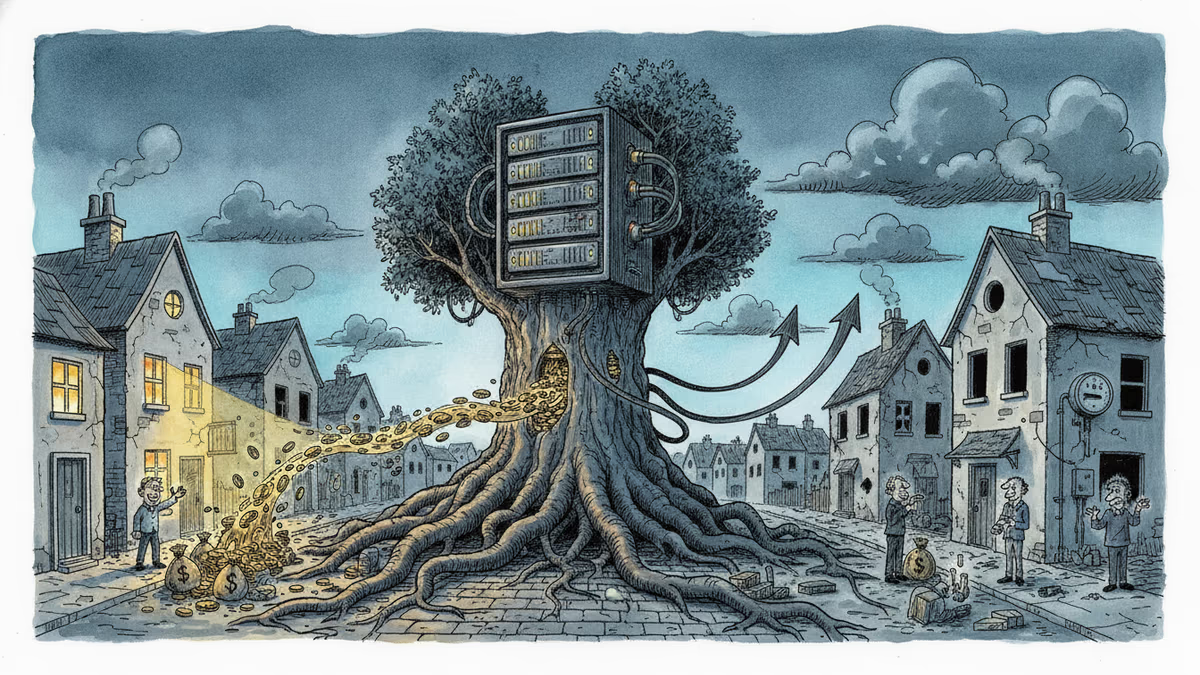
Data Centers Promised Jobs. The Reality Is More Complicated.
Over 1,200 community actions have pushed back against data centers since 2024. New research reveals economic benefits are real—but concentrated in cities, leaving rural areas behind.
The same communities that once rolled out tax breaks to lure data centers are now passing laws to keep them out.
Since early 2024, more than 1,200 public actions — zoning fights, moratorium proposals, organized campaigns — have been recorded by the Data Center Tracker, a U.S. database monitoring community responses to data center siting. The concerns cluster around three themes: grid capacity, water consumption, and a lack of transparency about where these facilities are being built and why.
Maine Draws the Battle Lines
No state has made this tension more visible than Maine. In spring 2026, the state legislature passed what would have been the nation's first statewide moratorium on new data center construction. Governor Janet Mills vetoed it — but not without concessions.
The specific reason for the veto was a single project: a $550 million conversion of the shuttered Androscoggin Mill in the town of Jay into a data center. Mills argued the moratorium would kill that deal. But she also signed separate legislation stripping state tax incentives from data centers and pledged to establish a council to study the industry statewide.
The episode captures the bind that local officials across the country find themselves in. Up to 10 other states are weighing similar restrictions. Yet lawmakers on all sides have been making these decisions with remarkably little hard evidence about whether data centers actually deliver on their economic promises.
What the Research Actually Shows
A team of scholars studying how technological change shapes business strategy set out to fill that gap. They matched records of when data centers began operating with county-level economic data, then compared outcomes before and after a county's first data center opened against similar counties that didn't get one.
The headline numbers look encouraging. In the first three years after a data center opened, local employment rose by an average of 0.9%, wages by 1.1%, and the number of business establishments by 1%. Over longer time horizons, those effects compounded to roughly 3.5%, 5%, and 4.7% respectively. Household income climbed 1.9%, and building permits surged 16.1%.
But averages can obscure as much as they reveal.

The economic gains are not evenly distributed. In metropolitan counties — where construction contractors, equipment suppliers, professional services, and skilled workers are already clustered — employment jumped by 4.1% and wages by 5.5%. In less populous counties, the spillover effects were negligible. The researchers' conclusion cuts against the standard pitch from data center developers: the host community's existing economic density matters more than the size of the facility itself.
Two additional patterns emerged. Facilities operated by major tech companies raised local wages more than smaller operators. And counties that attracted multiple data centers within five years of the first showed larger cumulative gains than those with a single, isolated facility — suggesting that clustering matters here too.
The Electricity Question
Opponents of data centers have a reliable rhetorical weapon: the power bill. These facilities consume electricity at industrial scale, and critics argue that ordinary households end up subsidizing that consumption through higher rates.
The researchers tested this in counties where a utility's service area was localized enough to isolate the effect. Their finding: retail electricity prices rose by approximately 5% after a data center became operational.
They're careful about the limits of that figure. Utility territories typically span multiple counties, rate-setting rules vary by state, and prices are influenced by weather, transmission infrastructure, and regulation. The researchers note their estimate is substantially lower than some widely circulated claims — but acknowledge the electricity effect was harder to pin down than the other outcomes they studied. A 5% increase isn't nothing, particularly for lower-income households with less flexibility to absorb it.
Why Opposition Keeps Growing
One pattern in the resistance data stands out: pushback against data centers is more common in places where data centers already operate. That could mean direct local experience is shaping opinion — residents who've seen the facilities up close are more likely to organize against the next one.
But it could also mean something else. Opposition to data centers may partly be a proxy for broader anxieties about artificial intelligence — its energy demands, its labor market implications, its concentration of power in a handful of large corporations. The researchers acknowledge they can't cleanly separate local grievance from diffuse cultural unease. That distinction matters for policymakers trying to respond: a community worried about its electric bill needs different solutions than one worried about the future of work.
The Details That Determine Who Benefits
The research points toward a practical conclusion that gets lost in the headline battles over moratoriums and tax breaks. Whether a data center benefits a community depends less on the investment figure in a company's press release and more on the fine print of the deal.
How are tax incentives structured? Who absorbs the cost of grid and water upgrades? How are electricity rate increases allocated across residential, commercial, and industrial users? Does new tax revenue flow back into public services for existing residents? These design choices, stacked together, determine whether the gains from a data center are broadly shared or captured by a narrow slice of the local economy.
The researchers are explicit that their work is a starting point, not a verdict. More research is needed on how these subsidiary decisions shape community outcomes — research that most local governments don't have the capacity to conduct before a developer is already at the table.
This content is AI-generated based on source articles. While we strive for accuracy, errors may occur. We recommend verifying with the original source.
Related Articles

Trump is reshaping Washington DC's built environment—tearing down the White House East Wing, planning a 250-foot arch, and dismantling the design review processes that have protected the city for over a century.

While Tesla grabs headlines with Cybercabs and humanoid robots, the company's actual future lies in massive Megapack batteries powering AI's energy hunger. Inside Musk's quiet pivot to energy dominance.

New Honolulu research reveals how high-end apartment construction creates a 'vacancy chain' that opens housing opportunities for low-income residents across the city.
Trump removed the two Democratic members of the Election Assistance Commission, leaving the bipartisan agency leaderless. A Supreme Court ruling made it legal. Here's why a non-crisis can still be a warning sign.
Trump is reshaping Washington DC's built environment—tearing down the White House East Wing, planning a 250-foot arch, and dismantling the design review processes that have protected the city for over a century.
While Tesla grabs headlines with Cybercabs and humanoid robots, the company's actual future lies in massive Megapack batteries powering AI's energy hunger. Inside Musk's quiet pivot to energy dominance.
New Honolulu research reveals how high-end apartment construction creates a 'vacancy chain' that opens housing opportunities for low-income residents across the city.
Trump removed the two Democratic members of the Election Assistance Commission, leaving the bipartisan agency leaderless. A Supreme Court ruling made it legal. Here's why a non-crisis can still be a warning sign.
Thoughts
Share your thoughts on this article
Sign in to join the conversation