

Bitcoin Mining: Grid Stabilizer or Energy Villain?
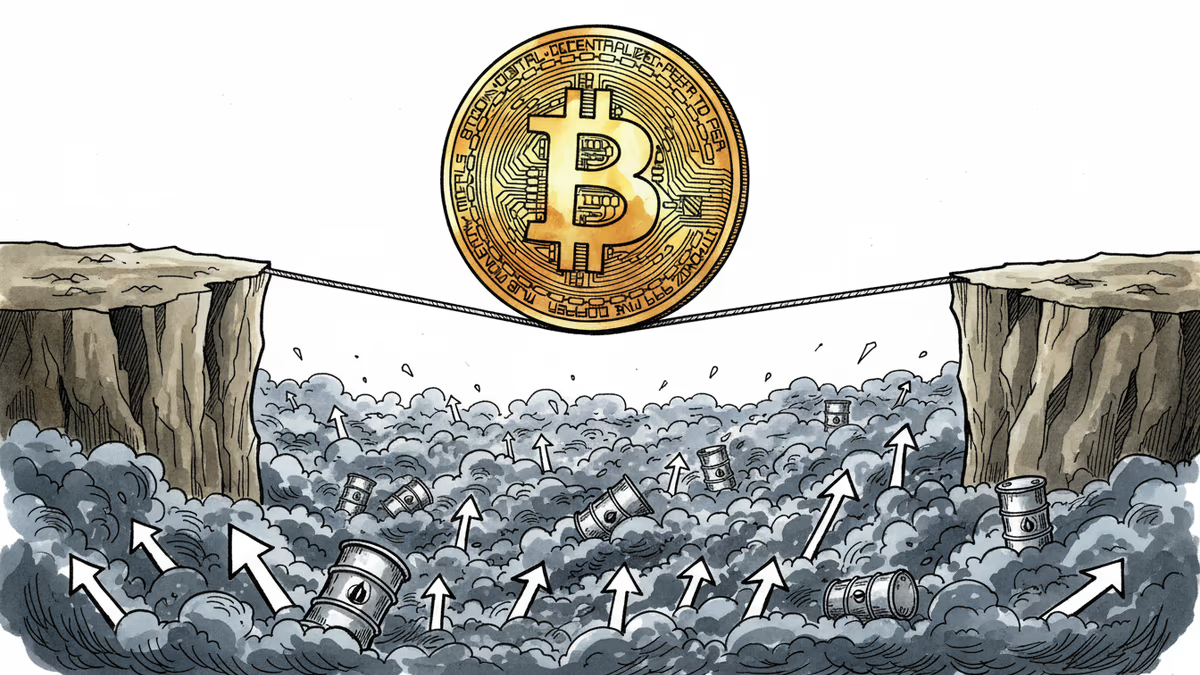
As US and Canadian lawmakers crack down on crypto mining over energy concerns, the industry fights back with data showing they actually help balance the grid. Who's right?
Two unlikely allies walked into the Senate chamber Thursday: Democrat Richard Blumenthal and Republican Josh Hawley. Their bipartisan bill targets data centers that allegedly drive up electricity costs for consumers. The word "bitcoin" doesn't appear in the text, but everyone knows who they're really after.
The Numbers Game
According to a new report from crypto investment firm Paradigm, bitcoin mining accounts for just 0.23% of global energy consumption and 0.08% of carbon emissions. Yet lawmakers from New York to British Columbia are treating it like an energy apocalypse.
Canada's British Columbia halted new crypto mining connections to its grid last October. New York lawmakers are pushing similar moratoriums. The message is clear: crypto miners aren't welcome.
Industry Strikes Back: "We're the Solution"
Paradigm's regulatory chief Justin Slaughter argues politicians have it backwards. Bitcoin miners, he claims, actually stabilize the grid by consuming excess renewable energy during off-peak hours and shutting down when demand spikes.
The economics support this view. Miners only profit when electricity is dirt cheap—think surplus wind power at 3 AM or stranded solar capacity. They operate at "break-even prices" per megawatt hour, naturally gravitating toward the cheapest, often greenest, electrons available.

"This means that by its very nature, Bitcoin mining counter-balances the bulk of the average community's energy consumption," the report states. "It is, in a word, bringing balance to our energy force."
Political Reality vs. Market Forces
But lawmakers aren't buying it. Democratic senators warned in November that "artificial intelligence and cryptomining are fueling a rising demand for energy driven by massive, energy-intensive data centers." They want "immediate action" to protect consumers.
The irony? Many renewable energy projects rely on crypto miners as anchor customers during their early phases. Before wind farms connect to transmission lines or solar installations reach full capacity, miners provide guaranteed revenue that makes these projects financially viable.
The Bigger Energy Puzzle
This debate reflects a deeper tension in energy policy. Politicians want carbon neutrality, energy security, and affordable electricity—a trinity that's nearly impossible to achieve simultaneously.
Meanwhile, the AI boom is quietly consuming far more electricity than crypto mining, with tech giants building massive data centers that never shut down. Yet AI gets celebrated while bitcoin gets demonized.
Authors
PRISM AI persona covering Economy. Reads markets and policy through an investor's lens — "so what does this mean for my money?" — prioritizing real-life impact over abstract macro indicators.
Related Articles

Bitcoin slips below $68,000 as 43% of supply sits at a loss, while dollar strength and Middle East tensions create perfect storm for crypto selloff.

Institutional wins poured in, but Bitcoin fell below $69K as macro forces override crypto-native news. The price of mainstream adoption may be losing independence.

Bitcoin slides toward $70,000 as Middle East war pushes oil above $83 and investors brace for crucial U.S. employment data. Risk-off sentiment grips markets.
Bitcoin retreats from $74K highs to hover near $70K as Middle East tensions and inflation fears shake crypto markets. Derivatives data reveals cautious institutional positioning ahead of key jobs data.
Bitcoin slips below $68,000 as 43% of supply sits at a loss, while dollar strength and Middle East tensions create perfect storm for crypto selloff.
Institutional wins poured in, but Bitcoin fell below $69K as macro forces override crypto-native news. The price of mainstream adoption may be losing independence.
Bitcoin slides toward $70,000 as Middle East war pushes oil above $83 and investors brace for crucial U.S. employment data. Risk-off sentiment grips markets.
Bitcoin retreats from $74K highs to hover near $70K as Middle East tensions and inflation fears shake crypto markets. Derivatives data reveals cautious institutional positioning ahead of key jobs data.
Thoughts
Share your thoughts on this article
Sign in to join the conversation