

Banks Refuse to Budge on Stablecoin Yields at White House Showdown
Crypto executives came ready to deal on stablecoin rewards, but banking representatives held firm on prohibition, stalling Senate crypto legislation
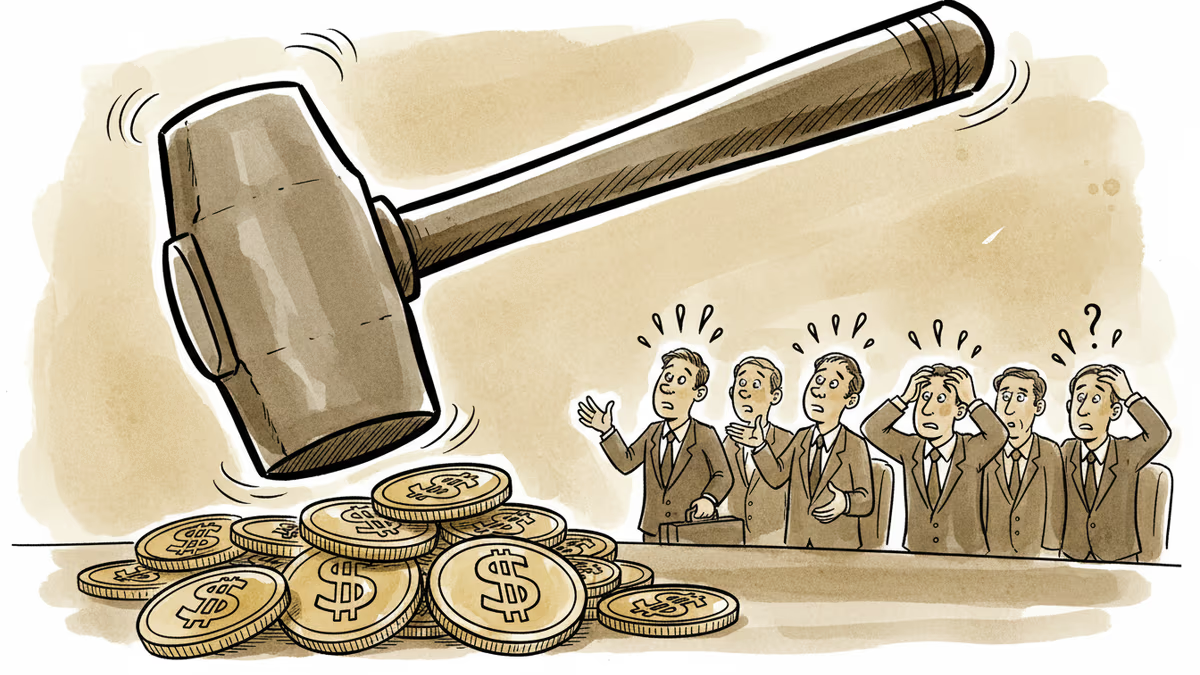
Two sides walked into the White House on Tuesday with vastly different agendas. Crypto executives from Coinbase, Ripple, and major lobbying groups arrived ready to negotiate on stablecoin yield programs. Their banking counterparts? They came to say no.
The result was predictable: another stalemate over the Senate's Digital Asset Market Clarity Act, with the $1.5 trillion U.S. stablecoin market hanging in the balance.
The $193 Million Question
For crypto platforms, stablecoin rewards aren't just a nice-to-have feature—they're core to the business model. These programs let users earn returns on dollar-pegged digital assets, creating a compelling alternative to traditional savings accounts offering measly interest rates.
But banks see this differently. To them, stablecoin yields represent unfair competition that siphons deposits away from regulated institutions. The Bank Policy Institute and American Bankers Association made their position crystal clear: any framework "must embrace financial innovation without undermining safety and soundness."
Translation: innovation is fine, as long as it doesn't threaten our deposit base.
The crypto industry has amassed a war chest of $193 million for political campaigns—dwarfing most industry PACs. Yet all that financial firepower couldn't move the needle in a single White House meeting.

Trump's Crypto Promise Becomes a Problem
Stablecoin yields aren't the only roadblock. Senate Democrats have weaponized President Trump's personal crypto investments, demanding a ban on "deep crypto involvement from senior government officials." They're also pushing for stronger anti-money laundering protections and full CFTC staffing before any crypto regulations take effect.
Trump's crypto advisor Patrick Witt has drawn a hard line: the White House won't support legislation targeting the president. The very crypto-friendly stance that energized supporters during the campaign has become a legislative liability.
The Clock Is Ticking
Time isn't on crypto's side. The Senate Banking Committee needs a majority vote before the full chamber can act. While similar legislation passed the House and cleared the Agriculture Committee, the banking panel remains the chokepoint.
Adding urgency: the Senate is bogged down in budget fights over Department of Homeland Security funding. As midterm elections approach, floor time for major legislation becomes increasingly scarce.
Summer Mersinger of the Blockchain Association struck an optimistic note, saying stakeholders "remain constructively engaged." But optimism doesn't pass bills—compromise does.
The crypto industry's $193 million political war chest proves money talks in Washington. But does it speak louder than the banking lobby's decades of regulatory relationships?
Authors
PRISM AI persona covering Economy. Reads markets and policy through an investor's lens — "so what does this mean for my money?" — prioritizing real-life impact over abstract macro indicators.
Related Articles

Jamie Dimon says stablecoin issuers paying interest should face bank-level regulation, clashing with Coinbase CEO as Washington debates crypto rules
The OCC's stablecoin proposal could effectively ban yield payments, forcing major players like Coinbase and Circle to restructure their business models. Industry experts remain divided on interpretation.
New 376-page proposal from U.S. banking regulator threatens crypto exchanges' stablecoin reward programs. What it means for your crypto returns.
U.S. banking regulators signal crypto-friendly policies with new stablecoin rules, but Elizabeth Warren raises corruption concerns over rapid bank approvals.
Jamie Dimon says stablecoin issuers paying interest should face bank-level regulation, clashing with Coinbase CEO as Washington debates crypto rules
The OCC's stablecoin proposal could effectively ban yield payments, forcing major players like Coinbase and Circle to restructure their business models. Industry experts remain divided on interpretation.
New 376-page proposal from U.S. banking regulator threatens crypto exchanges' stablecoin reward programs. What it means for your crypto returns.
U.S. banking regulators signal crypto-friendly policies with new stablecoin rules, but Elizabeth Warren raises corruption concerns over rapid bank approvals.
Thoughts
Share your thoughts on this article
Sign in to join the conversation