
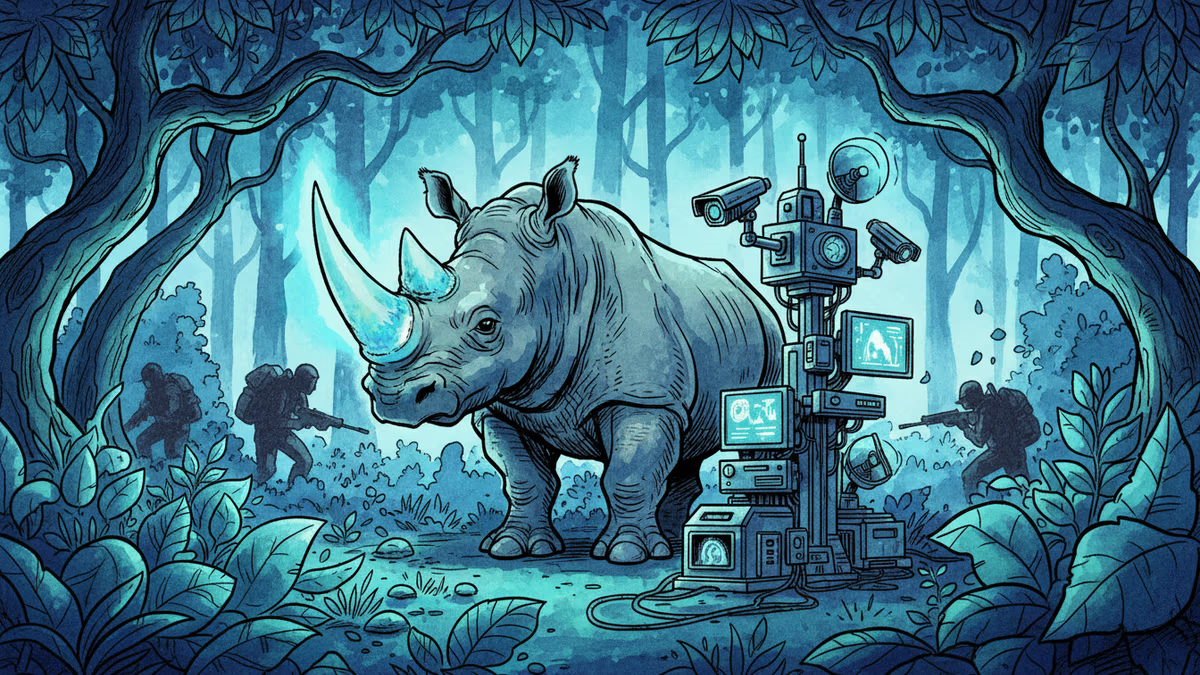
They're Injecting Rhinos With Radioactive Material
A $20 billion criminal industry meets cutting-edge tech. From radioactive rhino horns to instant DNA tests, five innovations changing how we protect wildlife from trafficking.
Every year, hundreds of rhinos are shot dead, millions of sharks are hauled from protected seas, and countless animals cross borders illegally. At $20 billion annually, according to Interpol, wildlife trafficking ranks as the world's fourth-largest criminal enterprise—trailing only drugs, weapons, and human trafficking.
The United Nations wants to end trafficking in protected species by 2030. But a recent UN Office on Drugs and Crime report found "no reason for confidence" that target would be met. The math is brutal: sophisticated criminal networks, slim chances of getting caught, massive profits.
Yet there's genuine reason for hope. Technologies developed for cities and labs are moving into the planet's wildest places, giving environmental agencies and local communities new weapons to detect illegal goods, trace smuggling networks, and prevent poaching at its source.
Last December, Interpol announced record seizures of live animals, thanks partly to sophisticated tools that exposed hidden trafficking networks. Operation Thunder 2025 coordinated agencies from 134 countries and seized 30,000 live animals—from apes to butterflies—using digital forensics and AI-driven detection.
Radioactive Rhino Horns Are Actually Happening
In July, South African researchers won government approval for one of the most eyebrow-raising anti-poaching attempts ever: drilling radioactive substances directly into rhino horns.
The Rhisotope Project fitted 33 rhinos from Limpopo Rhino Orphanage with pellets containing low-level radioactive isotopes during 2024 and 2025. Blood samples and veterinary exams confirmed the pellets don't harm the rhinos, rangers, or surrounding environment.
But here's the genius: those isotopes emit enough radiation to trigger the 11,000 radiation portal monitors already operating at airports and shipping terminals worldwide. In November 2024, the team tested their system at New York airports and harbors with US Customs. They successfully detected a single planted horn inside a full 40-foot shipping container.
"It's almost impossible to remove isotopes unless you're a skilled radiation protection officer," says James Larkin, the project's nuclear safety expert. Rhino horn fetches $60,000 per kilogram as traditional medicine, but radioactive contamination renders it worthless and dangerous to consume.
Each dose costs about $1,300 per animal and stays active for five years. Warning signs around perimeter fences alert would-be poachers that animals have been tagged. The South African health agency has now approved nationwide rollout, with plans to treat 500 rhinos yearly.
Reading Life Stories in Feathers and Scales
There are two parallel trades for exotic pets: legal captive-bred animals and illicit wild-caught ones. But faced with a lizard or parrot, how can law enforcement know its origin story?
Australia's Taronga Conservation Society developed an ingenious solution. Kate Brandis's team created a handheld X-ray fluorescence gun that analyzes elemental signatures in keratin—the stuff of quills, feathers, and hair.
Wild echidnas forage diverse diets of beetle larvae, ants, and grubs. Captive animals eat monotonous commercial feed. Each dietary history leaves a readable record in the mammals' spines, which the XRF gun detects with high accuracy.
The technology already proved its worth. A nationwide trial at Australian post offices, combining XRF guns with AI-equipped parcel scanners, uncovered more than 100 legally protected lizards being shipped overseas. The distributor got three years in jail.

Indonesia's yearly export of dozens of "captive-bred" echidnas had long raised suspicions—US zoos have produced only 19 echidna babies in a century of breeding efforts. The numbers simply didn't add up.
AI Eyes in the Sky Watch Everything
The Papahānaumokuākea Marine National Monument near Hawaii spans an area larger than all US national parks combined. Commercial fishing, diving, and oil exploration are banned. But how do you monitor thousands of square kilometers of open ocean?
Skylight, initially developed by Microsoft cofounder Paul Allen in 2017, provides the answer. AI analyzes satellite and ship-tracking data to detect suspicious behavior. More than 200 organizations in 70+ countries now use the technology.
January's Panama operation showcased the system's power. Satellites spotted 16 boats 200 kilometers offshore inside the Coiba Ridge marine reserve. Skylight's algorithms detected long-line fishing patterns and requested high-resolution images. Panama's environmental agency and military deployed ships and aircraft, ultimately seizing six vessels and thousands of kilograms of illegally caught fish.
Skylight detects around 300,000 vessels weekly, according to platform analytics. "The Panama case was one of those 'wow' moments," says Ted Schmitt, senior director at the Allen Institute for AI. "Not because the technology proved itself, but because agencies actually took it to a legal finish."
Three-Minute DNA Tests in the Field
When conservation scientist Natalie Schmitt researched snow leopards in remote Nepal, locals could point out piles of droppings. But leopard scat easily gets confused with wolf and fox poop—they share habitats and prey.
What she wanted was instant species identification through DNA sequencing. Traditional labs take weeks and require shipping samples across borders. Border agents opening suspicious shipments don't have weeks to spare.
In 2020, Schmitt founded WildTechDNA to solve this problem. Their test works like a home pregnancy test with two simple steps: a new extraction method cuts DNA processing from a day to three minutes ("literally put the sample in the tube and squeeze 10 times"), then lateral-flow strips—similar to COVID rapid tests—identify specific species.
Canada became the first adopter, targeting European eels—critically endangered species impossible to identify by appearance. This confusion allows €3 billion of European eels to be smuggled annually, disguised as other species.
Traditional methods meant shipping suspected samples to labs across the country for three-week waits. WildTechDNA developed eel-specific tests and trained Canadian enforcement officers for a "nationwide European eel blitz."
Results from 2025 campaigns: European eels turned up in less than 1% of shipments—significantly below 2016 detection rates using older technologies.
Forests Full of Listening Devices
The world's forests increasingly bristle with snooping devices. Rainforest Connection, founded by physicist-turned-conservation-tech entrepreneur Topher White in 2014, pioneered bioacoustic monitoring.
Solar-powered Guardian devices sit in treetops for years, capturing broad forest soundscapes and transmitting to the cloud for analysis. Initially designed to detect immediate threats—"chainsaws, logging trucks, gunshots"—they relay real-time alerts to police, Indigenous groups, and local communities.
Recent advances are more sophisticated. Testing on Sumatra island with German software firm SAP, the team used machine learning to hunt for "uncharacteristic sudden changes to the soundscape." When animals go silent, it could reveal approaching poachers.
In 2026, Rainforest Connection will roll out this approach to reserves in Thailand, Jamaica, and Romania, building unique models for each environment trained on thousands of hours of verified audio.
"We have a lot of eyes and ears in the forest already, all reacting to each other and new stimuli," White explains. For the rest of us, there's an app streaming live audio from Ecuador's rainforest—complete soundscapes of birdsong, frog chatter, and cicada chirps.
Authors
Related Articles
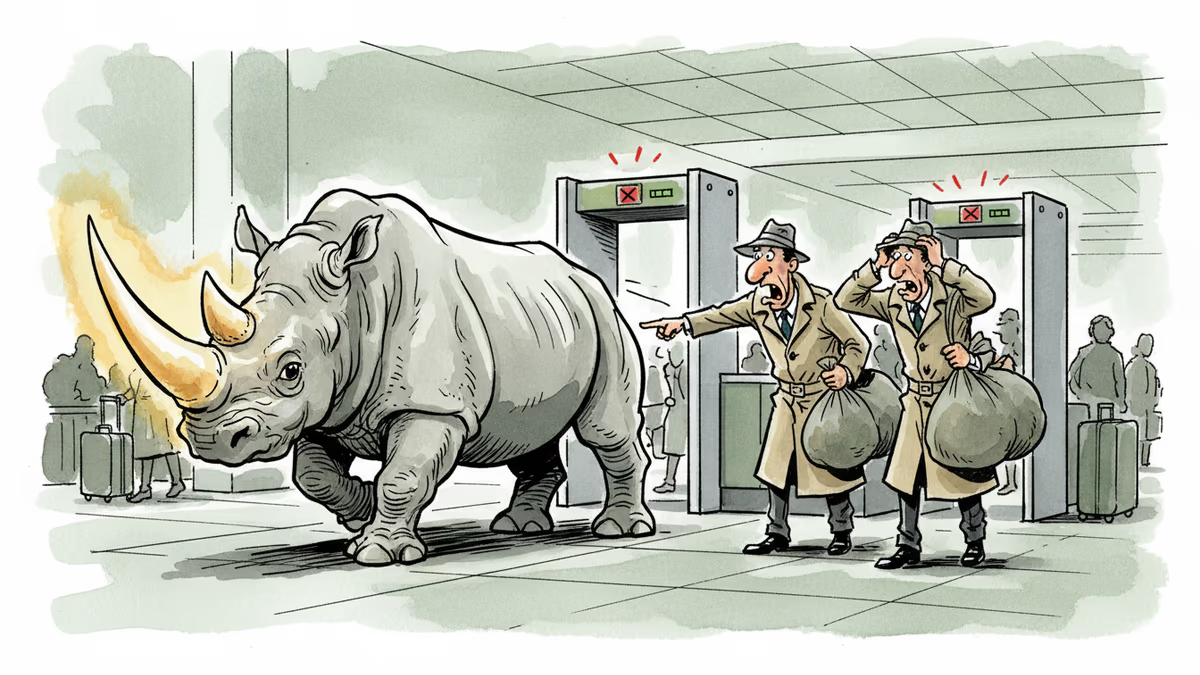
With poachers killing hundreds of rhinos annually and wildlife trafficking worth $20 billion, researchers are injecting radioactive isotopes into rhino horns. Can technology finally turn the tide against sophisticated criminal networks?
Samsung Electronics' union branch revealed that 84% of survey respondents oppose the government's roughly $290 billion (₩400 trillion) semiconductor megaproject in Gwangju. Government, management, the union and shareholders are all reading the same national project in sharply different ways.
Nvidia shipped roughly a billion RISC-V cores in 2024, then announced it would run CUDA on the open standard. We break down how royalty-free instruction sets and open software stacks are trying to route around CUDA's lock-in. Part 2 of the Semiconductor Sovereignty series.
US AI-chip export controls split into three layers in the first half of 2026 — January easing, a May crackdown on circumvention, and a pending bill. Nvidia erased China from its guidance and still posted a record $81.6 billion quarter. A look at the export policy that both shields and cages it.
With poachers killing hundreds of rhinos annually and wildlife trafficking worth $20 billion, researchers are injecting radioactive isotopes into rhino horns. Can technology finally turn the tide against sophisticated criminal networks?
Samsung Electronics' union branch revealed that 84% of survey respondents oppose the government's roughly $290 billion (₩400 trillion) semiconductor megaproject in Gwangju. Government, management, the union and shareholders are all reading the same national project in sharply different ways.
Nvidia shipped roughly a billion RISC-V cores in 2024, then announced it would run CUDA on the open standard. We break down how royalty-free instruction sets and open software stacks are trying to route around CUDA's lock-in. Part 2 of the Semiconductor Sovereignty series.
US AI-chip export controls split into three layers in the first half of 2026 — January easing, a May crackdown on circumvention, and a pending bill. Nvidia erased China from its guidance and still posted a record $81.6 billion quarter. A look at the export policy that both shields and cages it.
Thoughts
Share your thoughts on this article
Sign in to join the conversation