
Codex is Now Building Codex: Why OpenAI's Breakthrough Signals the Start of a New Software Revolution
OpenAI reveals its AI coding tool, Codex, is now primarily built by itself. PRISM analyzes why this recursive self-improvement marks a pivotal moment for software development and the future of AI.
The Lede: The Singularity in a Sandbox
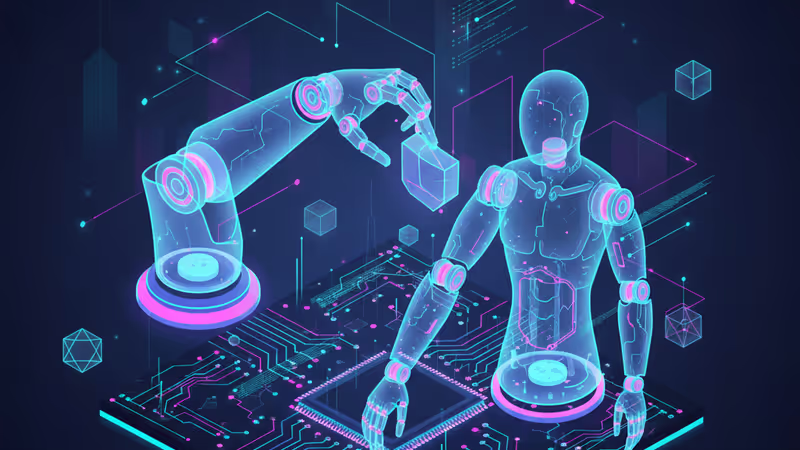
This week, OpenAI revealed a startling fact that went far beyond typical corporate 'dogfooding': its AI coding agent, Codex, is now largely responsible for its own development. "The vast majority of Codex is built by Codex," stated product lead Alexander Embiricos. For executives, investors, and developers, this isn't just a productivity hack. It's the first commercial-scale example of recursive self-improvement, a concept that fundamentally rewrites the economics of software development and accelerates the timeline for AI advancement.
Why It Matters: The Compounding Advantage
An AI that improves itself creates a powerful feedback loop. A better Codex can write more complex and efficient code, which makes Codex better. This creates a compounding effect, allowing for an exponential, not linear, increase in capability. While competitors are using human engineers to build their AI tools, OpenAI is building a system that bootstraps its own evolution. This creates a competitive moat that could become insurmountable.
- Second-Order Effect 1: The Pace of Innovation Detaches from Human Speed. Feature development, bug fixes, and performance optimizations can now happen at machine speed, limited only by compute power and the speed of human review and approval.
- Second-Order Effect 2: The Role of the Human Developer Undergoes a Tectonic Shift. The value of a developer is no longer in writing lines of code, but in architecting systems, defining high-level goals, and expertly curating the output of an AI collaborator.
The Analysis: Beyond AI-Assisted Coding

From Tool to Teammate: A Paradigm Shift
For years, the industry has viewed AI as an assistant—a supercharged autocomplete. This development reframes the AI as the primary builder. Historically, tools have been static; a hammer doesn't make a better hammer. But Codex is a dynamic tool that actively forges its own upgrades. This is a departure from anything we've seen in the history of software engineering. We are moving from a model of human-led development to one of AI-led development with human oversight.
The New Production Bottleneck: Strategic Direction
If the AI handles implementation, the new bottleneck becomes strategy, architecture, and validation. The most valuable software engineers of tomorrow will not be the fastest coders, but the clearest thinkers. Their core competency will be translating business goals into machine-understandable prompts and system designs. Companies will need to retrain their teams not to write code, but to direct an AI that writes code. This has profound implications for technical education, hiring, and team structure.
Competitive Dynamics: The Race for the Flywheel
How will rivals like Google, Microsoft (a close OpenAI partner), and startups in the space respond? They cannot simply copy the feature; they must replicate the entire self-reinforcing flywheel. This requires not only a powerful foundation model but also the sophisticated infrastructure—the sandboxed environments, the automated testing, and the human-in-the-loop review processes—that allows an AI to safely and effectively work on its own codebase. The race is no longer just about building the smartest model, but about building the most effective self-improving system.
PRISM's Take: We've Crossed the Rubicon
OpenAI's admission is more than a clever engineering milestone; it's a signal that the nature of value creation in the digital economy is changing. The era of handcrafted software, painstakingly written line-by-line by humans, is entering its twilight. We are at the dawn of the self-evolving enterprise, where a company's core software assets can improve themselves continuously. Human developers are not becoming obsolete, but their role is being elevated from digital bricklayer to architect of intelligent systems. For every organization, the strategic imperative is no longer just to 'adopt AI,' but to build a system that allows AI to build itself.
Authors
Related Articles

SpaceX's IPO filing puts AI at the center, claiming a $26.5 trillion market opportunity. But can Grok compete with OpenAI and Anthropic for enterprise customers?
AI is everywhere now—but is it helping or hurting? MIT Technology Review diagnoses a new mood: not excitement, not panic, just a creeping, uncomfortable uncertainty.
New data shows global app releases surged 60% year-over-year in Q1 2026. The theory that AI chatbots would replace apps may have it completely backwards.

A surprise leak of Anthropic's Claude Code source code revealed 'Kairos'—a dormant background AI agent designed to act before you even ask. Here's what it means.
SpaceX's IPO filing puts AI at the center, claiming a $26.5 trillion market opportunity. But can Grok compete with OpenAI and Anthropic for enterprise customers?
AI is everywhere now—but is it helping or hurting? MIT Technology Review diagnoses a new mood: not excitement, not panic, just a creeping, uncomfortable uncertainty.
New data shows global app releases surged 60% year-over-year in Q1 2026. The theory that AI chatbots would replace apps may have it completely backwards.
A surprise leak of Anthropic's Claude Code source code revealed 'Kairos'—a dormant background AI agent designed to act before you even ask. Here's what it means.
Thoughts
Share your thoughts on this article
Sign in to join the conversation