
Why Defense Giants Just Bet $125M on Code Translation AI
Code Metal reaches $1.25B valuation with AI that translates legacy code. Defense industry's urgent modernization needs drive massive investment in automated code conversion.
$1.25 billion. That's what investors think code translation is worth
Code Metal, a three-year-old Boston startup, just closed a $125 million Series B round, pushing its valuation to $1.25 billion. The company's business? Using AI to translate code from one programming language to another.
Sounds simple. But when your customers include Lockheed Martin, Raytheon, and the US Air Force, simple becomes mission-critical. The defense industry isn't known for throwing money at unproven tech. So why are they betting big on automated code translation?
The 60-Year-Old Code Problem
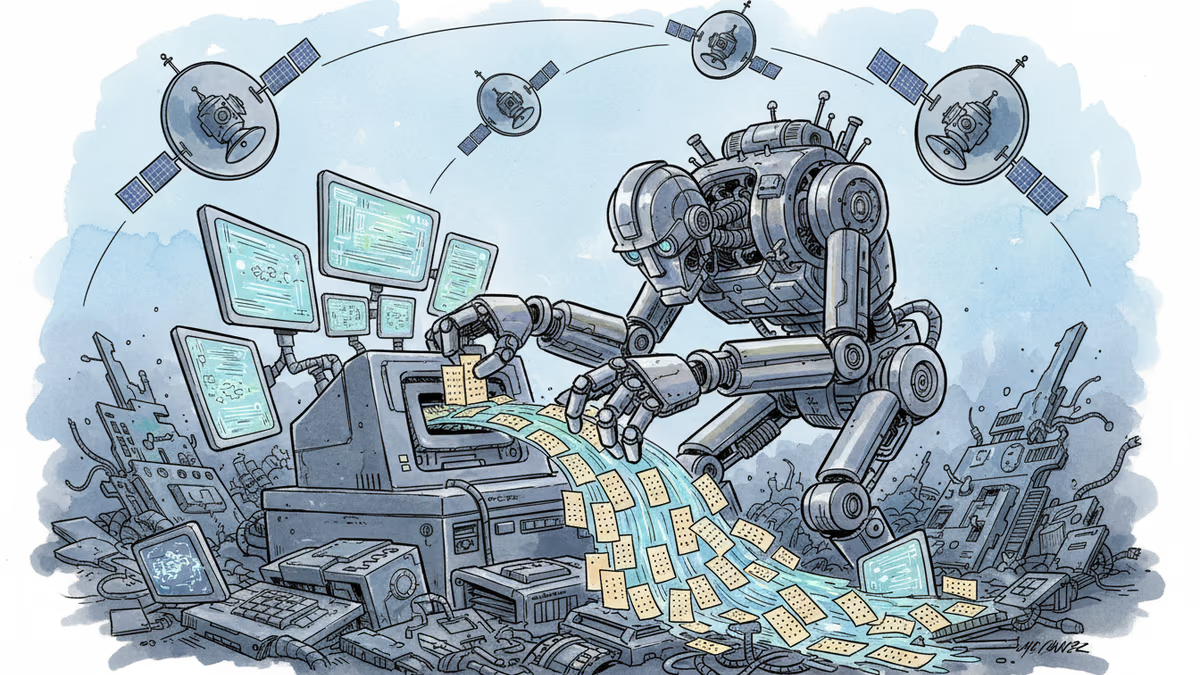
Here's the reality: Much of America's critical infrastructure runs on code written decades ago. Satellites, defense systems, financial networks—many still rely on programming languages like COBOL and Fortran. The engineers who understand these languages are retiring, and few young developers are learning them.
"Some of the code that controls essential communications infrastructure, and even satellites, is old, it's crufty, it's written in programming languages that people might not use anymore," explains Yan-David Erlich, general partner at B Capital, one of Code Metal's investors. "It needs to be modernized."
But here's the catch: "In the course of translation, you might be inserting bugs—which is catastrophically problematic." When a bug in consumer software means a crashed app, that's annoying. When a bug in defense software means a misdirected missile, that's existential.
The Translation Trap: Why Manual Conversion Isn't Enough
Code Metal's CEO Peter Morales, a former Microsoft and MIT Lincoln Laboratory engineer, points to a recent observation by AI researcher Andrej Karpathy: "It feels likely that we'll end up rewriting large fractions of all software ever written many times over."
"That is all of what we do in one tweet," Morales says.

The company's platform translates code from high-level languages like Python and C++ to lower-level languages like Rust and VHDL, or chip-specific languages like Nvidia's CUDA. But the real innovation isn't in translation—it's in verification.
At each step, Code Metal generates test harnesses that evaluate the translated code. "For the pipelines Code Metal currently runs, there's no way to generate an error," Morales claims. "The software will just say, 'There's no solution for this' if we can't complete the translation."
Beyond Per-Seat Pricing: The New Economics of AI Tools
Code Metal is also pioneering a new approach to enterprise software pricing. While traditional companies like Oracle and Salesforce charge based on user seats, Code Metal negotiates individual contracts based on three factors:
- Time to develop a kernel
- Lines of code translated
- Development time saved
This "value-based pricing" model reflects a broader shift in enterprise AI. When the product saves months of developer time, charging per user seat seems almost quaint. Though Morales acknowledges the process can "get murky," he notes that "every pilot [the company has] deployed ends up going to the next phase."
The Talent War: Why Legacy Skills Command Premium
The urgency around code modernization has created an unexpected talent premium. Developers who understand both legacy systems and modern architectures are commanding six-figure consulting rates. Defense contractors are competing for a shrinking pool of engineers who can bridge the 40-year gap between COBOL and Rust.
This talent scarcity is driving adoption of automated solutions. When a government agency needs urgent coding work but only has access to engineers specialized in legacy languages, projects stall. Code Metal's promise is simple: eliminate the bottleneck.
The Profitability Paradox: Unicorn with Positive Cash Flow
Code Metal claims to be profitable—a rarity among AI startups burning through venture capital. This combination of $1+ billion valuation and positive cash flow makes it a true unicorn in multiple senses.
The profitability likely stems from defense industry pricing power. When failure isn't an option, customers pay premium rates for proven solutions. Code Metal's early traction with L3Harris, RTX, and government agencies suggests strong product-market fit in a niche but lucrative sector.
Authors
Related Articles
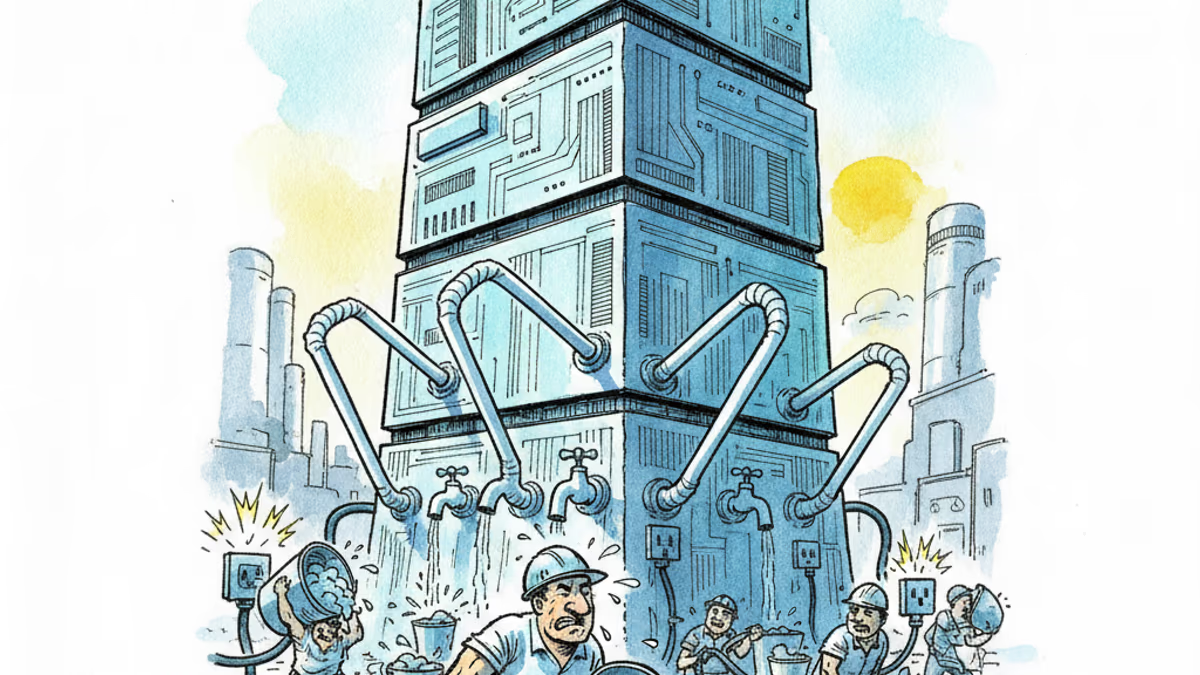
Samsung and SK unveiled a chip and AI investment package worth thousands of trillions of won on June 29. The headline number swings wildly by outlet, but the real contest isn't capital — it's water and power.

Viral videos show 2026 graduates jeering executives who praise AI at commencement ceremonies. It's not just rudeness — it's a signal about who pays for technological optimism.

Filipino virtual assistants using AI to ghost-manage LinkedIn profiles for executives is now a structured industry. 30 comments a day, fake engagement rings, and a platform struggling to tell real from fabricated.

Two commencement speakers learned the hard way that AI enthusiasm doesn't land well with today's graduates. The backlash reveals a widening gap between tech optimism and Gen Z's economic reality.
Samsung and SK unveiled a chip and AI investment package worth thousands of trillions of won on June 29. The headline number swings wildly by outlet, but the real contest isn't capital — it's water and power.
Viral videos show 2026 graduates jeering executives who praise AI at commencement ceremonies. It's not just rudeness — it's a signal about who pays for technological optimism.
Filipino virtual assistants using AI to ghost-manage LinkedIn profiles for executives is now a structured industry. 30 comments a day, fake engagement rings, and a platform struggling to tell real from fabricated.
Two commencement speakers learned the hard way that AI enthusiasm doesn't land well with today's graduates. The backlash reveals a widening gap between tech optimism and Gen Z's economic reality.
Thoughts
Share your thoughts on this article
Sign in to join the conversation