

2026 Climate Tech Investment Outlook: AI Hunger and the Rise of Grid Decoupling
Explore the 2026 climate tech investment outlook. From data center grid decoupling to Fervo's potential IPO, learn why clean energy is more resilient than ever.
Rumors of climate tech's demise have been greatly exaggerated. Despite political shifts in the U.S., clean energy investing hasn't tanked—it's proving remarkably resilient. According to CTVC, venture bets remained flat through 2025, driven by the fact that many climate technologies are now cheaper and more efficient than fossil fuels.
2026 Climate Tech Investment Outlook: Decoupling from the Grid
If 2025 was the year climate tech learned to love AI's thirst for electricity, 2026 will be about resilience. Lisa Coca of Toyota Ventures predicts a shift toward "decoupling" from the grid. Data centers are looking to generate their own power to bypass utility bottlenecks and public resistance over rising electricity prices.
Nuclear and Geothermal: The Next Frontier

Nuclear power is back in vogue, with startups recently raising over $1 billion. Meanwhile, enhanced geothermal leader Fervo Energy, fresh off a $462 million round, is widely tipped for a 2026 IPO. Their 500-megawatt project in Utah is set to become the blueprint for carbon-free, baseload power that can scale geometrically.
Sectors to Watch in 2026
- EV Trucking: The Tesla Semi's finalized specs and pricing will be a game-changer for logistics.
- Grid Execution: Software and robotics that accelerate interconnection and bury transmission lines faster and cheaper.
- Battery Chemistry: New moves in sodium-ion and zinc chemistries to drive down long-duration storage costs.
Authors
Related Articles
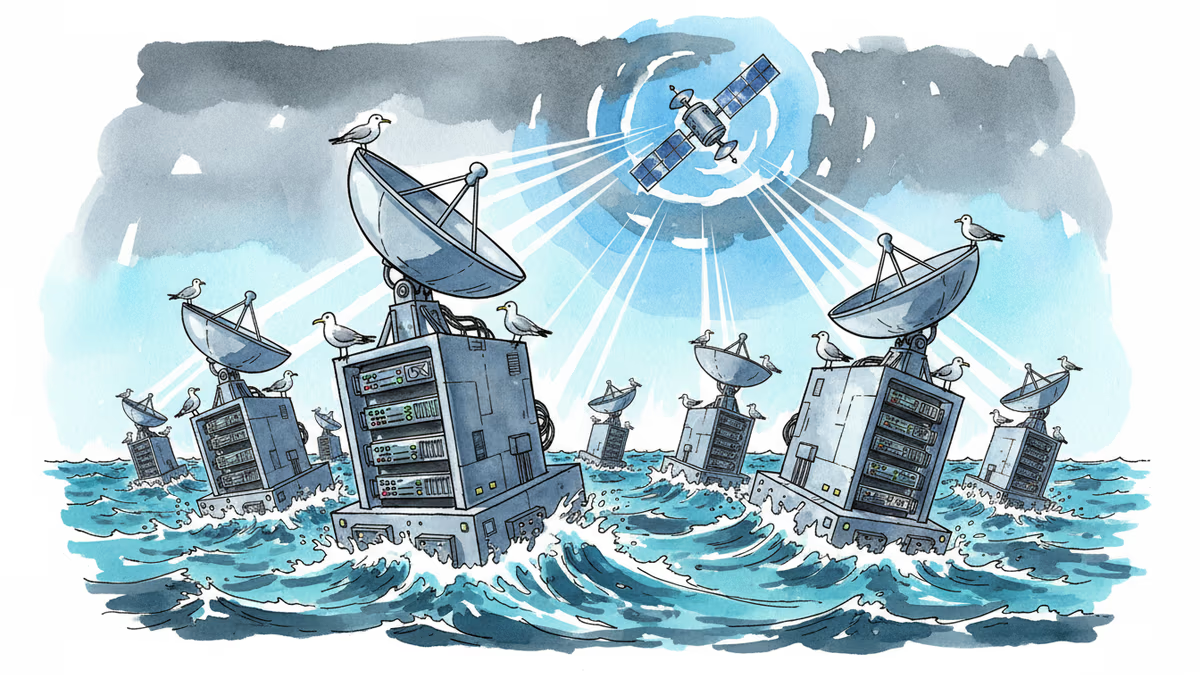
Palantir co-founder Peter Thiel and other Silicon Valley investors have poured $140 million into Panthalassa, a startup building wave-powered floating AI data centers in the open ocean. Here's what that actually means.

Iran's drone strikes on AWS data centers and its naming of 18 tech firms as military targets expose a structural flaw in AI infrastructure: civilian and military data sit on the same physical servers.
Gimlet Labs just raised $80M to build software that splits AI workloads across every chip type simultaneously. The pitch: 10x efficiency without buying new hardware.
A South Korean startup called Absolics is betting that glass substrates can cut AI chip energy consumption. Here's why that matters beyond the data center.
Palantir co-founder Peter Thiel and other Silicon Valley investors have poured $140 million into Panthalassa, a startup building wave-powered floating AI data centers in the open ocean. Here's what that actually means.
Iran's drone strikes on AWS data centers and its naming of 18 tech firms as military targets expose a structural flaw in AI infrastructure: civilian and military data sit on the same physical servers.
Gimlet Labs just raised $80M to build software that splits AI workloads across every chip type simultaneously. The pitch: 10x efficiency without buying new hardware.
A South Korean startup called Absolics is betting that glass substrates can cut AI chip energy consumption. Here's why that matters beyond the data center.
Thoughts
Share your thoughts on this article
Sign in to join the conversation