
Claude Can Now Use Your Mouse. Should You Let It?
Anthropic's Claude Code and Cowork can now directly control your Mac desktop—clicking, scrolling, and navigating files. As AI agents race to take over local computers, what are the real implications?
You step away from your desk. When you come back, the files are organized, the browser tabs are open, and the dev tools have already run. You didn't do any of it. Your AI did—by literally moving the mouse.
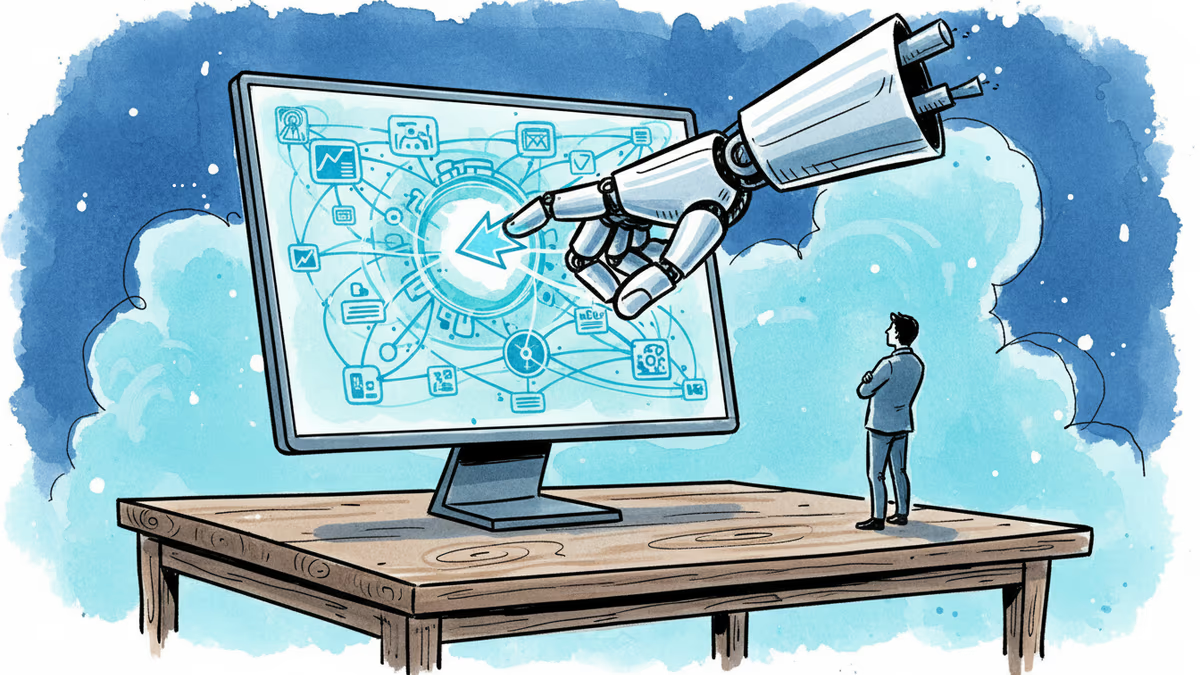
That's not a scene from a sci-fi demo reel. Anthropic made it real this week. Claude Code and its more casual sibling Claude Cowork can now point, click, scroll, and navigate your Mac desktop autonomously to complete tasks. The AI isn't just answering questions anymore. It's operating your machine.
What Actually Changed
Until now, Claude worked through 'Connectors'—pre-built integrations that let it access specific apps or data sources through defined channels. Think of it like a locked door with a key: structured, bounded, predictable.
The new 'computer use' feature is something different. When a Connector isn't available, Claude Code and Cowork can now ask permission to take direct control of the screen—opening files, navigating the browser, running developer tools, exploring whatever's visible. It's how a human uses a computer, replicated by AI.
The Dispatch tool adds another layer: as long as the target machine stays powered on, this desktop control can be initiated and managed remotely. Your office computer, operated by AI, from anywhere.
Anthropic is being upfront about the limitations. This is a 'research preview.' Complex tasks may need a second attempt. Computer use is slower and more error-prone than Connector-based actions. It's not a finished product—it's a capable, imperfect one. Currently available to Claude Pro and Max subscribers on macOS only.
Why This Moment Matters
This isn't Anthropic moving alone. OpenAI's Operator, Microsoft's Copilot Actions, Google's Project Mariner—every major AI lab is racing toward the same destination: AI that doesn't just advise but acts directly on your local environment. The chatbot wars are settling into a new phase, and the next battleground is your desktop.

The timing is strategic. Whoever embeds deepest into daily developer and enterprise workflows in the next 12–18 months has a strong claim on the subscription market for years to come. Computer use is a moat-building move, not just a feature drop.
For developers specifically, the pitch is compelling. Repetitive file manipulation, browser navigation, dev environment setup—the tedious scaffolding around actual coding—can now be delegated. Claude Code stops being a coding assistant and starts being a coding partner that shares your workspace.
The Part Nobody's Celebrating
Security professionals aren't popping champagne. An AI that reads and interacts with your screen has access to everything on that screen: passwords, personal data, financial information, confidential documents. The question isn't whether Anthropic intends harm—it's what data is captured, how it's processed, and what happens when something goes wrong.
For enterprise adoption, this creates a real friction point. IT and security teams will need to audit these capabilities carefully before any organization-wide rollout. The liability questions alone are non-trivial.
There's also a subtler concern for everyday users. The convenience of AI handling your computer tasks comes bundled with a gradual transfer of agency. Today it's opening files. The technology's natural trajectory leads toward email drafting, form submissions, payment approvals. Each step feels small. The cumulative shift is significant.
Three Perspectives Worth Holding
The optimist's view: Computer use finally closes the gap between AI capability and real-world utility. Most software doesn't have an API. Most workflows aren't structured. An AI that can navigate any interface the way a human does is genuinely more useful than one confined to pre-built integrations.
The skeptic's view: 'Research preview' is doing a lot of work in Anthropic's announcement. Slower, more error-prone, sometimes needs a second try—that's a polite way of saying it's not ready for anything mission-critical. Releasing it now is as much about competitive optics as user value.
The regulator's view: This category of AI capability—autonomous agents with direct system access—sits in a regulatory gray zone in most jurisdictions. The EU AI Act, US executive orders on AI, and emerging frameworks elsewhere haven't fully caught up with agents that can act on your behalf without real-time human confirmation of each step.
Authors
Related Articles
Anthropic shipped Claude Sonnet 5, its mid-tier agent model, on June 30. Behind the 'Opus-class power, budget price' headline sits a tokenizer catch and a three-horse race that's only half real. Here's what developers should actually run the numbers on.

A small but growing group of developers has gone all-in on AI coding agents like Claude Code and OpenClaw. History suggests the rest of us won't be far behind.
OpenAI's new Daybreak initiative uses the Codex AI agent to find and patch security vulnerabilities before attackers do—putting it in direct competition with Anthropic's secretive Claude Mythos.

Anthropic is closing what may be its final private fundraise at a $900B valuation, surpassing OpenAI. Investors have 48 hours to commit to the ~$50B round.
Anthropic shipped Claude Sonnet 5, its mid-tier agent model, on June 30. Behind the 'Opus-class power, budget price' headline sits a tokenizer catch and a three-horse race that's only half real. Here's what developers should actually run the numbers on.
A small but growing group of developers has gone all-in on AI coding agents like Claude Code and OpenClaw. History suggests the rest of us won't be far behind.
OpenAI's new Daybreak initiative uses the Codex AI agent to find and patch security vulnerabilities before attackers do—putting it in direct competition with Anthropic's secretive Claude Mythos.
Anthropic is closing what may be its final private fundraise at a $900B valuation, surpassing OpenAI. Investors have 48 hours to commit to the ~$50B round.
Thoughts
Share your thoughts on this article
Sign in to join the conversation