
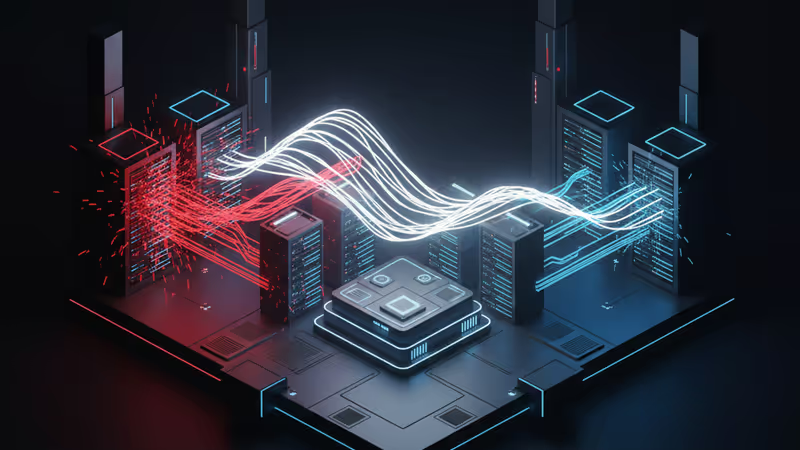
Cisco's 'Wipe and Restore' Mandate: Why China's Latest Hack is More Than a Breach
A new zero-day attack on Cisco by Chinese hackers requires a full system wipe, not a patch. PRISM analyzes the strategic implications for enterprise security.
The Lede: This Isn't About Volume, It's About Velocity and Violation
When Cisco disclosed that a Chinese state-sponsored actor was exploiting a zero-day flaw in its core enterprise hardware, the initial numbers seemed reassuringly small—a few hundred potential victims globally. This is a dangerous misinterpretation. The real story isn't the breadth of the attack, but its depth. The fact that Cisco's only remediation is a complete system wipe and restore signals a profound violation of trust in the foundational hardware that underpins corporate and government networks. This is not a routine patch; it's a digital organ transplant, and it’s a strategic warning shot to every CISO and CEO.
Why It Matters: The Erosion of Infrastructure Trust
The core issue is the attacker's ability to achieve deep, persistent access within Cisco’s Secure Email Gateways. These are not just servers; they are trusted security appliances, the digital gatekeepers for an organization's most sensitive communications. An attack of this nature has significant second-order effects:
- Operational Nightmare: A simple patch can be deployed at scale with minimal disruption. A full system wipe, reconfiguration, and restoration is a high-cost, high-risk, and time-intensive process. For a global enterprise, this translates into significant downtime and engineering overhead.
- The 'Black Box' Problem: Enterprises have long treated network appliances as reliable, sealed units. This attack shatters that illusion. The attackers have demonstrated the ability to burrow so deeply into the appliance's core software that the device itself cannot be trusted or easily cleaned.
- Strategic Pre-positioning: The targeted nature of the campaign, active since at least late 2023, suggests a goal beyond immediate data theft. This aligns with tactics used by groups like Volt Typhoon, who focus on gaining long-term footholds in critical infrastructure for future intelligence gathering or disruption. They are placing digital sleeper agents inside the walls of their targets.

The Analysis: A Scalpel, Not a Sledgehammer
This incident is a masterclass in modern state-sponsored espionage. Unlike noisy ransomware attacks that announce their presence, this campaign is low, slow, and highly targeted. By exploiting a vulnerability that requires a non-default, specific configuration (internet-facing with 'spam quarantine' enabled), the attackers ensured they would hit high-value targets without raising widespread alarms.
This is a tactical evolution from broader software supply chain attacks like SolarWinds. While SolarWinds poisoned the software well for thousands, this attack targets the wellspring itself—the hardware and firmware that networks are built upon. By compromising the email gateway, the actor gains a privileged position to monitor, intercept, or manipulate all email traffic, making it the perfect perch for corporate and government espionage. The low number of victims isn't a sign of failure; it's a hallmark of a successful, precision-guided intelligence operation.
PRISM's Take: Assume the Foundation is Cracked
For years, CISOs have been told to 'assume breach' at the user and endpoint level. This Cisco zero-day forces a more unsettling conclusion: you must now assume the very foundation of your network infrastructure is compromised. The attackers are no longer just rattling the front door; they are embedding themselves in the concrete. This incident serves as a stark reminder that in the era of great power competition, your network hardware is not just a piece of technology—it's a geopolitical battleground. The focus must shift from building higher walls to engineering for resilience, visibility, and rapid recovery, because the enemy is already inside the bricks.
Authors
Related Articles

China is restricting AI researchers and startup founders from traveling abroad as the U.S.-China AI performance gap narrows to just 2.7%. What Beijing's talent lockdown means for the global AI race.
A critical vulnerability in Starlette—downloaded 325 million times per week—puts millions of AI agent servers at risk, exposing stored credentials for email, databases, and third-party services.
GitHub confirmed hackers stole data from 3,800 internal repositories via a poisoned VS Code extension. Here's why developer tools are now the most dangerous attack surface in tech.

A Utah woman was sentenced to life in prison partly because of her Google searches and deleted texts. The Kouri Richins case reveals how digital footprints have become the courtroom's most reliable witness.
China is restricting AI researchers and startup founders from traveling abroad as the U.S.-China AI performance gap narrows to just 2.7%. What Beijing's talent lockdown means for the global AI race.
A critical vulnerability in Starlette—downloaded 325 million times per week—puts millions of AI agent servers at risk, exposing stored credentials for email, databases, and third-party services.
GitHub confirmed hackers stole data from 3,800 internal repositories via a poisoned VS Code extension. Here's why developer tools are now the most dangerous attack surface in tech.
A Utah woman was sentenced to life in prison partly because of her Google searches and deleted texts. The Kouri Richins case reveals how digital footprints have become the courtroom's most reliable witness.
Thoughts
Share your thoughts on this article
Sign in to join the conversation