

China's 'Starship Gambit': Why Beijing's Rocket Industry is Skipping a Generation to Beat SpaceX
China's space industry is skipping Falcon 9 clones and pivoting to Starship-like rockets. Our analysis explains why this strategic leapfrog threatens Western dominance.
The Lede: Beyond the Clones
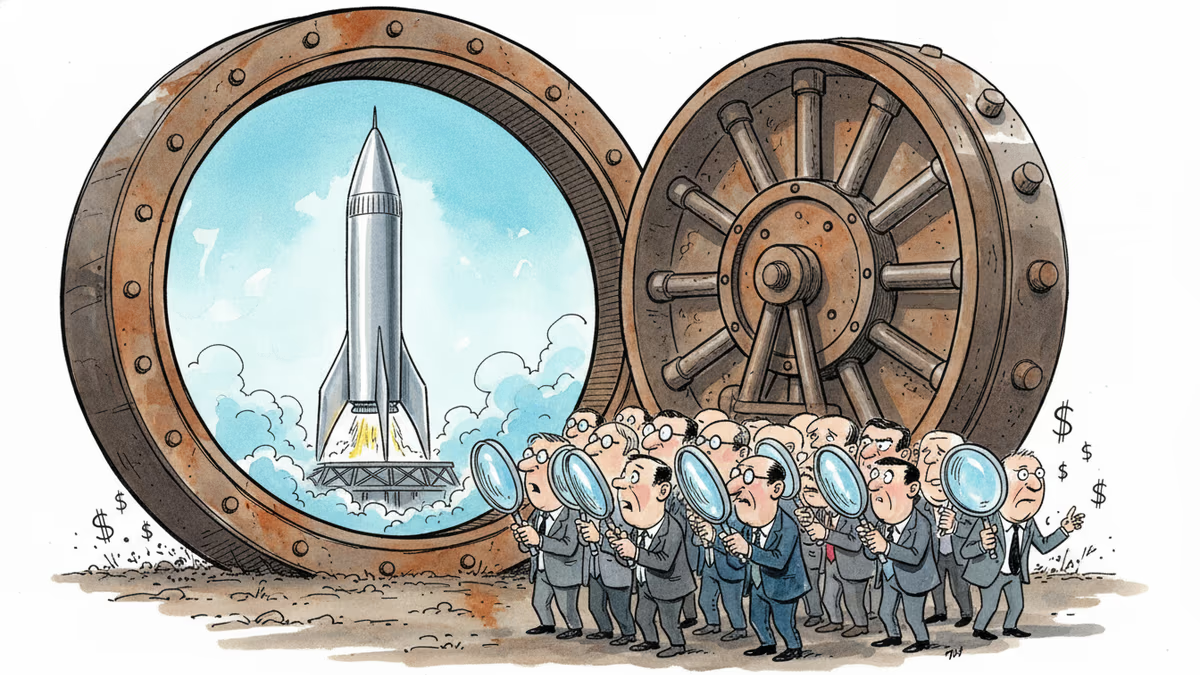
While the Western world has been fixated on China's fleet of 'Falcon 9 clones,' a far more audacious strategic pivot is underway. A new wave of Chinese launch companies is no longer just mimicking SpaceX's present; they're aggressively targeting its future. By abandoning the proven, partially-reusable model and leaping directly to designs mirroring the fully-reusable Starship, China is signaling its intent not just to compete, but to dominate the next era of space access. This isn't imitation; it's a calculated generational leapfrog.
Why It Matters: The Future of Space is at Stake
This shift transcends simple rocket design. It represents a fundamental challenge to Western leadership in the burgeoning cislunar economy. A successful Starship-class vehicle provides the ultra-low-cost, heavy-lift capability required for three strategic goals:
- Mega-Constellation Dominance: Deploying China's state-backed Guowang satellite internet constellation to rival Starlink becomes economically and logistically feasible.
- Lunar Supremacy: Establishing a permanent lunar presence, a stated goal for both the US and China, requires a vehicle capable of transporting massive amounts of infrastructure.
- Market Disruption: Flooding the global commercial launch market with capacity at a price point that could render most Western rockets, including those still on the drawing board, obsolete before they even fly.
For US and European launch providers still struggling to replicate the economics of the Falcon 9, China's focus on the next paradigm is a stark warning. The competitive goalposts are moving faster than anyone anticipated.

The Analysis: A Proven Playbook in a New Arena
The Falcon 9 Era Was Just a Dress Rehearsal
The recent flight of LandSpace's Zhuque-3, a classic Falcon 9 analogue, shouldn't be seen as the pinnacle of China's ambition. Instead, it represents the culmination of a 'copy and learn' phase. This is a well-worn playbook for Beijing, previously used to master and then dominate industries from high-speed rail to electric vehicles. By successfully replicating the technology of the 2010s, Chinese firms have built the technical expertise, supply chains, and talent pools necessary for a much bigger jump. The failed landing of the Zhuque-3 is not a setback, but a valuable data point in an accelerated, state-backed learning curve.
Why Leapfrog to Full Reusability?
The strategic calculus is clear. Competing head-to-head with Falcon 9 is a race for second place. SpaceX has a decade-and-a-half head start and a launch cadence that is nearly impossible to match. By targeting a Starship-like architecture, Chinese companies aim to bypass the established market and compete on the terrain of the 2030s. Success would mean leapfrogging not only SpaceX's current workhorse but also the next-generation rockets from ULA, Arianespace, and Blue Origin, positioning China as the leader in cost-per-kilogram to orbit—the single most important metric in space logistics.
PRISM's Take: The Complacency Clock is Ticking
The West's belief in its insurmountable technological lead in space is becoming its greatest vulnerability. China's pivot to Starship-class vehicles is a direct assault on that assumption. This is more than an industrial trend; it's a clear statement of geopolitical intent. Beijing views control of low-cost, high-volume space access as a non-negotiable pillar of 21st-century power. While SpaceX's visionary progress is commendable, relying on a single company to carry the torch for the entire Western world is a dangerously fragile strategy. The race for the future of space is no longer a duel; China has just turned it into a multi-front war.
Authors
Related Articles

American Airlines just signed Starlink for 500+ aircraft. It's not just about faster inflight internet — it's a calculated move in the run-up to what could be the largest IPO in history.

SpaceX's upgraded Starship V3 completed its first test flight, deploying 20 Starlink simulators but losing the Super Heavy booster. With an IPO weeks away, the stakes just got higher.

SpaceX's IPO filing puts AI at the center, claiming a $26.5 trillion market opportunity. But can Grok compete with OpenAI and Anthropic for enterprise customers?
SpaceX filed a nearly 400-page S-1 with the SEC, targeting an IPO as early as June 12. Here's what the filing reveals—and what it doesn't.
American Airlines just signed Starlink for 500+ aircraft. It's not just about faster inflight internet — it's a calculated move in the run-up to what could be the largest IPO in history.
SpaceX's upgraded Starship V3 completed its first test flight, deploying 20 Starlink simulators but losing the Super Heavy booster. With an IPO weeks away, the stakes just got higher.
SpaceX's IPO filing puts AI at the center, claiming a $26.5 trillion market opportunity. But can Grok compete with OpenAI and Anthropic for enterprise customers?
SpaceX filed a nearly 400-page S-1 with the SEC, targeting an IPO as early as June 12. Here's what the filing reveals—and what it doesn't.
Thoughts
Share your thoughts on this article
Sign in to join the conversation