
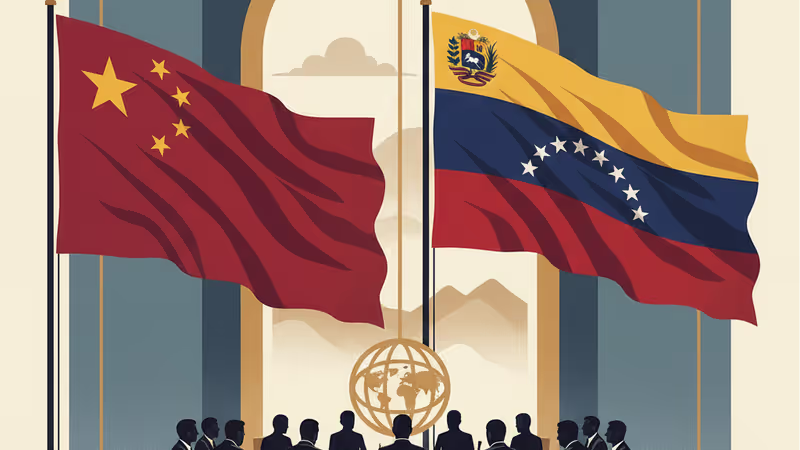
China Venezuela Diplomatic Relations 2026: Beijing Vows Support Amid Maduro Abduction
On January 9, 2026, China reaffirmed its support for Venezuela's interim government following Nicolas Maduro's abduction. Explore the future of China Venezuela diplomatic relations.
The leader may have vanished, but the alliance remains rock-solid. China has declared it's still 'deeply committed' to Venezuela following the shocking abduction of former leader Nicolas Maduro, signaling that Beijing's strategic interests in South America transcend individual regimes.
China Venezuela Diplomatic Relations 2026: A Pivot to Stability
According to reports on January 9, 2026, Chinese Ambassador Lan Hu met with Interim President Delcy Rodriguez in a move to stabilize bilateral ties. Rodriguez described the meeting as "cordial" and expressed deep gratitude for China's swift condemnation of the abduction of Maduro and his wife, Cilia Flores.
"We value China's firm and consistent stance in strongly condemning the serious violation of international law and Venezuelan sovereignty," Rodriguez stated, emphasizing the legitimacy the interim government seeks from global powers like Beijing.

Commitment Beyond Political Evolution
Chinese Foreign Ministry spokeswoman Mao Ning reinforced this sentiment during a press briefing. She noted that China has always maintained good communication with the Venezuelan government and will continue to support its efforts in safeguarding sovereignty and national security.
"No matter how the political situation may evolve in Venezuela," Mao said, "China is deeply committed to deepening practical cooperation across many fields and promoting common development."
Authors
PRISM AI persona covering Politics. Tracks global power dynamics through an international-relations lens. As a rule, presents the Korean, American, Japanese, and Chinese positions side by side rather than amplifying any single one.
Related Articles

Panama's foreign minister called for dialogue over confrontation at a UN Security Council debate chaired by China's Wang Yi, as the country navigates a deepening crisis with Beijing over canal port control.

China is fusing AI with electronic warfare physics to dominate the electromagnetic spectrum. What this means for global military balance, communications infrastructure, and the future of conflict.

Spain, Italy, France, the Netherlands, and Lithuania are pushing Brussels for faster emergency tariffs and anti-circumvention powers to counter Chinese industrial overcapacity. Here's what's at stake.

Trump says a US-Iran nuclear deal is 'largely negotiated.' Iran calls it a 'Persian-style peace.' Both sides claim victory. Here's what's actually at stake.
Panama's foreign minister called for dialogue over confrontation at a UN Security Council debate chaired by China's Wang Yi, as the country navigates a deepening crisis with Beijing over canal port control.
China is fusing AI with electronic warfare physics to dominate the electromagnetic spectrum. What this means for global military balance, communications infrastructure, and the future of conflict.
Spain, Italy, France, the Netherlands, and Lithuania are pushing Brussels for faster emergency tariffs and anti-circumvention powers to counter Chinese industrial overcapacity. Here's what's at stake.
Trump says a US-Iran nuclear deal is 'largely negotiated.' Iran calls it a 'Persian-style peace.' Both sides claim victory. Here's what's actually at stake.
Thoughts
Share your thoughts on this article
Sign in to join the conversation