
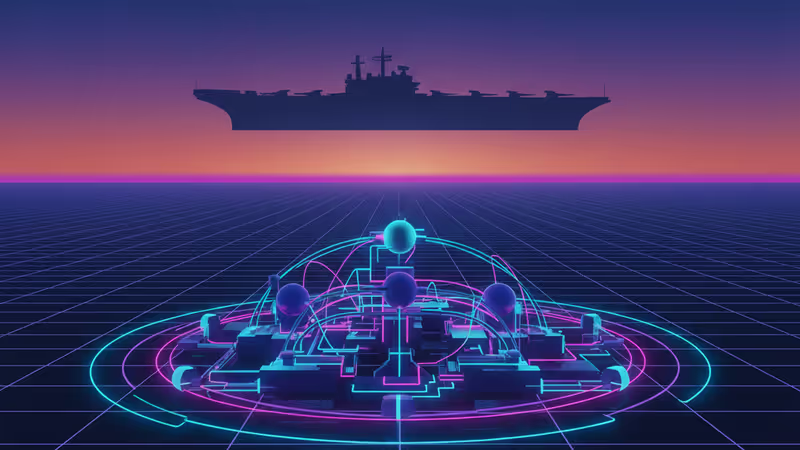
Pentagon Report: China Accelerating Quantum Tech for Future Wars, Eyes 2027 Taiwan Window
A new Pentagon report warns that Beijing is accelerating quantum technology development as a cornerstone of its military strategy, potentially eclipsing conventional assets ahead of a possible 2027 Taiwan conflict.
Is the age of the aircraft carrier over? A stark new report from the Pentagon suggests China's ultimate weapon for future warfare isn't a ship, but a quantum computer. In its annual report to Congress released on Tuesday, December 24, the U.S. Department of Defense warned that Beijing sees quantum technology as vital to its national security and is rapidly accelerating its development, a move that aligns with its goal of being ready for a Taiwan conflict by 2027.
The Pentagon's Quantum Warning
The report, delivered from Washington, details how China views technologies like quantum computing and secure quantum communications as central to its military strategy. According to Reuters, the Pentagon's assessment is that China aims to use this technological leap to break modern encryption, dominate battlefield communications, and gain an overwhelming strategic advantage through ultra-fast data processing. It's a strategy designed to fight and win a war in the information domain before a single shot is fired.

A Dual-Track Military Buildup
This focus on next-generation technology doesn't mean China is ignoring conventional arms. The same report notes Beijing's plan to triple its aircraft carrier fleet by 2035. This two-pronged approach—building a massive conventional navy while simultaneously investing in disruptive tech—suggests a calculated strategy. While carriers project power in the physical world, analysts believe China's real bet is that quantum superiority could one day render those same carrier groups obsolete and vulnerable.
Authors
Related Articles
China is restricting AI researchers and startup founders from traveling abroad as the U.S.-China AI performance gap narrows to just 2.7%. What Beijing's talent lockdown means for the global AI race.
The US government invested $2 billion in quantum computing startups, but Congress says the money was never authorized for that purpose. The fate of IBM-backed Anderon hangs in the balance.
Taiwan's Thunder Tiger became the first Asian firm to win US military drone clearance with a China-free supply chain. As Trump meets Xi, the drone arithmetic reshapes defense strategy.
TSMC has signed a 30-year power purchase agreement for 100% of output from Taiwan's Hai Long offshore wind project. The 1GW deal reveals how chipmakers are quietly becoming energy companies.
China is restricting AI researchers and startup founders from traveling abroad as the U.S.-China AI performance gap narrows to just 2.7%. What Beijing's talent lockdown means for the global AI race.
The US government invested $2 billion in quantum computing startups, but Congress says the money was never authorized for that purpose. The fate of IBM-backed Anderon hangs in the balance.
Taiwan's Thunder Tiger became the first Asian firm to win US military drone clearance with a China-free supply chain. As Trump meets Xi, the drone arithmetic reshapes defense strategy.
TSMC has signed a 30-year power purchase agreement for 100% of output from Taiwan's Hai Long offshore wind project. The 1GW deal reveals how chipmakers are quietly becoming energy companies.
Thoughts
Share your thoughts on this article
Sign in to join the conversation