
The 1-Terawatt Surge: China Solar Energy Revolution 2026 and the Chaos of Plenty
Explore the China solar energy revolution 2026. From record 92GW monthly installations to negative electricity prices, discover how oversupply is reshaping the world.
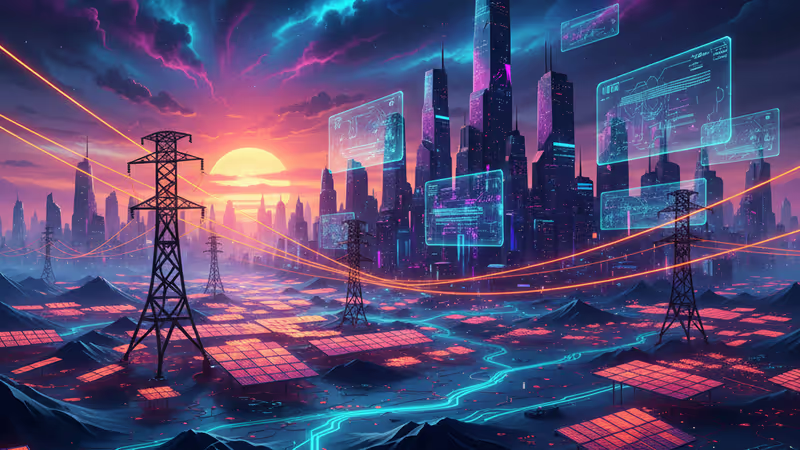
The dream of limitless energy is no longer sci-fi—it's a logistical nightmare. China is currently rewiring the planet at a brain-warping pace. While the world's total power capacity stood at 10 terawatts in 2024, the Chinese solar supply chain can now pump out 1 terawatt of panels every single year. But this transition isn't a neat, top-down utopia; it's a runaway train of competition and grid instability.
Breaking Records: The China Solar Energy Revolution 2026 Surge
The dash for solar reached a fever pitch in May 2025. Before Beijing phased out a key subsidy that pegged solar prices to coal, developers scrambled to connect to the grid. In that month alone, an eye-watering 92 gigawatts of capacity was added—equivalent to 3 gigawatts every day. This single-month surge dwarfed the annual records of almost every other nation.
This glut has sent global prices into a tailspin. In Europe, Chinese photovoltaic panels are so cheap they're being used as garden fencing. The average cost of generation has plunged to 4 cents per kilowatt-hour, making it perhaps the cheapest energy source in human history. Yet, this success is built on a gauntlet of survival where manufacturers are bleeding cash to maintain market share.

Negative Prices and the Grid's Death Spiral
The sheer volume of electricity is overwhelming technical infrastructure. In Shandong Province, negative electricity prices have become a common occurrence during the day. Grid managers are struggling to balance the intermittent flow of solar with traditional coal and nuclear plants that can't be easily throttled. According to the South China Morning Post, voltage fluctuations in the western Xinjiang region even caused a regional blackout, threatening the national system.
The disruption is global. In Pakistan, millions have installed cheap panels to flee an unreliable national grid, leading to a 'death spiral' where remaining customers face higher costs. While this helps the environment, it undermines the economics of major state-funded infrastructure projects, creating a new brand of geopolitical friction.
Authors
Related Articles
Fusion startup Helion achieved 150 million degrees Celsius in its reactor, three-quarters toward commercial viability. With a Microsoft contract for 2028, can fusion finally deliver on decades of promises?

Trump Media's merger with fusion firm TAE Technologies is more than a bizarre deal. It's a high-stakes gamble on the future of energy, politics, and deep-tech finance.
Samsung Electronics' union branch revealed that 84% of survey respondents oppose the government's roughly $290 billion (₩400 trillion) semiconductor megaproject in Gwangju. Government, management, the union and shareholders are all reading the same national project in sharply different ways.

Nvidia shipped roughly a billion RISC-V cores in 2024, then announced it would run CUDA on the open standard. We break down how royalty-free instruction sets and open software stacks are trying to route around CUDA's lock-in. Part 2 of the Semiconductor Sovereignty series.
Fusion startup Helion achieved 150 million degrees Celsius in its reactor, three-quarters toward commercial viability. With a Microsoft contract for 2028, can fusion finally deliver on decades of promises?
Trump Media's merger with fusion firm TAE Technologies is more than a bizarre deal. It's a high-stakes gamble on the future of energy, politics, and deep-tech finance.
Samsung Electronics' union branch revealed that 84% of survey respondents oppose the government's roughly $290 billion (₩400 trillion) semiconductor megaproject in Gwangju. Government, management, the union and shareholders are all reading the same national project in sharply different ways.
Nvidia shipped roughly a billion RISC-V cores in 2024, then announced it would run CUDA on the open standard. We break down how royalty-free instruction sets and open software stacks are trying to route around CUDA's lock-in. Part 2 of the Semiconductor Sovereignty series.
Thoughts
Share your thoughts on this article
Sign in to join the conversation