
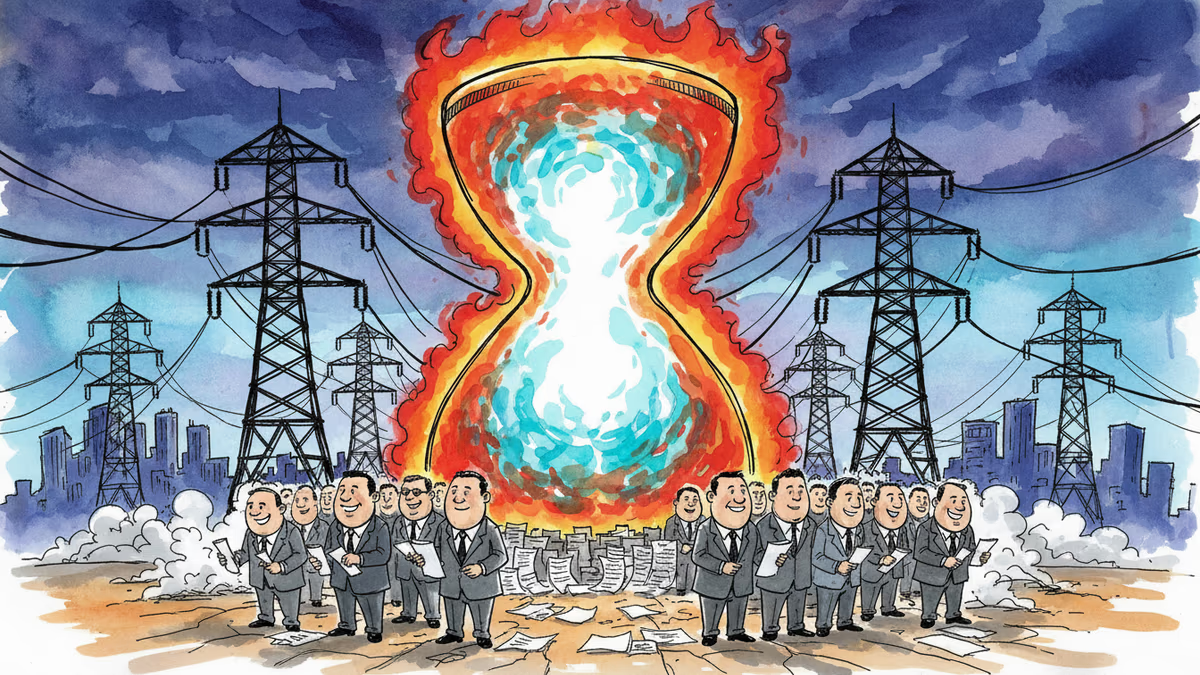
Helion Hits 150 Million Degrees: Is 2028 Fusion Power More Than Hype?
Fusion startup Helion achieved 150 million degrees Celsius in its reactor, three-quarters toward commercial viability. With a Microsoft contract for 2028, can fusion finally deliver on decades of promises?
The $450 Million Week That Changed Everything
Fusion energy just had its biggest week in decades. While Helion announced hitting 150 million degrees Celsius in its reactor—three-quarters of the way to commercial viability—Inertia Enterprises closed a $450 million Series A round. Add Commonwealth Fusion Systems' $863 million raise last summer and Type One Energy's $250 million round in progress, and you're looking at nearly $2 billion flowing into fusion in less than a year.
But here's what makes Helion different: while competitors target the early 2030s, this Washington-based startup has a contract to sell electricity to Microsoft starting in 2028. That's not a research milestone—it's a commercial deadline.
The Race Nobody Expected to Be This Close
Every fusion company faces different technical hurdles based on their reactor design. Commonwealth Fusion Systems needs plasmas above 100 million degrees in their tokamak—a doughnut-shaped device using powerful magnets. Helion's "field-reversed configuration" looks like an hourglass and requires nearly twice that temperature: 200 million degrees.
The physics sound impossible, but the timeline is getting real. CEO David Kirtley says they've reached 150 million degrees using deuterium-tritium fuel, making Helion the first fusion company to operate with this fuel mix. "We were able to see the fusion power output increase dramatically as expected in the form of heat," he told TechCrunch.
What Microsoft's Bet Really Means

Microsoft isn't known for moonshot energy bets. The company's 2028 power purchase agreement with Helion signals something beyond venture capital optimism—it suggests corporate America is hedging against the possibility that fusion actually works.
That hedge makes sense when you consider the alternatives. Solar and wind require massive storage infrastructure. Nuclear fission faces public resistance and regulatory delays. If fusion delivers even 50 megawatts reliably—Helion's target for their Orion reactor—it could reshape how tech giants think about powering data centers.
The Fuel Problem Nobody Talks About
Here's where Helion's approach gets interesting and risky. While most fusion companies plan to use deuterium-tritium and extract energy as heat, Helion wants to use deuterium-helium-3 and generate electricity directly from the fusion reaction's magnetic field.
The problem? Helium-3 is common on the Moon but rare on Earth. Helion must manufacture its own fuel by fusing deuterium nuclei first. Kirtley says they've achieved "very high efficiencies in terms of both throughput and purity," but scaling fuel production for commercial operation remains unproven.
Interestingly, Kirtley hints Helion might sell helium-3 to competitors: "Other folks will want to be using helium-3 fuel as well." That suggests the company sees itself not just as a power generator, but potentially as a fuel supplier for the entire fusion industry.
The Scientific Breakeven Question
When asked whether Helion had reached scientific breakeven—the point where fusion generates more energy than it consumes—Kirtley deflected: "We focus on the electricity piece, making electricity, rather than the pure scientific milestones."
That's either confidence or clever marketing. Scientific breakeven has been fusion's holy grail for decades. If Helion has achieved it with deuterium-tritium fuel, it would be the biggest energy breakthrough since the steam engine. If they haven't, their 2028 timeline looks increasingly ambitious.
Authors
Related Articles
Explore the China solar energy revolution 2026. From record 92GW monthly installations to negative electricity prices, discover how oversupply is reshaping the world.
MIT and CFS are revolutionizing the energy sector with the ARC fusion roadmap. Using ReBCO tape, they reached 20 tesla with just 30 watts, aiming for commercial power by 2030.

Trump Media's merger with fusion firm TAE Technologies is more than a bizarre deal. It's a high-stakes gamble on the future of energy, politics, and deep-tech finance.

Five stories from late September, traced to where the paper trail stops: Korea's export record, Nvidia's Hugging Face 8-K, a US-China AI channel, the UN on AI, and rising births.
Explore the China solar energy revolution 2026. From record 92GW monthly installations to negative electricity prices, discover how oversupply is reshaping the world.
MIT and CFS are revolutionizing the energy sector with the ARC fusion roadmap. Using ReBCO tape, they reached 20 tesla with just 30 watts, aiming for commercial power by 2030.
Trump Media's merger with fusion firm TAE Technologies is more than a bizarre deal. It's a high-stakes gamble on the future of energy, politics, and deep-tech finance.
Five stories from late September, traced to where the paper trail stops: Korea's export record, Nvidia's Hugging Face 8-K, a US-China AI channel, the UN on AI, and rising births.
Thoughts
Share your thoughts on this article
Sign in to join the conversation