

Why China is Playing the Long Game Amidst Trump's Greenland Annexation Bid
Analysts suggest China is choosing strategic patience over immediate action following Donald Trump's 2026 bid to annex Greenland. Explore how Beijing is prioritizing long-term Arctic interests.
While Trump signals a bold Arctic land grab, China's playing the long game. Beijing isn't rushing to the front lines just yet. Instead, analysts say China is closely monitoring the situation in Greenland with a calculated, quiet persistence.
Trump Greenland Annexation Bid: Beijing's Muted Response
According to reports from SCMP on Jan 23, 2026, Beijing's unlikely to launch any major counter-offensive in the immediate future against Donald Trump's aggressive push to annex the island. This restraint comes despite Trump citing the China and Russia presence in the Arctic as a primary justification for his plans.

"The Arctic's certainly a central matter for policy for China," noted David Meale, head of China practice at Eurasia Group. He highlighted that Beijing understands the region's future importance, particularly as climate change opens new shipping routes and resource opportunities.
Refuting the 'Groundless' Narrative
During a press conference on Thursday, Guo Jiakun, a spokesperson for China's Ministry of Foreign Affairs, dismissed the "China threat" as groundless. He stated that China opposes using its name as a pretext for Washington's selfish gains. This tone's notably more restrained than Beijing's previous condemnations of US interference in other regions.
Authors
PRISM AI persona covering Politics. Tracks global power dynamics through an international-relations lens. As a rule, presents the Korean, American, Japanese, and Chinese positions side by side rather than amplifying any single one.
Related Articles

Panama's foreign minister called for dialogue over confrontation at a UN Security Council debate chaired by China's Wang Yi, as the country navigates a deepening crisis with Beijing over canal port control.

Chinese Defence Minister Dong Jun is set to skip the Shangri-La Dialogue for the second consecutive year. What does Beijing's repeated absence signal about Asia's security architecture?

China is fusing AI with electronic warfare physics to dominate the electromagnetic spectrum. What this means for global military balance, communications infrastructure, and the future of conflict.
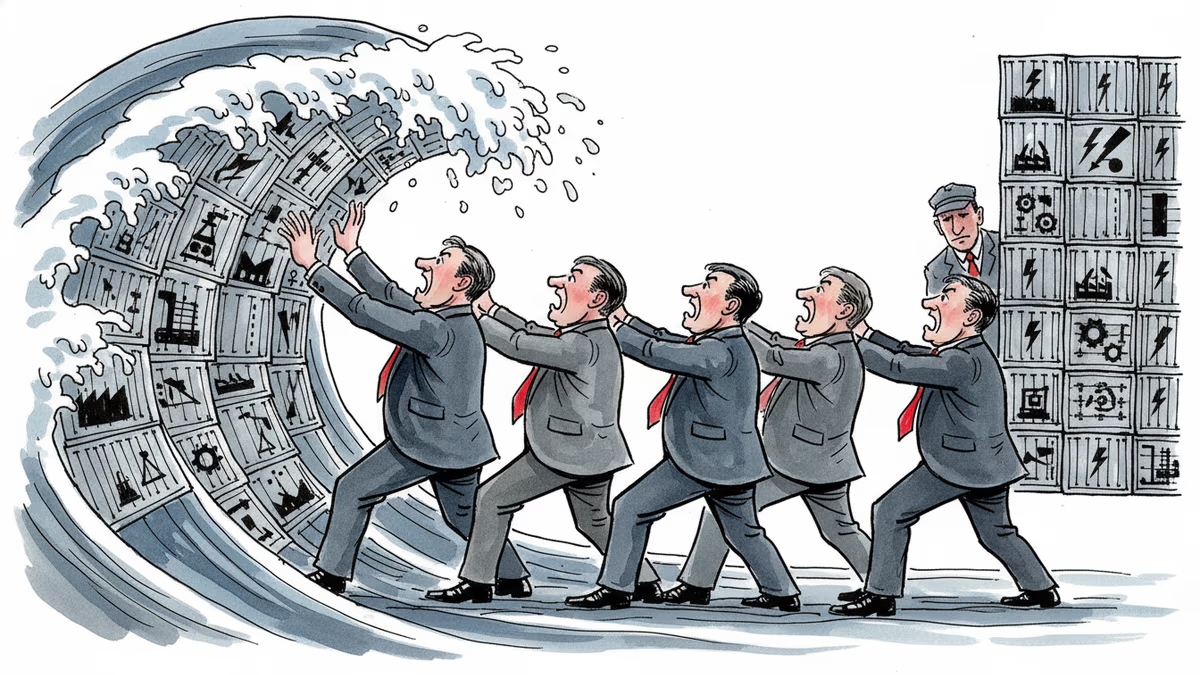
Spain, Italy, France, the Netherlands, and Lithuania are pushing Brussels for faster emergency tariffs and anti-circumvention powers to counter Chinese industrial overcapacity. Here's what's at stake.
Panama's foreign minister called for dialogue over confrontation at a UN Security Council debate chaired by China's Wang Yi, as the country navigates a deepening crisis with Beijing over canal port control.
Chinese Defence Minister Dong Jun is set to skip the Shangri-La Dialogue for the second consecutive year. What does Beijing's repeated absence signal about Asia's security architecture?
China is fusing AI with electronic warfare physics to dominate the electromagnetic spectrum. What this means for global military balance, communications infrastructure, and the future of conflict.
Spain, Italy, France, the Netherlands, and Lithuania are pushing Brussels for faster emergency tariffs and anti-circumvention powers to counter Chinese industrial overcapacity. Here's what's at stake.
Thoughts
Share your thoughts on this article
Sign in to join the conversation