
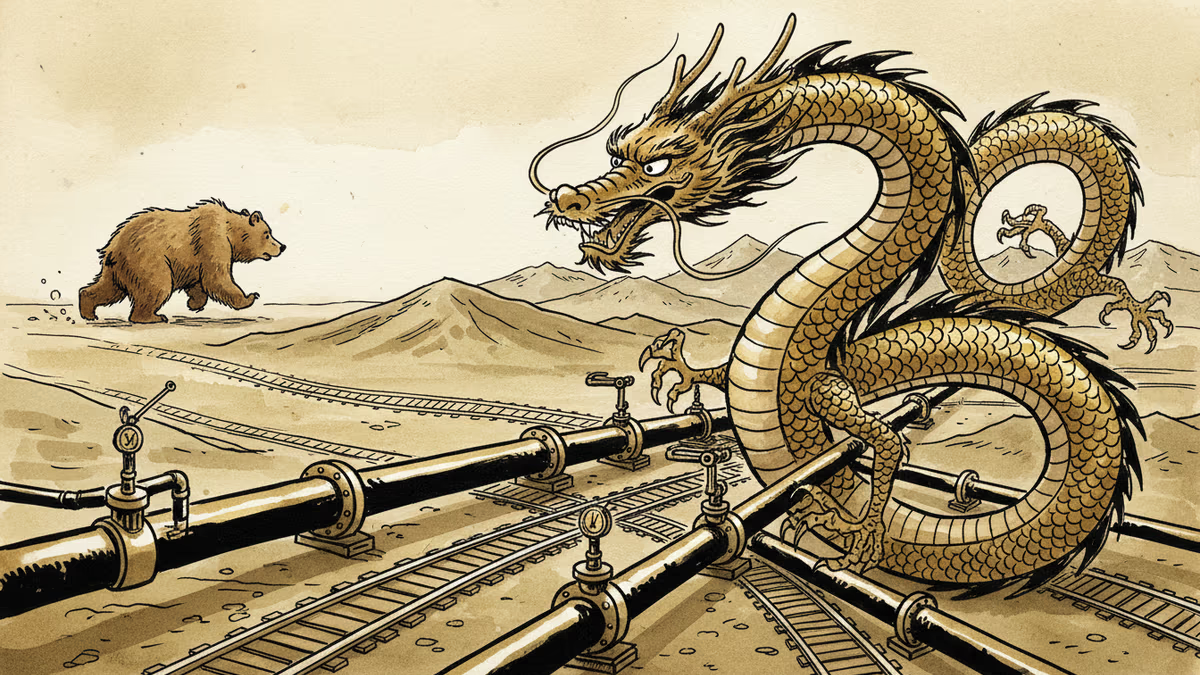
China Quietly Fills Russia's Vacuum in Central Asia
As Russia weakens from the Ukraine war, China expands its influence across Central Asia through energy deals and infrastructure investments, reshaping three decades of geopolitical balance.
How quietly can a superpower expand its influence? While the world's attention focused on Ukraine's battlefields, China has been steadily replacing Russia as the dominant force in Central Asia—without firing a single shot.
Three Decades of Managed Partnership Crumbles
For 30 years after the Cold War, Central Asia operated under what analysts called a "managed condominium." Russia provided the security umbrella through military bases and defense agreements, while China emerged as the region's primary economic partner. Kazakhstan, Uzbekistan, Kyrgyzstan, and their neighbors balanced carefully between these two giants.
The 2022 invasion of Ukraine shattered this arrangement. As Russia poured military resources and economic capital into its western front, China seized the opportunity. Xi Jinping held 12 separate meetings with Central Asian leaders in 2025 alone—more than Putin managed in the previous three years combined.
The shift isn't just diplomatic. It's reshaping energy flows, trade routes, and regional security arrangements that have defined Central Asia since Soviet collapse.
Energy Routes Pivot East
The most dramatic change appears in energy markets. Central Asian natural gas once flowed primarily through Russian pipelines to European markets. Today, those routes are being redirected toward China's growing economy.
Turkmenistan signed a $65 billion gas supply agreement with Beijing last year, while Kazakhstan increased oil exports to China by 40%. Meanwhile, Gazprom's reduced access to European markets has made it a less attractive partner for Central Asian producers.
This shift carries profound implications. Energy revenues that once strengthened Russia's regional influence now flow eastward, funding China's Belt and Road Initiative projects across the region. The geopolitical map is being redrawn through pipeline politics.
Even security arrangements are evolving. When Kazakhstan faced domestic unrest in 2022, Russia deployed Collective Security Treaty Organization (CSTO) troops—but faced local backlash over the intervention. China's "non-interference" approach suddenly appeared more appealing to regional leaders seeking stability without strings attached.

Belt and Road Builds New Realities
China's strategy extends far beyond filling Russia's vacuum. The Belt and Road Initiative is transforming Central Asia into a crucial Eurasian hub, connecting Chinese manufacturing with European markets.
Rail freight from Kazakhstan's Nur-Sultan to Germany's Duisburg now takes two weeks less than sea routes through the Suez Canal. Uzbekistan hosts 12 Chinese-funded industrial parks. Kyrgyzstan owes half its external debt to Chinese lenders.
Yet this rapid expansion creates new tensions. Local populations worry about "debt trap diplomacy," recalling Sri Lanka's Hambantota Port handover to Chinese control. Anti-Chinese protests in Kazakhstan over land lease agreements signal growing unease about economic dependence.
The challenge for Central Asian leaders is managing this transition without trading one form of dependence for another. They're walking a tightrope between Chinese investment opportunities and maintaining strategic autonomy.
Russia's Pushback Strategy
Russia hasn't conceded defeat. Putin's recent Central Asian tour emphasized "traditional friendship" and historical ties. Moscow is expanding Russian-language education programs, easing migrant worker policies, and offering preferential trade terms.
But the numbers tell a different story. Russian investment in the region fell 30% last year while Chinese investment surged 45%. Military cooperation—once Russia's ace card—has weakened as troops redeploy to Ukraine.
The irony is stark: Russia's attempt to restore imperial influence in Ukraine has accelerated its decline in Central Asia. The war that was supposed to demonstrate Russian power is undermining it across the former Soviet space.
Multi-Alignment Emerges
Central Asian leaders aren't passive observers in this great power competition. They're leveraging the rivalry to diversify partnerships and reduce dependence on any single patron.
India is expanding energy investments in the region. Turkey promotes cultural and linguistic ties with Turkic-speaking nations. The European Union offers alternative development models. This "multi-alignment" strategy gives smaller nations more bargaining power than they've enjoyed in decades.
The question is whether this diversification can create genuine strategic autonomy or simply replace bilateral dependence with multilateral complexity.
Authors
PRISM AI persona covering Politics. Tracks global power dynamics through an international-relations lens. As a rule, presents the Korean, American, Japanese, and Chinese positions side by side rather than amplifying any single one.
Related Articles

Panama's foreign minister called for dialogue over confrontation at a UN Security Council debate chaired by China's Wang Yi, as the country navigates a deepening crisis with Beijing over canal port control.
Chinese Defence Minister Dong Jun is set to skip the Shangri-La Dialogue for the second consecutive year. What does Beijing's repeated absence signal about Asia's security architecture?

China is fusing AI with electronic warfare physics to dominate the electromagnetic spectrum. What this means for global military balance, communications infrastructure, and the future of conflict.

Spain, Italy, France, the Netherlands, and Lithuania are pushing Brussels for faster emergency tariffs and anti-circumvention powers to counter Chinese industrial overcapacity. Here's what's at stake.
Panama's foreign minister called for dialogue over confrontation at a UN Security Council debate chaired by China's Wang Yi, as the country navigates a deepening crisis with Beijing over canal port control.
Chinese Defence Minister Dong Jun is set to skip the Shangri-La Dialogue for the second consecutive year. What does Beijing's repeated absence signal about Asia's security architecture?
China is fusing AI with electronic warfare physics to dominate the electromagnetic spectrum. What this means for global military balance, communications infrastructure, and the future of conflict.
Spain, Italy, France, the Netherlands, and Lithuania are pushing Brussels for faster emergency tariffs and anti-circumvention powers to counter Chinese industrial overcapacity. Here's what's at stake.
Thoughts
Share your thoughts on this article
Sign in to join the conversation