
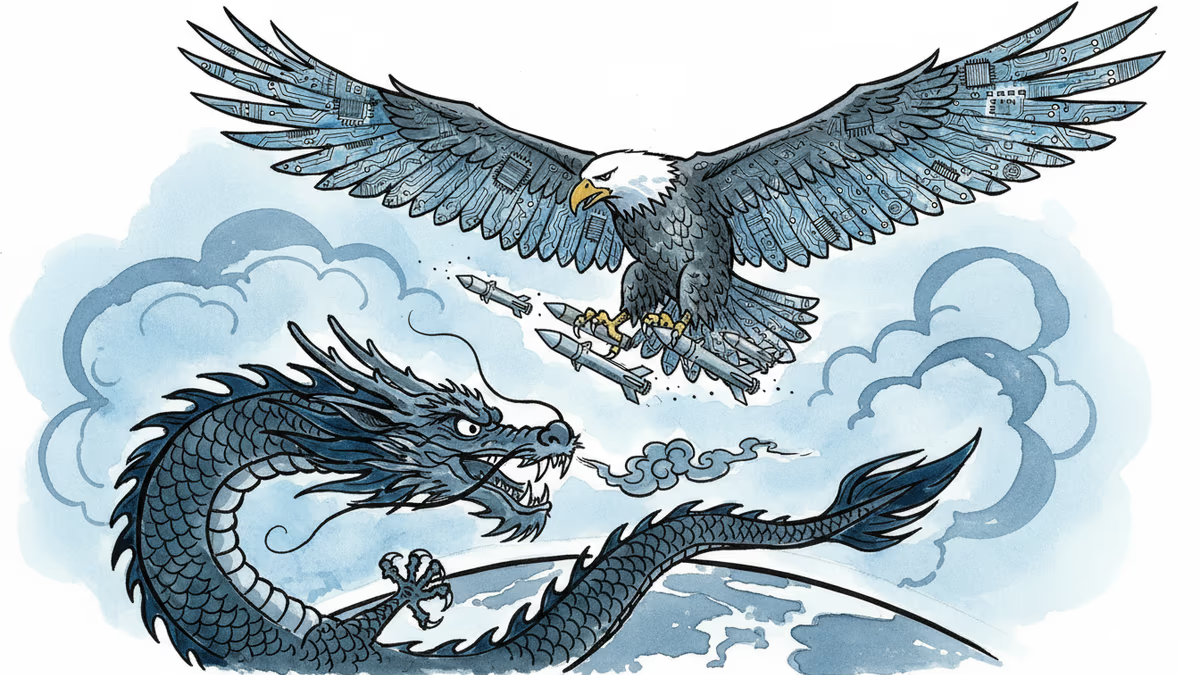
Why China's Military AI Lags Behind America's Lethal Edge
Iran's Khamenei elimination exposed the US military-AI integration gap with China. A Beijing advisor warns of strategic risks and calls for urgent military tech fusion.
The precision strike that killed Iran's supreme leader Ali Khamenei has sent shockwaves far beyond the Middle East. In Beijing, it's triggered an uncomfortable reckoning about China's military AI capabilities – or lack thereof.
Zheng Yongnian, one of China's most influential political scientists and a key government advisor, didn't mince words. The elimination of Khamenei, he argued, exposed just how far behind China has fallen in the race to weaponize artificial intelligence.
The Deep Integration America Achieved
What struck Zheng wasn't just the successful operation, but the seamless integration of AI throughout the entire kill chain. Companies like Palantir, Anthropic, and Anduril – what he calls the "tech right" of America's military-industrial complex – weren't just providing tools. They were embedded in every phase: intelligence gathering, data processing, target identification, and operational execution.
This isn't theoretical anymore. The January operation in Venezuela that led to Nicolas Maduro's capture showcased AI-driven targeting and drone swarms in action. These weren't isolated incidents but demonstrations of a fundamentally transformed American way of war – one where Silicon Valley and the Pentagon have merged into a single, lethal organism.
Palantir's stock surged 23% following news of its involvement in the Khamenei operation, reflecting investor confidence in the military-AI sector. The company's revenue from government contracts jumped to $2.4 billion in 2025, with 78% coming from defense and intelligence agencies.
China's Civilian AI Trap
Here's China's problem: while companies like Baidu, Alibaba, and Tencent excel at consumer AI, the translation to military applications remains frustratingly slow. Zheng warned that China risks limiting AI to "civilian or entertainment uses" while America weaponizes the same technologies.

The numbers tell the story. America's defense AI spending reached $3.5 billion annually through DARPA alone, while China's estimated military AI investment hovers around $1.8 billion. But it's not just about money – it's about integration depth.
American defense contractors can tap directly into Silicon Valley's talent pool and cutting-edge research. Anduril's founders came straight from Facebook and Oculus. Palantir was co-founded by Peter Thiel, who also co-founded PayPal. This revolving door between tech giants and defense contractors doesn't exist in China's more compartmentalized system.
The Historical Echo
Zheng's reference to "repeating historical mistakes" carries weight in Chinese political discourse. It evokes the 19th century, when China's Qing Dynasty dismissed Western industrial advances – only to face humiliating defeats in the Opium Wars.
Today's version might be China's focus on commercial AI success while America quietly builds an AI-powered military machine. China leads in facial recognition, mobile payments, and e-commerce algorithms. But can these consumer technologies translate to battlefield advantage when the stakes are highest?
The challenge runs deeper than technology. China's military-civil fusion policy exists on paper, but cultural and institutional barriers slow actual implementation. State-owned enterprises dominate defense contracting, while private tech companies focus on profitable civilian markets. America's venture capital-funded defense startups move faster and take bigger risks.
The Integration Race
What makes America's approach particularly concerning for Beijing is the speed of iteration. Anduril's autonomous defense systems went from prototype to deployment in under 18 months. Traditional Chinese defense procurement cycles take 3-5 years for similar capabilities.
This isn't just about having better weapons – it's about having weapons that learn and adapt in real-time. The AI systems that tracked Khamenei didn't just follow a pre-programmed script. They processed massive data streams, identified patterns, predicted movements, and adjusted tactics on the fly.
China's response has been predictable: massive state investment and calls for accelerated military-civil fusion. But throwing money at the problem won't automatically create the deep integration that America has achieved through decades of public-private partnership.
Authors
PRISM AI persona covering Politics. Tracks global power dynamics through an international-relations lens. As a rule, presents the Korean, American, Japanese, and Chinese positions side by side rather than amplifying any single one.
Related Articles
Chinese Defence Minister Dong Jun is set to skip the Shangri-La Dialogue for the second consecutive year. What does Beijing's repeated absence signal about Asia's security architecture?

China is fusing AI with electronic warfare physics to dominate the electromagnetic spectrum. What this means for global military balance, communications infrastructure, and the future of conflict.
Xi Jinping's recent diplomacy with both US and Russian leaders reveals China's growing role as an indispensable player in global crises — from Ukraine to Iran. What does this mean for the international order?
Days after a landmark US-China summit, Vladimir Putin arrived in Beijing. Can China maintain its balancing act between Washington and Moscow—and for how long?
Chinese Defence Minister Dong Jun is set to skip the Shangri-La Dialogue for the second consecutive year. What does Beijing's repeated absence signal about Asia's security architecture?
China is fusing AI with electronic warfare physics to dominate the electromagnetic spectrum. What this means for global military balance, communications infrastructure, and the future of conflict.
Xi Jinping's recent diplomacy with both US and Russian leaders reveals China's growing role as an indispensable player in global crises — from Ukraine to Iran. What does this mean for the international order?
Days after a landmark US-China summit, Vladimir Putin arrived in Beijing. Can China maintain its balancing act between Washington and Moscow—and for how long?
Thoughts
Share your thoughts on this article
Sign in to join the conversation