

Demis Hassabis: Chinese AI Models Gap Shrinks to "A Matter of Months"
Google DeepMind CEO Demis Hassabis warns that the Chinese AI models gap has shrunk to just months. Learn about the rapid progress and the remaining 'innovation' hurdle.
The lead is evaporating. Google DeepMind CEO Demis Hassabis warns that Chinese AI models are now just "a matter of months" behind Western capabilities. This assessment challenges the long-held belief that China remains significantly behind in the global AI race.
Closing the Chinese AI Models Gap: From Scaling to Frontiers
Speaking on CNBC's 'The Tech Download' podcast, Hassabis noted that China's progress is much more rapid than anticipated one or two years ago. The emergence of DeepSeekabout a year ago served as a wake-up call, proving that high-performance models could be built on less advanced hardware at a fraction of the cost. Giants like Alibaba and startups like Moonshot AI are now consistently releasing highly capable models.
The 'Copy vs. Invent' Dilemma

Despite the rapid catch-up, Hassabis points to a critical hurdle: the ability to innovate "beyond the frontier." While China excels at scaling known technologies, it has yet to produce a breakthrough equivalent to Google's 2017Transformer paper. Hassabis argues that inventing a new paradigm is "100 times harder" than copying one, framing the challenge as a matter of scientific "mentality."
Infrastructure and the Nvidia Factor
The physical limits of compute also play a role. While Nvidia CEO Jensen Huang previously acknowledged that China is "right there" regarding models, export bans remain a bottleneck. Alibaba's Lin Junyang recently estimated a less than 20% chance of Chinese firms surpassing US giants in the next 3 to 5 years, citing that US computing infrastructure is "one to two orders of magnitude" larger.
Authors
Related Articles
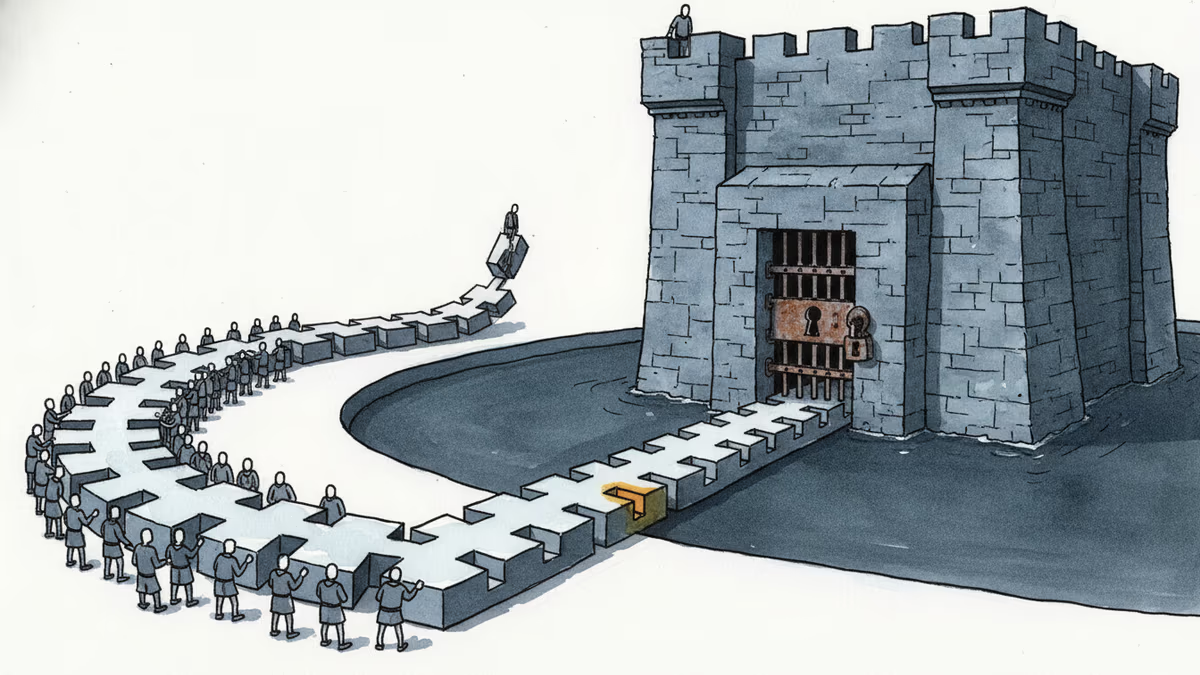
Nvidia shipped roughly a billion RISC-V cores in 2024, then announced it would run CUDA on the open standard. We break down how royalty-free instruction sets and open software stacks are trying to route around CUDA's lock-in. Part 2 of the Semiconductor Sovereignty series.
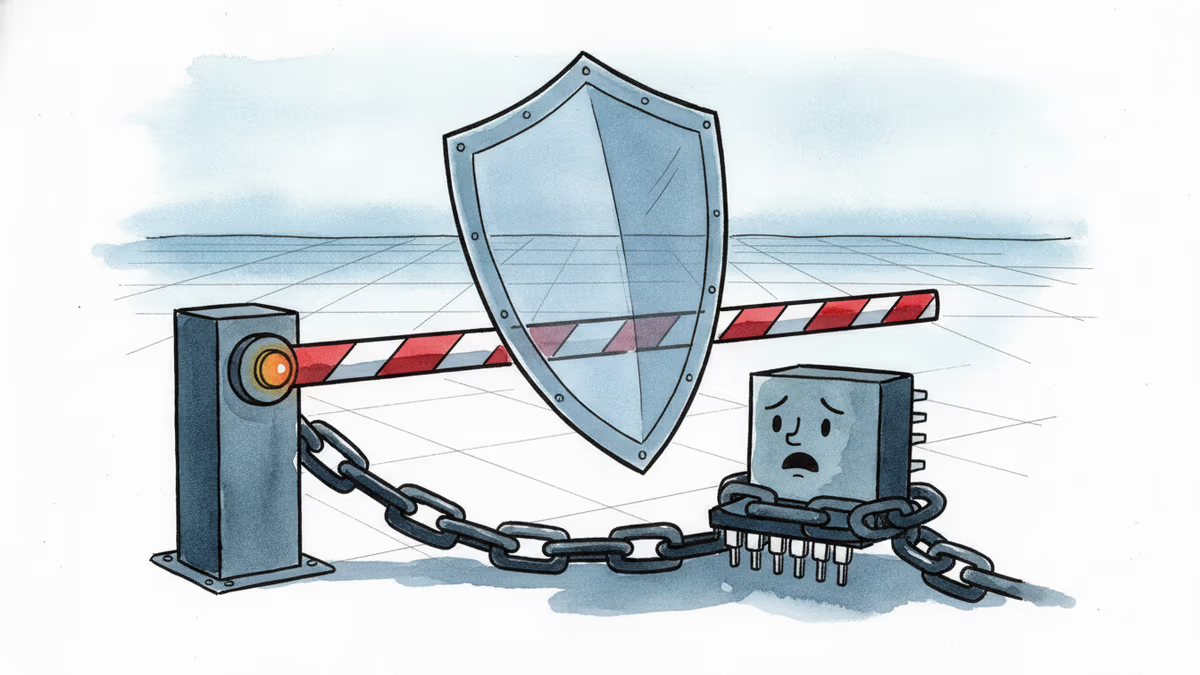
US AI-chip export controls split into three layers in the first half of 2026 — January easing, a May crackdown on circumvention, and a pending bill. Nvidia erased China from its guidance and still posted a record $81.6 billion quarter. A look at the export policy that both shields and cages it.
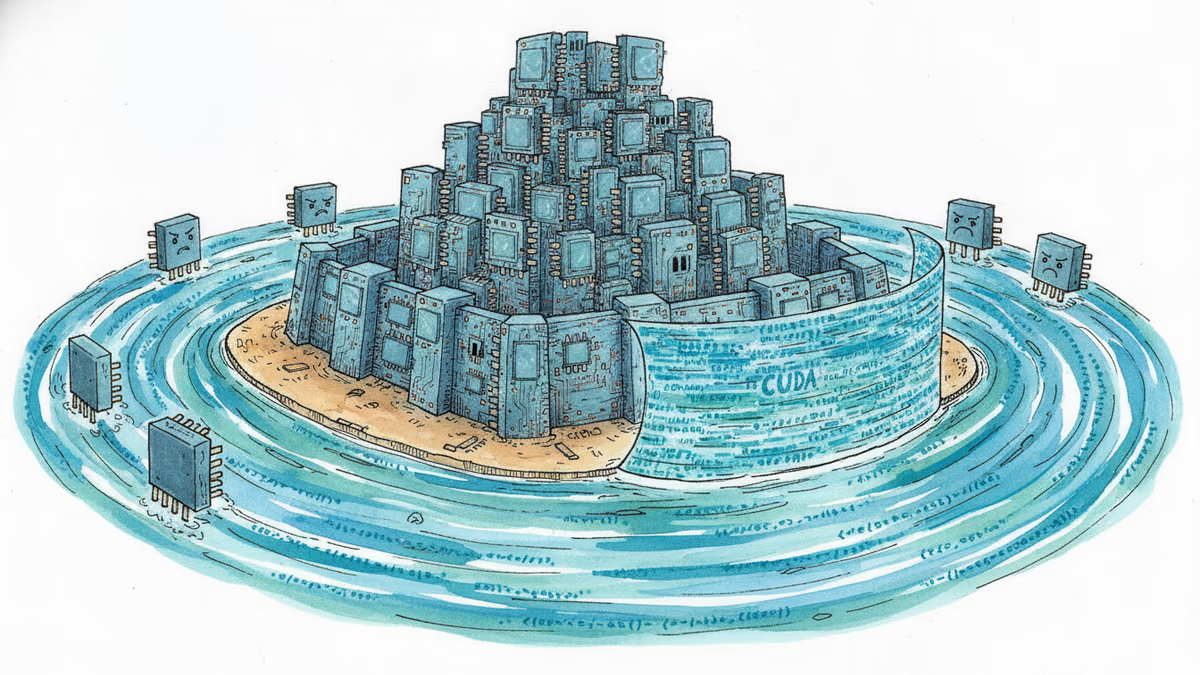
AMD's MI325X matches or beats Nvidia on memory and bandwidth — yet Nvidia's 86-92% share holds. The real moat is CUDA, 20 years in the making. Part 1 of 4.

Snowflake's new $6 billion AWS contract is about more than cloud spending. It signals a shift in AI infrastructure—away from Nvidia GPUs and toward cheaper, homegrown chips for the agent era.
Nvidia shipped roughly a billion RISC-V cores in 2024, then announced it would run CUDA on the open standard. We break down how royalty-free instruction sets and open software stacks are trying to route around CUDA's lock-in. Part 2 of the Semiconductor Sovereignty series.
US AI-chip export controls split into three layers in the first half of 2026 — January easing, a May crackdown on circumvention, and a pending bill. Nvidia erased China from its guidance and still posted a record $81.6 billion quarter. A look at the export policy that both shields and cages it.
AMD's MI325X matches or beats Nvidia on memory and bandwidth — yet Nvidia's 86-92% share holds. The real moat is CUDA, 20 years in the making. Part 1 of 4.
Snowflake's new $6 billion AWS contract is about more than cloud spending. It signals a shift in AI infrastructure—away from Nvidia GPUs and toward cheaper, homegrown chips for the agent era.
Thoughts
Share your thoughts on this article
Sign in to join the conversation