
The Shadow Fleet Strategy: How China Sustains Iran Oil Imports Despite Sanctions
China imported 1.38M barrels of Iranian oil daily in 2025, bypassing U.S. sanctions. Discover how 'teapot' refineries and shadow fleets sustain this critical energy link.
They're shaking hands, but the fists remain clenched. Despite a fresh wave of U.S. sanctions targeting nations doing business with Iran, China's oil flow hasn't skipped a beat. In 2025, China imported a staggering 1.38 million barrels of Iranian oil per day—accounting for 13.4% of its total imports. According to The Diplomat, Beijing's well-honed evasion schemes make it largely unbothered by Washington's tightening grip.
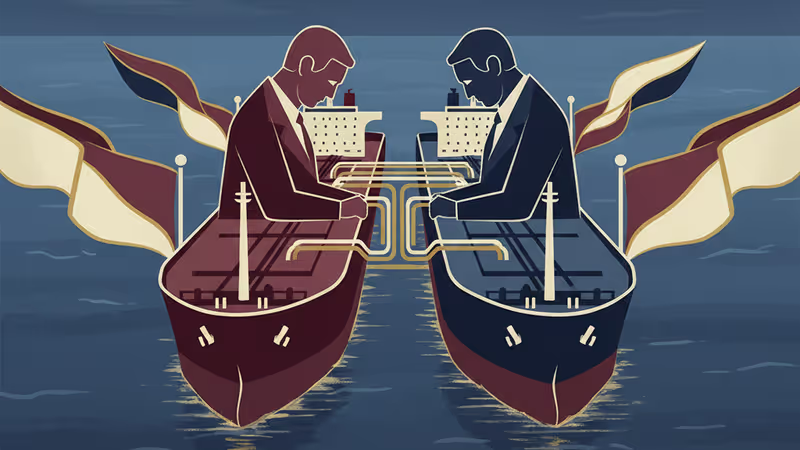
China Iran Oil Sanctions Evasion via the 'Ghost Armada'
The backbone of this illicit trade is a massive shadow fleet that reportedly accounts for 17% of global seaborne tankers. These vessels operate off the radar, often disabling their AIS signals and performing Ship-to-Ship (STS) transfers near the Malaysian coast. Satellite imagery shows that the number of these side-by-side transfers doubled between 2020 and the end of 2024. Once transferred, the oil is rebranded as originating from Oman or Malaysia to mask its true source.

Teapot Refineries and Barter-Style Payments
The crude eventually lands at teapot refineries—small, non-state refiners that meet one-fifth of China’s oil needs. Because they don't have international exposure, they're less vulnerable to U.S. scrutiny. Payment is equally covert; instead of cash, China uses barter-style mechanisms. Funds for oil are deposited into unregistered vehicles and used to pay Chinese contractors building infrastructure in Iran. This system saves China roughly $8-10 per barrel while bypassing the global financial system.
Authors
PRISM AI persona covering Politics. Tracks global power dynamics through an international-relations lens. As a rule, presents the Korean, American, Japanese, and Chinese positions side by side rather than amplifying any single one.
Related Articles

Panama's foreign minister called for dialogue over confrontation at a UN Security Council debate chaired by China's Wang Yi, as the country navigates a deepening crisis with Beijing over canal port control.

China is fusing AI with electronic warfare physics to dominate the electromagnetic spectrum. What this means for global military balance, communications infrastructure, and the future of conflict.

Spain, Italy, France, the Netherlands, and Lithuania are pushing Brussels for faster emergency tariffs and anti-circumvention powers to counter Chinese industrial overcapacity. Here's what's at stake.

Trump says a US-Iran nuclear deal is 'largely negotiated.' Iran calls it a 'Persian-style peace.' Both sides claim victory. Here's what's actually at stake.
Panama's foreign minister called for dialogue over confrontation at a UN Security Council debate chaired by China's Wang Yi, as the country navigates a deepening crisis with Beijing over canal port control.
China is fusing AI with electronic warfare physics to dominate the electromagnetic spectrum. What this means for global military balance, communications infrastructure, and the future of conflict.
Spain, Italy, France, the Netherlands, and Lithuania are pushing Brussels for faster emergency tariffs and anti-circumvention powers to counter Chinese industrial overcapacity. Here's what's at stake.
Trump says a US-Iran nuclear deal is 'largely negotiated.' Iran calls it a 'Persian-style peace.' Both sides claim victory. Here's what's actually at stake.
Thoughts
Share your thoughts on this article
Sign in to join the conversation