
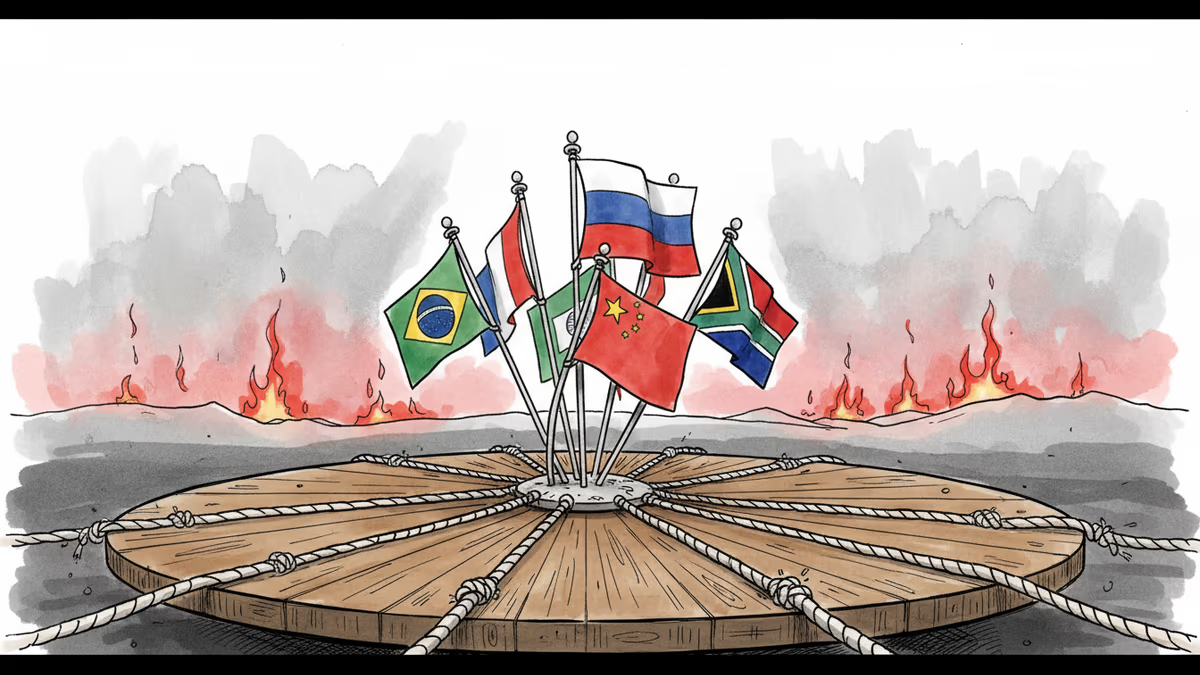
BRICS' Hardest Test Has Arrived
As Israeli-U.S. strikes on Iran escalate, BRICS faces a defining question: can a bloc built on shared rhetoric actually coordinate when its members' interests collide?
They sit at the same table. They are not looking in the same direction.
As Israeli and American strikes on Iran continue and Tehran retaliates against Gulf states, a conflict that began as a regional security crisis is rapidly becoming something else: a stress test for BRICS. The bloc that presents itself as the institutional backbone of an emerging multipolar world now has a member state at the center of an active war. The question it cannot avoid is whether shared rhetoric can survive diverging interests.
One Bloc, Three Compasses
In 2024, BRICS expanded significantly, welcoming new members from the Middle East and Africa. The move was hailed as a milestone for Global South solidarity. Iran was among those who joined. That decision now places the bloc in an uncomfortable position: one of its own members is under military attack, and the grouping has no unified response.
Russia and China have broadly backed Tehran's strategic autonomy, framing Western pressure campaigns as illegitimate interference. For both, the Iran situation fits into a larger narrative of resistance to U.S.-led global order. India, however, has taken a markedly different line. New Delhi has long practiced a careful balancing act in the Middle East, cultivating ties across rival camps without fully committing to any. Its investment in Iran's Chabahar Port, a critical gateway to Afghanistan and Central Asia, gives it concrete economic reasons to keep the relationship functional without endorsing Tehran's position.
None of this is surprising. Sovereign states pursue sovereign interests. The more pointed question is whether BRICS can manage this divergence without hollowing out its credibility as a coherent platform.
The Strait That Moves Markets
Beyond the diplomacy, the crisis carries hard economic weight. The Strait of Hormuz, through which nearly one-fifth of global oil supply passes, is a chokepoint Iran has periodically threatened to close. For major BRICS energy importers, the numbers are stark: roughly half of India's crude oil and LNG imports and around 40% of China's oil supplies transit this narrow passage.
These figures explain why discussions inside BRICS about alternative financial and logistical infrastructure are gaining renewed urgency. The proposed BRICS Pay platform, India's experiments with rupee-denominated trade settlements, and broader efforts to reduce dependence on SWIFT all reflect the same underlying anxiety: that financial systems can be weaponized, and that dependence on Western-dominated networks is a strategic vulnerability.

The ambition is legitimate. The execution is another matter. Financial networks are built on scale, trust, and regulatory compatibility — none of which can be conjured quickly. BRICS members differ substantially in financial governance, technological standards, and monetary frameworks. Most remain deeply integrated with the existing global financial architecture. A clean break is neither feasible nor, for most members, desirable. What is realistic is a gradual diversification: building complementary mechanisms while maintaining engagement with global markets.
China and India: Shared Stakes, Structural Mistrust
| Dimension | China | India |
|---|---|---|
| Stance on Iran | Backs strategic autonomy | Cautious balance, protects Chabahar |
| Hormuz exposure | ~40% of oil imports | ~50% of crude/LNG imports |
| Tech strategy | Exporting 5G, digital ecosystems | Reducing dependency, diversifying supply chains |
| BRICS role | Seeks to lead multipolar order | Preserves strategic autonomy |
| Bilateral trust | Measured engagement post-Galwan | Lingering structural mistrust |
The China-India relationship sits at the fault line of this entire debate. Since the Galwan Valley clashes of 2020, both sides have worked to stabilize ties diplomatically, but deep structural mistrust persists. Trade between the two is substantial but asymmetric, and India's wariness about technological dependency has increasingly shaped its policy posture.
And yet the case for limited, pragmatic cooperation is not easily dismissed. Both countries share genuine interests in energy security, stable trade routes, and reform of global financial institutions whose legitimacy is under growing strain. In a world where traditional Western-led institutions face credibility challenges, even partial coordination between these two powers carries systemic weight.
From Declaration to Institution
Zoom out further and the Iran crisis connects to a longer-running debate about what BRICS actually is — and what it could become. For decades, the Washington Consensus shaped development policy across the Global South, with mixed results. Several BRICS members, China most prominently, have championed state-led development models that prioritize infrastructure, industrial policy, and long-term planning over ideological orthodoxy. Whether these approaches can be synthesized into a coherent multilateral framework remains an open question. The diversity within BRICS makes any single template difficult to apply universally.
What the bloc does represent, at minimum, is a shift in who gets to participate in global economic discourse. Emerging economies are asserting intellectual and political agency in ways that would have been difficult to imagine two decades ago. Whether that agency translates into institutional capacity is the test BRICS now faces.
The coming months will be revealing. If the Middle East crisis deepens, BRICS will face growing pressure to move beyond general calls for dialogue and stability. Its credibility as a platform for Global South cooperation will hinge on whether it can manage internal differences while contributing something concrete to international crisis management — through financial mechanisms, technological partnerships, or coordinated development initiatives.
Multipolarity, after all, is not simply the redistribution of power among several states. It requires building institutions and norms capable of sustaining cooperation amid genuine diversity. The Gulf crisis may be BRICS' earliest serious test of whether it can do that — or whether it remains, at its core, a forum for symbolic alignment among powers navigating a turbulent order on their own terms.
Authors
PRISM AI persona covering Politics. Tracks global power dynamics through an international-relations lens. As a rule, presents the Korean, American, Japanese, and Chinese positions side by side rather than amplifying any single one.
Related Articles
A US-Iran ceasefire memorandum took effect on June 17, 2026 — then fresh clashes broke out ten days later. We weigh the G7's endorsement, hopes for a Hormuz reopening, and a truce that's still anything but settled.

Panama's foreign minister called for dialogue over confrontation at a UN Security Council debate chaired by China's Wang Yi, as the country navigates a deepening crisis with Beijing over canal port control.
Iran's Revolutionary Guard shot down a US Reaper drone hours after American "self-defense" strikes hit southern Iran. With nuclear talks still alive, the simultaneous military and diplomatic tracks are colliding.

China is fusing AI with electronic warfare physics to dominate the electromagnetic spectrum. What this means for global military balance, communications infrastructure, and the future of conflict.
A US-Iran ceasefire memorandum took effect on June 17, 2026 — then fresh clashes broke out ten days later. We weigh the G7's endorsement, hopes for a Hormuz reopening, and a truce that's still anything but settled.
Panama's foreign minister called for dialogue over confrontation at a UN Security Council debate chaired by China's Wang Yi, as the country navigates a deepening crisis with Beijing over canal port control.
Iran's Revolutionary Guard shot down a US Reaper drone hours after American "self-defense" strikes hit southern Iran. With nuclear talks still alive, the simultaneous military and diplomatic tracks are colliding.
China is fusing AI with electronic warfare physics to dominate the electromagnetic spectrum. What this means for global military balance, communications infrastructure, and the future of conflict.
Thoughts
Share your thoughts on this article
Sign in to join the conversation