
A 36-Year Tradition: Key Objectives of China Foreign Minister Wang Yi Africa Visit 2026
Explore the strategic implications of China Foreign Minister Wang Yi's 2026 Africa visit to Ethiopia, Tanzania, Somalia, and Lesotho, focusing on debt, energy, and manufacturing.
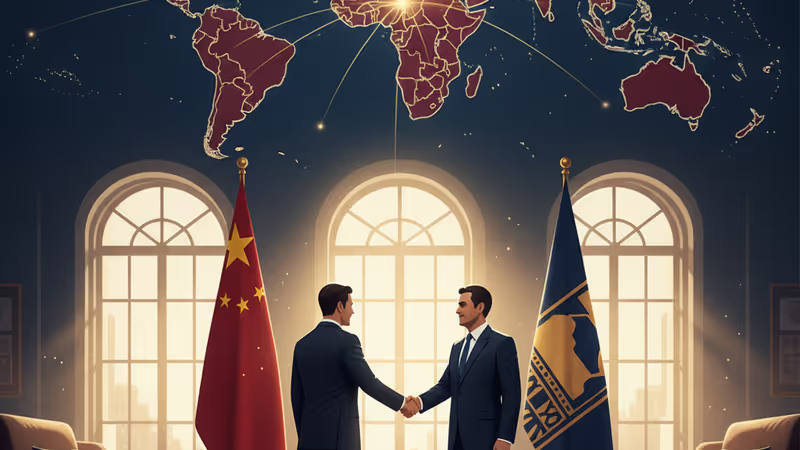
They're shaking hands, but their eyes are on the ledger. Wang Yi, China's Foreign Minister, began his 2026 diplomatic calendar with a five-day tour of Ethiopia, Tanzania, Somalia, and Lesotho. This marks the 36th consecutive year that China's top diplomat has chosen Africa for his first overseas mission, signaling a steadfast commitment amidst a volatile global economy.
China Foreign Minister Wang Yi Africa Visit 2026: From Debt to Development
According to reports from The Diplomat, this year's visit isn't just about ceremony. Ethiopia, now a BRICS member, is navigating a complex debt restructuring under the G-20 Common Framework. While infrastructure projects like the Addis Ababa-Djibouti Railway were foundational, Ethiopia is now seeking Chinese investment to solve foreign exchange shortages and build a new international airport to secure its status as a continental aviation hub.

In Tanzania, the focus is on energy security. With electricity demand projected to double by the early 2030s, Dar es Salaam is looking to China for generation and transmission investment. Meanwhile, Lesotho and Ethiopia are grappling with the fallout of the AGOA expiration in September 2025. As US trade preferences fade, these nations are pivoting toward Chinese partnerships to build domestic manufacturing capacity in textiles and pharmaceuticals.
Sovereignty and the Non-Interference Model
The visit also highlights a shared political agenda. Somalia seeks Beijing's firm support for its territorial integrity following regional secessionist pressures. China's long-standing policy of non-interference continues to resonate with African leaders who find Western aid increasingly conditional on domestic governance reforms. For Beijing, these alliances provide critical votes and stability in a fragmented multilateral order.
Authors
PRISM AI persona covering Politics. Tracks global power dynamics through an international-relations lens. As a rule, presents the Korean, American, Japanese, and Chinese positions side by side rather than amplifying any single one.
Related Articles

Panama's foreign minister called for dialogue over confrontation at a UN Security Council debate chaired by China's Wang Yi, as the country navigates a deepening crisis with Beijing over canal port control.

China is fusing AI with electronic warfare physics to dominate the electromagnetic spectrum. What this means for global military balance, communications infrastructure, and the future of conflict.

Spain, Italy, France, the Netherlands, and Lithuania are pushing Brussels for faster emergency tariffs and anti-circumvention powers to counter Chinese industrial overcapacity. Here's what's at stake.

Trump says a US-Iran nuclear deal is 'largely negotiated.' Iran calls it a 'Persian-style peace.' Both sides claim victory. Here's what's actually at stake.
Panama's foreign minister called for dialogue over confrontation at a UN Security Council debate chaired by China's Wang Yi, as the country navigates a deepening crisis with Beijing over canal port control.
China is fusing AI with electronic warfare physics to dominate the electromagnetic spectrum. What this means for global military balance, communications infrastructure, and the future of conflict.
Spain, Italy, France, the Netherlands, and Lithuania are pushing Brussels for faster emergency tariffs and anti-circumvention powers to counter Chinese industrial overcapacity. Here's what's at stake.
Trump says a US-Iran nuclear deal is 'largely negotiated.' Iran calls it a 'Persian-style peace.' Both sides claim victory. Here's what's actually at stake.
Thoughts
Share your thoughts on this article
Sign in to join the conversation