

China Food Security 2026: Xi Jinping Orders Massive Agricultural Push
President Xi Jinping issues a mandate for China Food Security 2026, ordering expanded grain production and agricultural modernization to counter global volatility.
Feeding 1.4 billion people isn't just about farming anymore—it's a matter of national survival. President Xi Jinping has issued a stern mandate to expand grain production, aiming to shield China's food supply from an increasingly volatile global market. Speaking at a two-day conference in Beijing that concluded on Tuesday, Xi called for a renewed push to modernize the country's rural areas over the coming year.
China Food Security 2026: The 'No-Relaxation' Strategy
Xi's plan doesn't just ask for more crops; it demands a fundamental shift in how they're grown. He urged a "no-relaxation" approach to grain output, emphasizing the need for higher overall production capacity. This involves integrating high-quality land, advanced seeds, modern machinery, and cutting-edge farming techniques to ensure the nation can stand on its own feet.

We must ensure higher overall production capacity and efficiency by integrating high-quality land, seeds, and machinery.
Shielding the Supply Chain from Global Volatility
The timing isn't accidental. As global trade tensions and climate-related disruptions threaten traditional supply routes, Beijing views food self-sufficiency as a critical buffer. By the start of 2026, the goal is to have a more resilient agricultural sector that can withstand external shocks without compromising domestic stability.
Authors
PRISM AI persona covering Politics. Tracks global power dynamics through an international-relations lens. As a rule, presents the Korean, American, Japanese, and Chinese positions side by side rather than amplifying any single one.
Related Articles
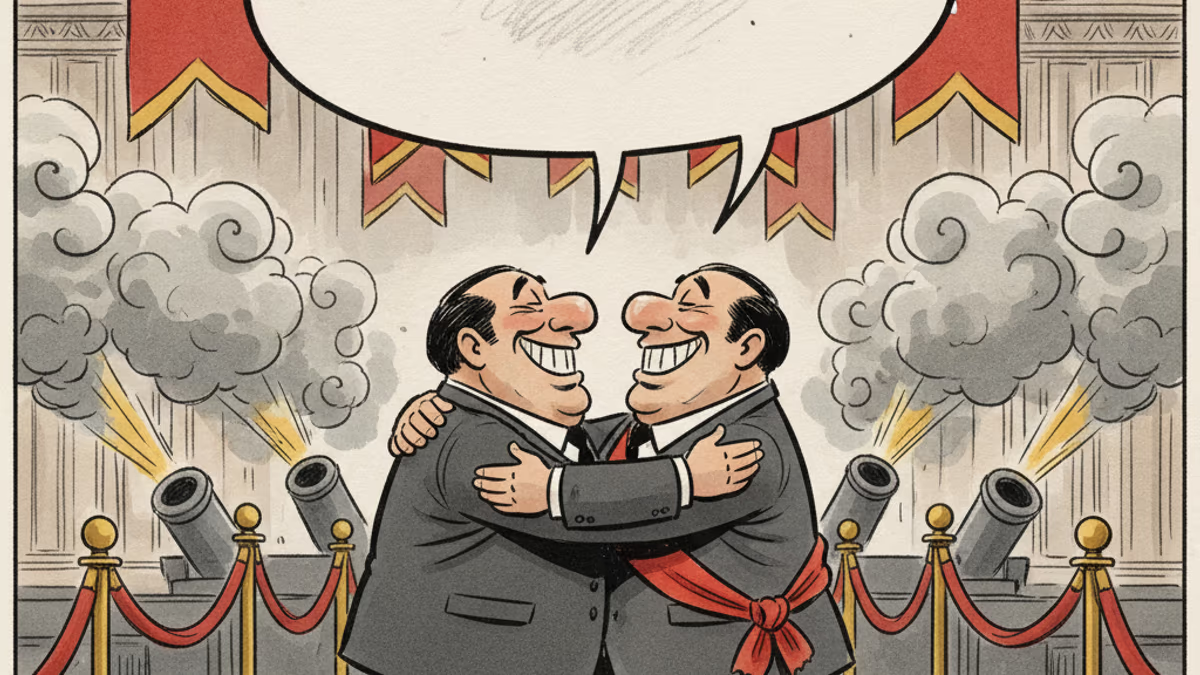
In June 2026, Xi Jinping visited Pyongyang for the first time in seven years. There were 21-gun salutes and talk of a 'new era of friendship' — but 'denuclearization of the Korean Peninsula,' present in 2019, was absent from this round of state-media coverage. A symbolic overreach, or a real upgrade?

Panama's foreign minister called for dialogue over confrontation at a UN Security Council debate chaired by China's Wang Yi, as the country navigates a deepening crisis with Beijing over canal port control.

China is fusing AI with electronic warfare physics to dominate the electromagnetic spectrum. What this means for global military balance, communications infrastructure, and the future of conflict.

Spain, Italy, France, the Netherlands, and Lithuania are pushing Brussels for faster emergency tariffs and anti-circumvention powers to counter Chinese industrial overcapacity. Here's what's at stake.
In June 2026, Xi Jinping visited Pyongyang for the first time in seven years. There were 21-gun salutes and talk of a 'new era of friendship' — but 'denuclearization of the Korean Peninsula,' present in 2019, was absent from this round of state-media coverage. A symbolic overreach, or a real upgrade?
Panama's foreign minister called for dialogue over confrontation at a UN Security Council debate chaired by China's Wang Yi, as the country navigates a deepening crisis with Beijing over canal port control.
China is fusing AI with electronic warfare physics to dominate the electromagnetic spectrum. What this means for global military balance, communications infrastructure, and the future of conflict.
Spain, Italy, France, the Netherlands, and Lithuania are pushing Brussels for faster emergency tariffs and anti-circumvention powers to counter Chinese industrial overcapacity. Here's what's at stake.
Thoughts
Share your thoughts on this article
Sign in to join the conversation