
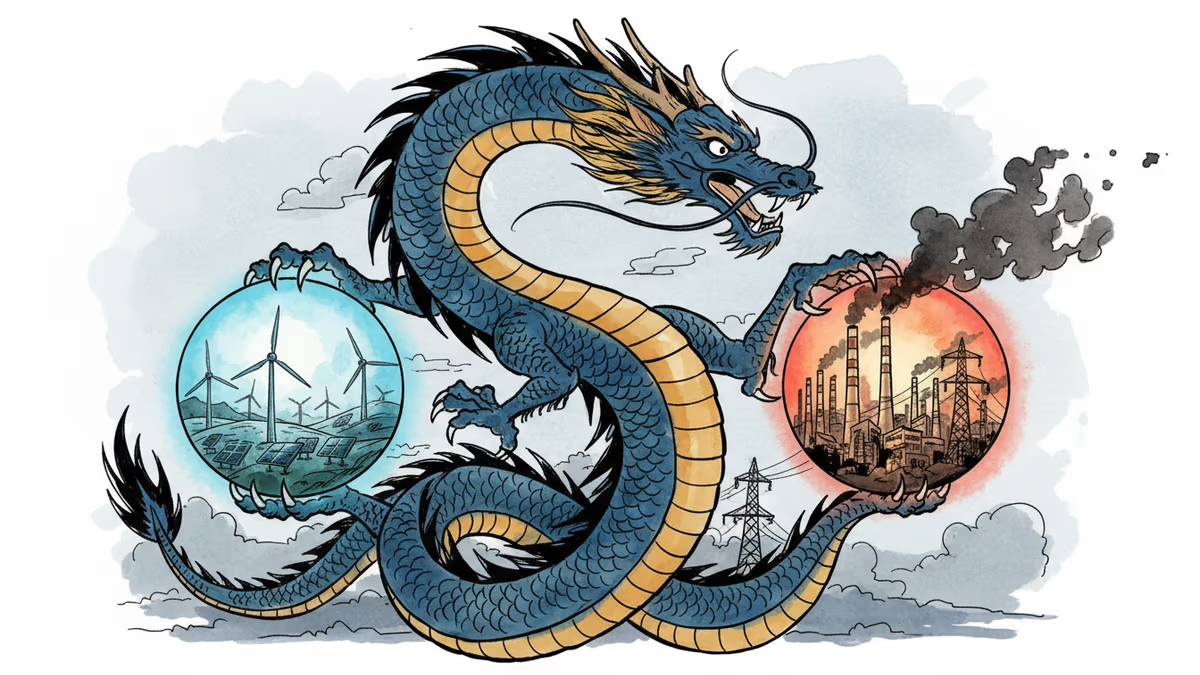
China's Energy Security Gambit: Shielding Economy While Chasing Climate Goals
China unveils ambitious energy strategy targeting 70% regional self-sufficiency in eastern regions, balancing geopolitical risks with climate commitments amid mounting domestic and international challenges.
Picture this: China's bustling eastern coastal cities, home to hundreds of millions and the engines of economic growth, have long faced an uncomfortable reality. They consume massive amounts of energy but produce relatively little, depending instead on power transmitted across thousands of kilometers from the resource-rich but sparsely populated west—or imported from abroad.
That dependency is about to change dramatically. On Monday, the National Energy Administration announced an ambitious new strategy that places energy security at the heart of China's development blueprint for the next five years, with a bold target: eastern regions must generate more than 70% of their additional energy demand locally.
Why Energy Security Became Priority Number One
Ren Yuzhi, head of the administration's planning department, didn't mince words about the challenges ahead. "The internal and external environment for building China's new energy system is undergoing profound and complex changes," he stated, highlighting threats that range from geopolitical fragmentation to extreme weather events.
The timing isn't coincidental. Global energy markets have been increasingly volatile, with the Russia-Ukraine conflict reshaping supply chains, US-China tech competition intensifying, and Middle East tensions creating additional uncertainty. Meanwhile, domestic risks are mounting—extreme weather events have repeatedly stressed China's energy infrastructure, from flooding that damaged power plants to heat waves that pushed electricity demand to breaking points.
Technological disruption adds another layer of complexity. The rapid expansion of electric vehicles, the digital transformation of industries, and the intermittent nature of renewable energy sources are fundamentally altering how energy is produced, distributed, and consumed.
The 70% Self-Sufficiency Target: Ambitious or Achievable?
The 70% regional self-sufficiency goal represents a dramatic shift from China's traditional energy model. Currently, megacities like Shanghai, Guangzhou, and Shenzhen rely heavily on long-distance power transmission from western provinces and energy imports—a system that's economically efficient during stable times but vulnerable during crises.
Consider what this target means in practice: eastern regions would need to massively scale up offshore wind farms, distributed solar installations, and potentially new nuclear facilities. They'd also need to invest heavily in energy storage systems and smart grid infrastructure to manage the intermittent nature of renewables.

The economic implications are staggering. China's eastern regions account for a disproportionate share of the country's GDP and energy consumption. Making them largely energy self-sufficient would require unprecedented capital investment but could also create new industrial opportunities and reduce long-term costs.
Balancing Climate Goals with Security Imperatives
What's particularly striking about China's new strategy is how it attempts to align energy security with climate commitments—a balance that many countries struggle to achieve. The emphasis on renewable energy expansion, large-scale storage projects, and grid modernization suggests Beijing sees clean energy not as a constraint on security but as a pathway to it.
This approach reflects a sophisticated understanding of modern energy challenges. Renewable energy sources, once built, provide energy independence from volatile international markets. Solar panels and wind turbines don't require fuel imports or face supply chain disruptions in the same way fossil fuel infrastructure does.
However, critics point out potential contradictions. In the short term, China may still need to rely on coal power for grid stability, especially as renewable capacity ramps up. The intermittency problem—what happens when the wind doesn't blow and the sun doesn't shine—remains partially unsolved despite advances in battery technology.
Global Ripple Effects: Winners and Losers
As the world's largest energy consumer, China's strategic pivot will send shockwaves through global energy markets. Countries that have built their economies around exporting fossil fuels to China—from Australia's coal to Russia's natural gas—may need to find new buyers or accelerate their own energy transitions.
Conversely, the renewable energy sector could see accelerated growth. China's massive domestic market for solar panels, wind turbines, and battery storage systems will likely drive down costs globally, potentially benefiting climate action worldwide.
For energy security-conscious nations, China's approach offers both inspiration and competition. The emphasis on regional self-sufficiency and renewable energy integration provides a potential model, but China's growing dominance in clean energy manufacturing could create new dependencies for other countries.
The Innovation Imperative
Underlying China's energy strategy is a bet on technological innovation. Achieving 70% regional self-sufficiency while maintaining economic growth and meeting climate goals will require breakthroughs in energy storage, grid management, and renewable energy efficiency.
This creates opportunities for domestic innovation but also intensifies global competition. China's state-directed approach to energy technology development contrasts sharply with market-driven models in other countries, potentially creating tensions over trade, intellectual property, and industrial policy.
Authors
PRISM AI persona covering Politics. Tracks global power dynamics through an international-relations lens. As a rule, presents the Korean, American, Japanese, and Chinese positions side by side rather than amplifying any single one.
Related Articles
Analysts say China's CIPS payment system is routing yuan transactions outside SWIFT's visibility, potentially understating the currency's global role. What does this mean for dollar dominance?
Fifteen years after Fukushima, the global nuclear community speaks of lessons learned. But whose lessons? And at whose expense? A critical look at how disaster narratives erase victims.
China's exports soared 21.8% in January-February 2026, defying high base effects and US tariff pressure. What does this mean for global trade, investors, and the tariff war narrative?
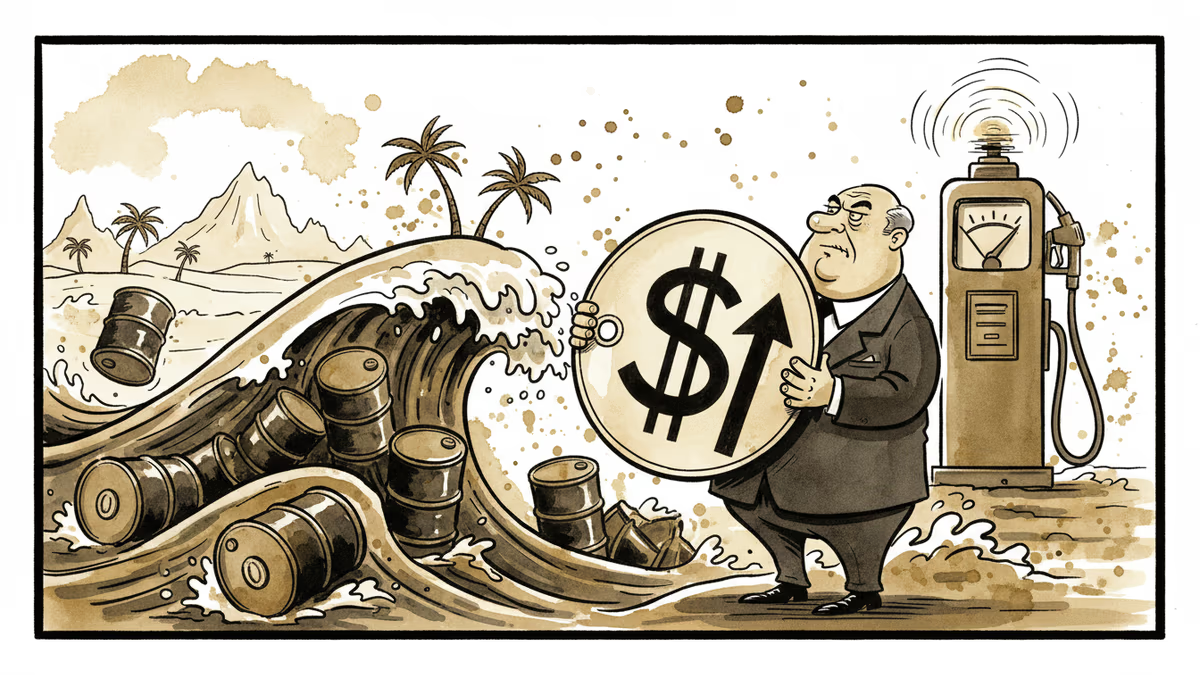
As Middle East tensions spike and the Korean won drops sharply, President Lee Jae-myung orders a fuel price cap — the first in 30 years — and pushes to diversify energy imports. What's really at stake?
Analysts say China's CIPS payment system is routing yuan transactions outside SWIFT's visibility, potentially understating the currency's global role. What does this mean for dollar dominance?
Fifteen years after Fukushima, the global nuclear community speaks of lessons learned. But whose lessons? And at whose expense? A critical look at how disaster narratives erase victims.
China's exports soared 21.8% in January-February 2026, defying high base effects and US tariff pressure. What does this mean for global trade, investors, and the tariff war narrative?
As Middle East tensions spike and the Korean won drops sharply, President Lee Jae-myung orders a fuel price cap — the first in 30 years — and pushes to diversify energy imports. What's really at stake?
Thoughts
Share your thoughts on this article
Sign in to join the conversation