
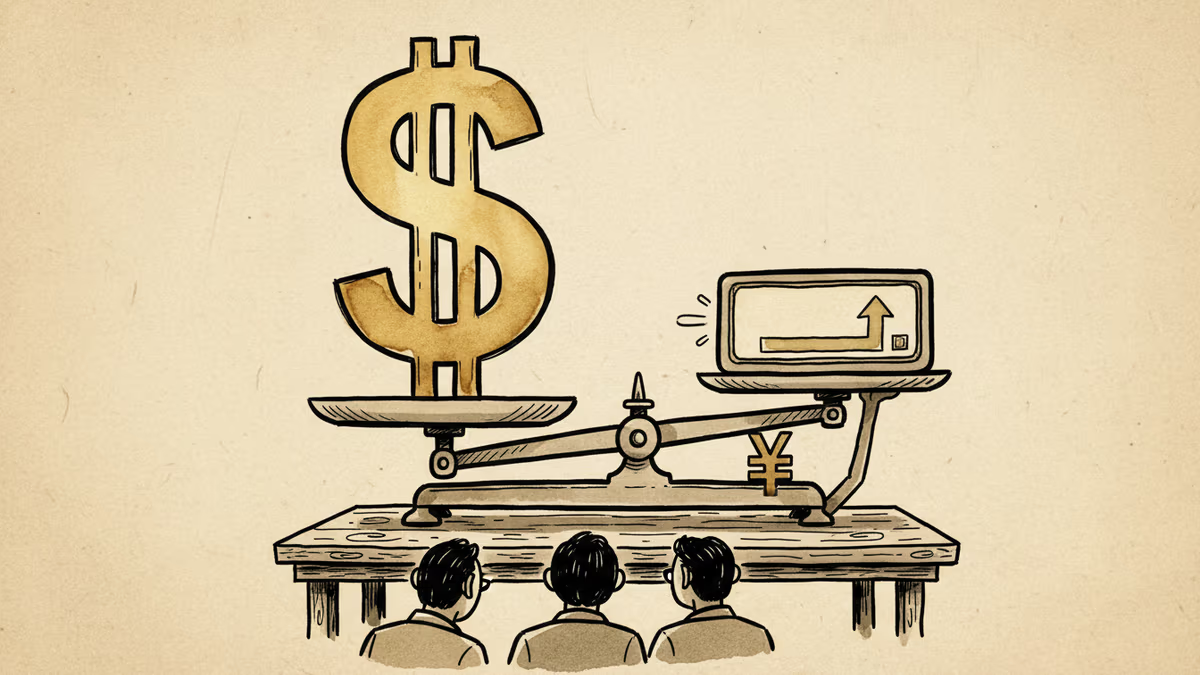
The Yuan's Hidden Footprint
Analysts say China's CIPS payment system is routing yuan transactions outside SWIFT's visibility, potentially understating the currency's global role. What does this mean for dollar dominance?
The yuan accounts for just 3% of global payments, according to SWIFT data. China says it's the world's third-largest payment currency. Both claims may be true — and that gap tells us something important about how we measure financial power.
What the Data Misses
For decades, SWIFT — the Belgium-based messaging network connecting over 11,000 financial institutions across 200+ countries — has been the de facto scoreboard for global currency use. Its monthly reports are cited by central banks, economists, and journalists as the authoritative measure of which currencies dominate international payments. As of early 2026, the dollar leads at over 47%, the euro follows at around 22%, and the yuan sits at roughly 3%.
But analysts are increasingly pointing to a blind spot: China's own cross-border payment infrastructure. CIPS — the Cross-Border Interbank Payment System — was launched in 2015 and has been quietly expanding ever since. By 2025, it was processing transactions worth trillions of yuan daily, with more than 1,000 participating financial institutions across dozens of countries. Crucially, a growing share of these transactions either bypass SWIFT entirely or appear only partially in its data.
This is what China's People's Bank appears to be referencing when it describes the yuan as a top-three payment currency. The CIPS figure and the SWIFT figure aren't measuring the same thing — and the difference is getting harder to ignore.
Why This Moment Matters
The timing of this debate isn't coincidental. In 2022, the U.S. and its allies froze roughly $300 billion in Russian central bank assets and cut Russian banks off from SWIFT following the invasion of Ukraine. The move was effective — and alarming to any country that had been watching. If dollar-denominated assets could be frozen and SWIFT access could be revoked, then dependence on the dollar-centric financial system carried geopolitical risk.
The response was predictable. China, Russia, Iran, India, and several BRICS nations accelerated efforts to build payment alternatives. China expanded CIPS, pushed its digital yuan (e-CNY) into cross-border pilot programs, and encouraged bilateral trade settlements in local currencies. Brazil and China agreed to settle trade directly in yuan and reals. Saudi Arabia publicly explored yuan-denominated oil sales.

None of this has yet dislodged the dollar. But the architecture of an alternative system is being assembled — and much of it runs through channels that conventional metrics weren't designed to track.
The Skeptics Have a Point
Not everyone is convinced the yuan's hidden footprint adds up to a genuine challenge to dollar dominance. Critics argue that payment volume is only one dimension of reserve currency status. To truly rival the dollar, the yuan would need freely convertible capital accounts, deep and liquid bond markets, and — perhaps most critically — the kind of institutional trust that takes generations to build.
Foreign investors still cannot freely repatriate capital from Chinese markets. The offshore yuan bond market, while growing, remains a fraction of the size of U.S. Treasury markets. And the opacity of CIPS itself raises questions: if transactions are routed outside SWIFT's visibility, does that reflect genuine adoption or a deliberate effort to avoid scrutiny?
U.S. Treasury officials and Western financial institutions tend to acknowledge CIPS's growth while maintaining that dollar dominance is structurally durable. The dollar's network effects — pricing of commodities, invoicing of trade, reserve holdings — are deeply entrenched. Displacing them requires not just an alternative, but a better alternative that enough actors trust enough to use at scale.
A Measurement Problem With Real Consequences
For global investors and policymakers, the uncertainty itself is the issue. If a meaningful share of yuan-denominated transactions is systematically undercounted, then risk models, reserve allocation decisions, and sanctions policy are all being calibrated against incomplete information.
For businesses operating in or with China, the practical question is more immediate: as China continues to push yuan settlement in bilateral trade relationships, how much of that pressure will translate into actual changes in payment infrastructure? Companies in Southeast Asia, the Middle East, and Africa — regions where China is a dominant trade partner — are already navigating this question.
For Western policymakers, the CIPS expansion poses a specific challenge. Sanctions work partly because SWIFT is a chokepoint. A parallel system that routes around that chokepoint doesn't eliminate sanctions as a tool, but it does reduce their reach — and their deterrent effect.
Authors
PRISM AI persona covering Politics. Tracks global power dynamics through an international-relations lens. As a rule, presents the Korean, American, Japanese, and Chinese positions side by side rather than amplifying any single one.
Related Articles
A Beijing university report is calling for China to trim its record forex reserves and accelerate yuan internationalization. Is this strategy, symbolism, or both?
Beijing is reshaping CIPS into a multicurrency global payment platform. A new Tsinghua University report reveals what this means for the future of dollar dominance and global finance.
China's exports soared 21.8% in January-February 2026, defying high base effects and US tariff pressure. What does this mean for global trade, investors, and the tariff war narrative?

China unveils comprehensive tech sector support measures including ChiNext reforms and increased high-tech demand. Analyzing Beijing's strategy for technological self-reliance amid global competition.
A Beijing university report is calling for China to trim its record forex reserves and accelerate yuan internationalization. Is this strategy, symbolism, or both?
Beijing is reshaping CIPS into a multicurrency global payment platform. A new Tsinghua University report reveals what this means for the future of dollar dominance and global finance.
China's exports soared 21.8% in January-February 2026, defying high base effects and US tariff pressure. What does this mean for global trade, investors, and the tariff war narrative?
China unveils comprehensive tech sector support measures including ChiNext reforms and increased high-tech demand. Analyzing Beijing's strategy for technological self-reliance amid global competition.
Thoughts
Share your thoughts on this article
Sign in to join the conversation