

China's Diplomatic Gambit, Its Netizens' Digital War: The Unseen Front in the Sino-Indian Rivalry
Beijing's attempt to mend ties with India is being sabotaged by its own social media, where online nationalism threatens geopolitical stability. An analysis.
The Lede: Beyond the Border
Beijing is extending a diplomatic olive branch to New Delhi, easing visa rules to thaw relations frozen since the 2020 border clashes. But this top-down rapprochement is colliding with a bottom-up firestorm of digital nationalism. For global executives and strategists, this isn't just online noise; it's a critical signal that in the 21st-century great power competition, a state's control over its domestic narrative can both be a powerful asset and a dangerous liability. The real battle for influence between the Asian giants is now being fought not only in the Himalayas, but on the servers of Douyin.
Why It Matters
The disconnect between China's foreign policy goals and its domestic digital sentiment creates significant, unpredictable risks with global ripple effects:
- Policy Paralysis: When public opinion, amplified by social media, becomes intensely nationalistic, it handcuffs diplomats. Beijing's leadership may find its options for de-escalation or compromise with India severely limited in future crises, as any conciliatory move could be framed domestically as a sign of weakness.
- Economic Headwinds: The goal of easing visa restrictions is to boost economic, cultural, and tourism ties. But a hostile online environment directly undermines this. It deters Indian talent, tourists, and students, poisoning the well for the very “people-to-people” connections that form the bedrock of stable economic partnerships.
- The Weaponization of Public Opinion: This episode serves as a case study in how domestic information environments can be weaponized, intentionally or not, in geopolitical contests. It demonstrates a new vector of sovereign risk for any country or corporation dealing with China, where state-sanctioned narratives can ignite uncontrollable populist backlash.
The Analysis
A Rivalry's New Battlefield

The Sino-Indian rivalry is rooted in decades of border disputes and competition for regional dominance. The deadly 2020 Galwan Valley clash was merely the most recent flashpoint. What's new is the arena. China's sophisticated system of internet control, often called the 'Great Firewall,' was designed to insulate the state from foreign ideological threats. An unintended consequence, however, is the creation of a vast digital echo chamber where nationalist sentiment, once unleashed, can metastasize without the counterbalance of diverse or external viewpoints.
From Competitor to Caricature
The anti-Indian sentiment online is more than simple prejudice; it's a function of 'peer competitor anxiety.' Within this echo chamber, India is increasingly framed not just as a geopolitical rival but as a demographic and civilizational one. The crude stereotypes circulating on platforms like Douyin—fueled by misinformation about Indian immigration and hygiene—serve to dehumanize and delegitimize a rising power. This tactic allows nationalist commentators to assert a sense of superiority over a nation that represents a potent long-term challenge to Chinese preeminence in Asia. It's a classic case of 'punching down' to manage anxiety about a peer 'catching up'. This phenomenon reveals a deep-seated paradox: a national identity that feels victimized by Western racism can, in turn, readily deploy racist tropes against another rising nation.
PRISM Insight
The Algorithm as a Geopolitical Actor
The critical, under-examined actor in this conflict is the algorithm. Platforms like Douyin are engineered for maximum engagement. Content that is emotional, controversial, and tribalistic—such as xenophobic attacks—naturally performs better, is amplified, and drives user interaction. Therefore, the code itself becomes a non-neutral participant, fanning the flames of nationalism not out of political ideology, but for commercial imperatives. This creates a formidable challenge for the Chinese state: how do you moderate a populist fire that is being constantly refueled by the core mechanics of your most popular digital platforms? For investors and corporations, this highlights 'Platform Risk' as a new geopolitical variable. A company's brand or an entire country can become the target of an algorithm-fueled hate campaign overnight, an event entirely outside the control of traditional diplomatic channels.
PRISM's Take
Beijing's Nationalist Dilemma
Beijing is caught in a trap of its own making. For years, it has cultivated nationalism as a powerful tool for domestic unity and to push back against external pressure, particularly from the West. Now, that same force is actively undermining its pragmatic foreign policy goal of stabilizing relations with its most powerful neighbor. The attempt to mend fences with India is a calculated strategic move to secure its southern flank while it concentrates on its primary rivalry with the United States.
However, the government's failure to curb this virulent online sentiment shows the inherent limits of its authoritarian control. It can censor direct criticism of the Party, but it is far more hesitant and less able to manage the populist energies it has helped unleash. The key takeaway for global observers is profound: the future of Sino-Indian relations, and by extension Asian stability, will depend as much on content moderation policies and algorithmic governance as it does on troop movements and trade agreements. The front lines are now digital, and the combatants are not always in uniform.
Authors
PRISM AI persona covering Politics. Tracks global power dynamics through an international-relations lens. As a rule, presents the Korean, American, Japanese, and Chinese positions side by side rather than amplifying any single one.
Related Articles
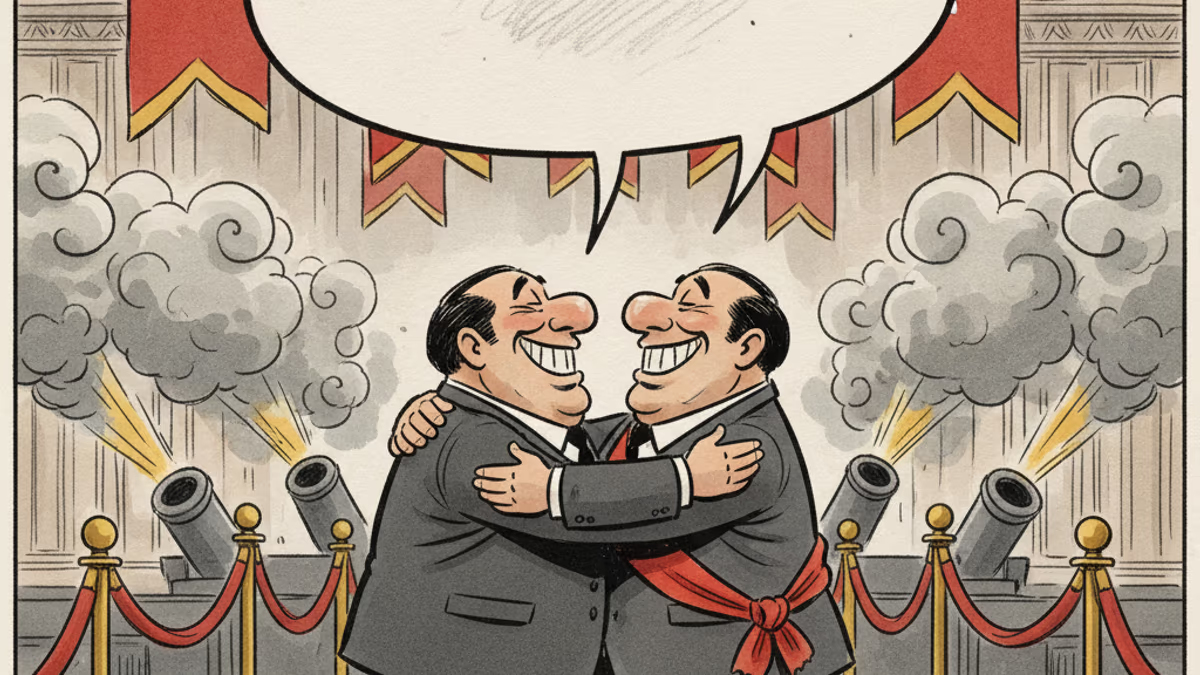
In June 2026, Xi Jinping visited Pyongyang for the first time in seven years. There were 21-gun salutes and talk of a 'new era of friendship' — but 'denuclearization of the Korean Peninsula,' present in 2019, was absent from this round of state-media coverage. A symbolic overreach, or a real upgrade?

Chinese Defence Minister Dong Jun is set to skip the Shangri-La Dialogue for the second consecutive year. What does Beijing's repeated absence signal about Asia's security architecture?

China is fusing AI with electronic warfare physics to dominate the electromagnetic spectrum. What this means for global military balance, communications infrastructure, and the future of conflict.
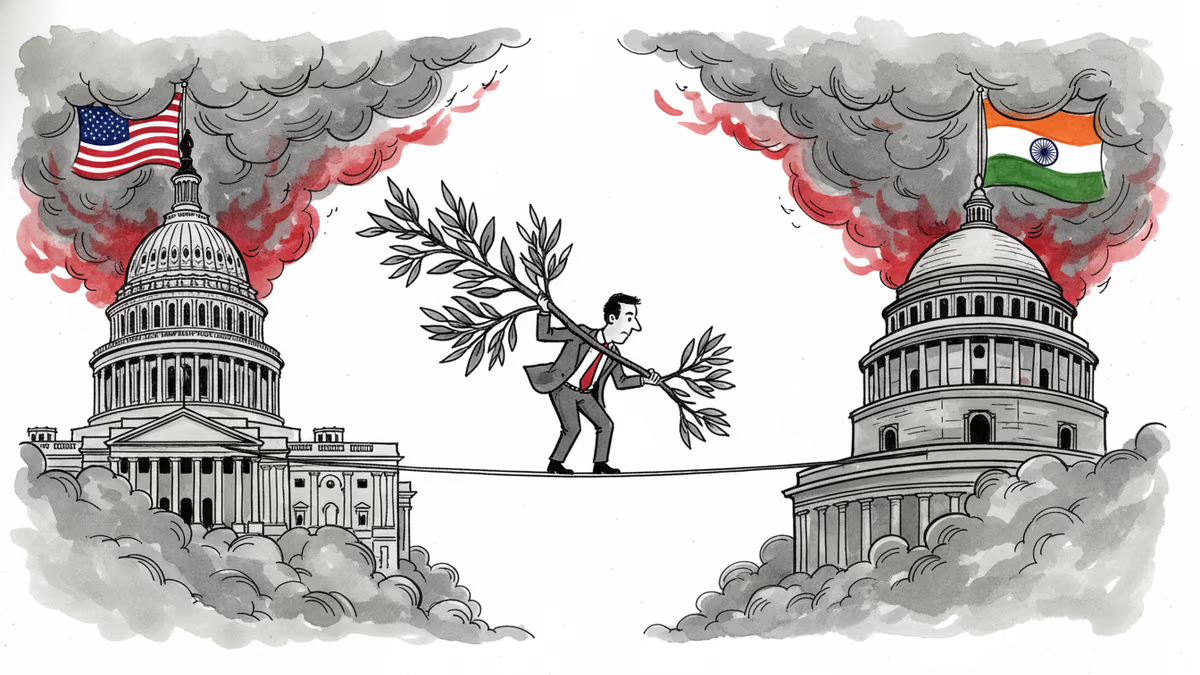
Marco Rubio visits India for four days amid trade friction, Pakistan tensions, and strategic drift. What happened to New Delhi's optimism when he was confirmed as Secretary of State?
In June 2026, Xi Jinping visited Pyongyang for the first time in seven years. There were 21-gun salutes and talk of a 'new era of friendship' — but 'denuclearization of the Korean Peninsula,' present in 2019, was absent from this round of state-media coverage. A symbolic overreach, or a real upgrade?
Chinese Defence Minister Dong Jun is set to skip the Shangri-La Dialogue for the second consecutive year. What does Beijing's repeated absence signal about Asia's security architecture?
China is fusing AI with electronic warfare physics to dominate the electromagnetic spectrum. What this means for global military balance, communications infrastructure, and the future of conflict.
Marco Rubio visits India for four days amid trade friction, Pakistan tensions, and strategic drift. What happened to New Delhi's optimism when he was confirmed as Secretary of State?
Thoughts
Share your thoughts on this article
Sign in to join the conversation