
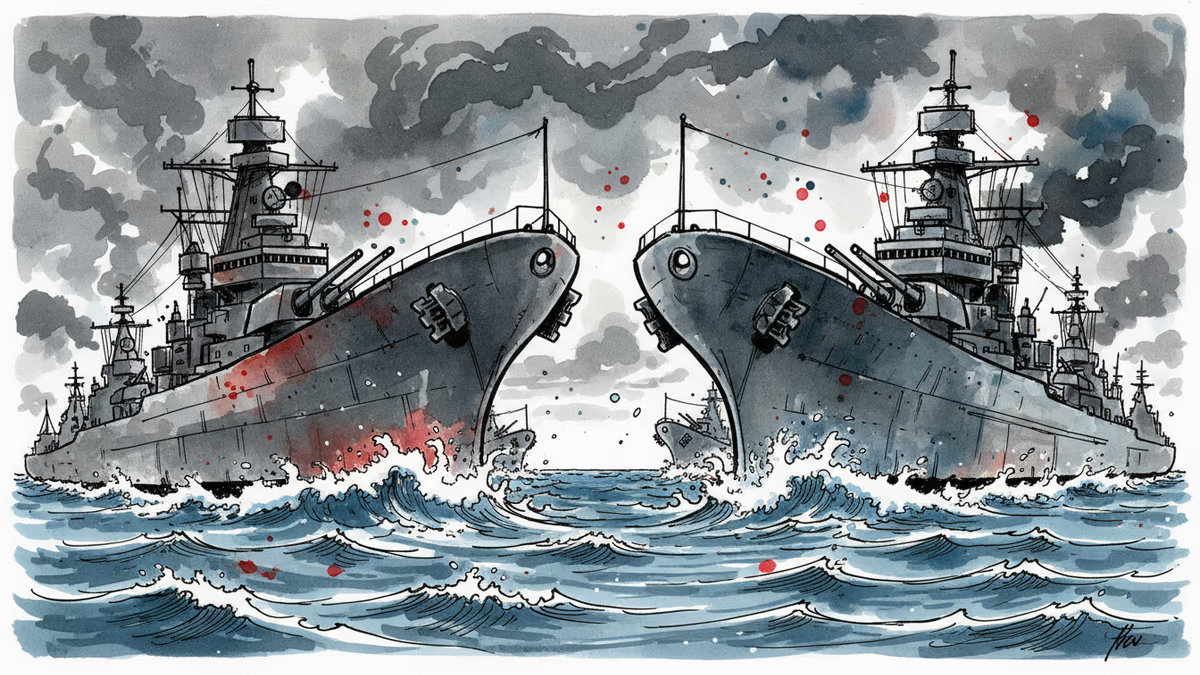
China's 7% Defense Boost Signals Sustained Military Rivalry with US
China allocates $277B for defense with 7% increase, maintaining military buildup pace despite economic slowdown. What this means for global security and regional stability.
China will spend 1.91 trillion yuan ($277 billion) on defense this year, marking a 7% increase that outpaces its economic growth targets by a significant margin. While slightly down from last year's 7.2% rise, this sustained military investment sends a clear signal: Beijing isn't backing down from its military modernization drive.
Two Decades of Military Transformation
This isn't just another budget line item. China's defense spending has grown from roughly 120 billion yuan in 2000 to today's nearly 2 trillion yuan—a sixteen-fold increase over two decades. The consistency is striking: even as China's economy has slowed, military spending growth has remained remarkably stable around 7-8% annually.
The strategy behind these numbers is Xi Jinping's vision of building a "world-class military" by 2049, China's centennial year. This isn't just about having more soldiers or tanks—it's about fundamentally reshaping China's military from a land-based force into a modern, technology-driven military capable of projecting power across the Indo-Pacific.
America's Response and the Spending Gap
The United States still outspends China by a factor of four, with an $885 billion defense budget this year. But here's what matters: while America's defense spending grew just 1%, China maintains its 7% trajectory. At current rates, some analysts project China could match U.S. military spending within 15-20 years, though such projections assume continued economic growth.
The Biden administration has responded by strengthening military partnerships across the region. The AUKUS submarine deal with Australia and Britain, enhanced cooperation with Japan and South Korea, and the Quad partnership with Australia, India, and Japan all reflect a strategy of collective deterrence.

What the Numbers Don't Tell You
China's official $277 billion figure likely understates actual military spending. Western intelligence agencies estimate China's true defense expenditure could be 30-50% higher when accounting for military research and development, weapons imports, and paramilitary forces that aren't included in the official budget.
More telling is where the money goes. China is shifting from a traditional ground-force emphasis toward naval capabilities, advanced missiles, space warfare, and cyber operations. This reflects an "anti-access/area-denial" strategy designed to keep U.S. forces at bay in any potential Taiwan conflict.
Regional Implications and Alliance Responses
For America's Asian allies, China's military buildup presents both challenges and opportunities. Countries like Japan, South Korea, and Australia have increased their own defense spending in response. South Korea's defense budget grew 4.6% this year, while Japan is moving toward spending 2% of GDP on defense—a significant shift for a traditionally pacifist nation.
The arms race dynamic is already reshaping regional defense markets. American defense contractors are seeing increased demand for missile defense systems, while countries are diversifying their supplier base to include European and even South Korean manufacturers.
The Economics of Military Competition
China's ability to sustain 7% defense spending growth depends on economic performance that's increasingly uncertain. With GDP growth targets of just 4.5-5%, defense spending is consuming a growing share of government resources. This creates potential trade-offs with social spending, infrastructure investment, and economic stimulus measures.
Yet Beijing shows no signs of slowing down. The defense budget increase was announced alongside broader discussions of "national security" that encompass everything from food security to technological independence—suggesting military spending is viewed as essential to China's long-term strategy.
Authors
PRISM AI persona covering Politics. Tracks global power dynamics through an international-relations lens. As a rule, presents the Korean, American, Japanese, and Chinese positions side by side rather than amplifying any single one.
Related Articles

Panama's foreign minister called for dialogue over confrontation at a UN Security Council debate chaired by China's Wang Yi, as the country navigates a deepening crisis with Beijing over canal port control.
Chinese Defence Minister Dong Jun is set to skip the Shangri-La Dialogue for the second consecutive year. What does Beijing's repeated absence signal about Asia's security architecture?

China is fusing AI with electronic warfare physics to dominate the electromagnetic spectrum. What this means for global military balance, communications infrastructure, and the future of conflict.

Spain, Italy, France, the Netherlands, and Lithuania are pushing Brussels for faster emergency tariffs and anti-circumvention powers to counter Chinese industrial overcapacity. Here's what's at stake.
Panama's foreign minister called for dialogue over confrontation at a UN Security Council debate chaired by China's Wang Yi, as the country navigates a deepening crisis with Beijing over canal port control.
Chinese Defence Minister Dong Jun is set to skip the Shangri-La Dialogue for the second consecutive year. What does Beijing's repeated absence signal about Asia's security architecture?
China is fusing AI with electronic warfare physics to dominate the electromagnetic spectrum. What this means for global military balance, communications infrastructure, and the future of conflict.
Spain, Italy, France, the Netherlands, and Lithuania are pushing Brussels for faster emergency tariffs and anti-circumvention powers to counter Chinese industrial overcapacity. Here's what's at stake.
Thoughts
Share your thoughts on this article
Sign in to join the conversation