

CES 2026 Jensen Huang and Nvidia's Physical AI Revolution
Explore the future of Physical AI at CES 2026 with Nvidia's Jensen Huang. Discover how industrial robots and China's tech comeback are shaping the 2026 tech landscape.
AI is stepping out of the screen and into the physical world. This isn't just about chatbots anymore; it's about machines that think, move, and act. As CES 2026 kicks off in Las Vegas, Nvidia CEO Jensen Huang is once again the star of the show, unveiling a blueprint for how 'Physical AI' will redefine global industries in 2026.
CES 2026 Jensen Huang Physical AI: The Dawn of Robotics
According to reports, the central theme of this year's extravaganza is the evolution of Physical AI. Nvidia has teamed up with Japanese industrial giant Fanuc to push for AI-integrated industrial robots. This collaboration aims to transform factories into fully autonomous environments where robots don't just follow pre-programmed paths but adapt to real-time changes.

This massive shift is already hitting the supply chain. The hunger for memory chips required for AI processing is putting significant upward pressure on PC prices. Analysts suggest that as AI becomes a standard feature in consumer hardware, consumers should prepare for a tighter market throughout 2026.
China's Tech Comeback and Global Ambitions
Beyond the Western giants, CES 2026 marks a major comeback for Chinese technology companies. From flying cars to AI-driven consumer electronics, China's presence is impossible to ignore. Jensen Huang has even warned of China's 'AI Belt and Road' ambitions, highlighting the growing geopolitical stakes in the artificial intelligence race.
Authors
Related Articles

Nvidia shipped roughly a billion RISC-V cores in 2024, then announced it would run CUDA on the open standard. We break down how royalty-free instruction sets and open software stacks are trying to route around CUDA's lock-in. Part 2 of the Semiconductor Sovereignty series.

US AI-chip export controls split into three layers in the first half of 2026 — January easing, a May crackdown on circumvention, and a pending bill. Nvidia erased China from its guidance and still posted a record $81.6 billion quarter. A look at the export policy that both shields and cages it.
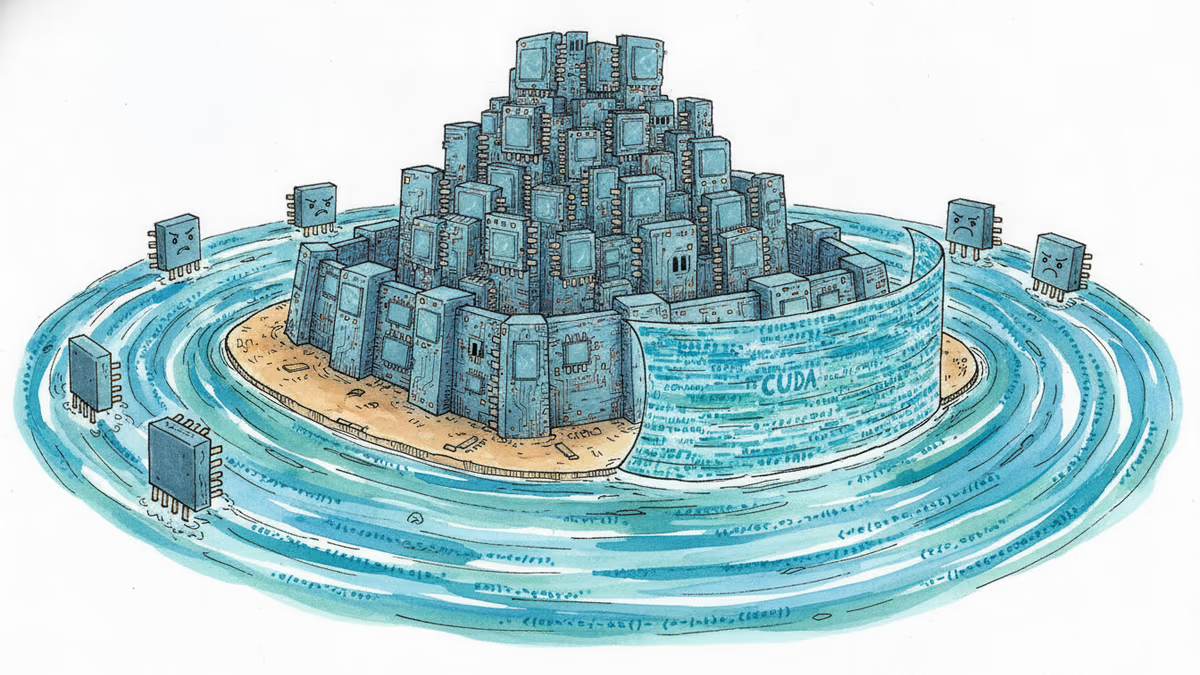
AMD's MI325X matches or beats Nvidia on memory and bandwidth — yet Nvidia's 86-92% share holds. The real moat is CUDA, 20 years in the making. Part 1 of 4.

Snowflake's new $6 billion AWS contract is about more than cloud spending. It signals a shift in AI infrastructure—away from Nvidia GPUs and toward cheaper, homegrown chips for the agent era.
Nvidia shipped roughly a billion RISC-V cores in 2024, then announced it would run CUDA on the open standard. We break down how royalty-free instruction sets and open software stacks are trying to route around CUDA's lock-in. Part 2 of the Semiconductor Sovereignty series.
US AI-chip export controls split into three layers in the first half of 2026 — January easing, a May crackdown on circumvention, and a pending bill. Nvidia erased China from its guidance and still posted a record $81.6 billion quarter. A look at the export policy that both shields and cages it.
AMD's MI325X matches or beats Nvidia on memory and bandwidth — yet Nvidia's 86-92% share holds. The real moat is CUDA, 20 years in the making. Part 1 of 4.
Snowflake's new $6 billion AWS contract is about more than cloud spending. It signals a shift in AI infrastructure—away from Nvidia GPUs and toward cheaper, homegrown chips for the agent era.
Thoughts
Share your thoughts on this article
Sign in to join the conversation